
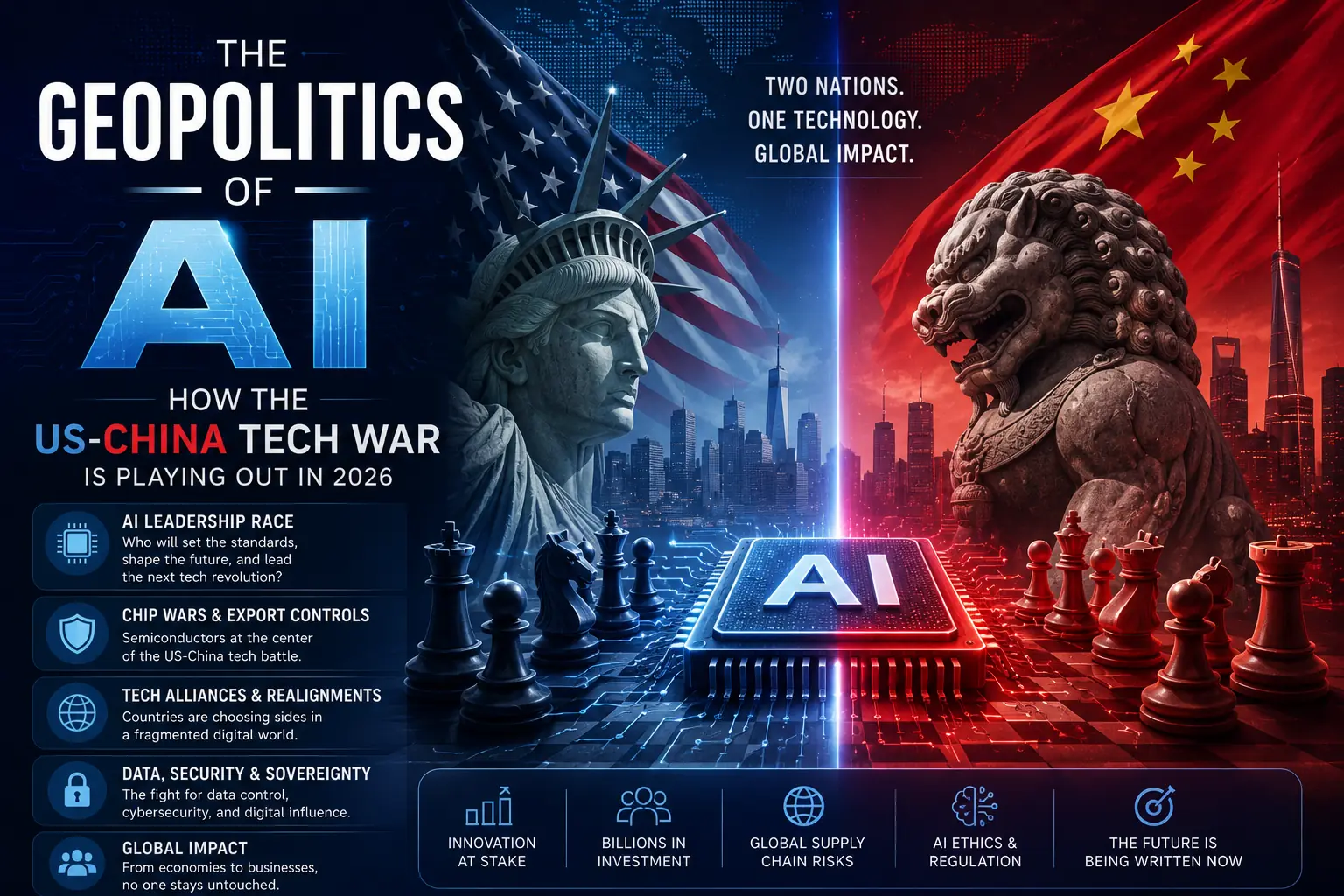
Nvidia CEO Jensen Huang has acknowledged that his company has ‘largely conceded’ China’s AI chip market to Huawei. The US Commerce Department’s January 2026 export control revisions changed H200 chip exports to China from presumption-of-denial to case-by-case licensing. A year of uncertainty has already driven Chinese hyperscalers to accelerate domestic alternatives. The AI semiconductor competition is reshaping the global technology industry.
The US-China AI competition in 2026 is primarily a semiconductor competition. AI capability scales with compute. Compute comes from advanced chips. The US has used export controls to restrict China’s access to the most capable AI chips, specifically targeting Nvidia’s H100 and H200 GPU lines. China has responded with accelerated domestic development. The outcome is a managed bifurcation of the global AI industry.
The Export Control Timeline
The US export control escalation against China’s AI chip access has proceeded in waves:
October 2022: BIS (Bureau of Industry and Security) restricted export of advanced AI chips to China, targeting chips above specific performance thresholds. Nvidia’s A100 and later H100 were affected.
October 2023: Updated controls closed loopholes that had allowed export of slightly-below-threshold chips. Nvidia’s A800 and H800 chips (created specifically for the Chinese market at slightly reduced specs) were restricted.
January 2026: The Commerce Department revised rules for H200 exports, moving from presumption-of-denial to case-by-case licensing with conditions including 25 percent tariffs, certification of non-military use, and independent third-party verification. The practical effect: a narrow, compliance-heavy channel for sales that has produced a trickle of shipments.
June 2026: The US issued guidance affirming that restrictions on AI chip shipments apply to Chinese company subsidiaries outside China, closing a significant loophole that had allowed procurement through overseas entities.
China’s Response: The Domestic Semiconductor Push
The export controls have had a dual effect that Huawei’s chairman explicitly acknowledged: they have slowed China’s access to US chips while accelerating China’s investment in domestic alternatives. Huawei’s Ascend AI chip series is now the primary domestic alternative to Nvidia hardware in Chinese AI deployments.
Huawei’s Ascend AI chips: Demand for Huawei’s Ascend processors has risen sharply as Chinese technology firms search for domestic replacements for Nvidia hardware. Chinese hyperscalers (Baidu, Alibaba, ByteDance) have accelerated procurement of Ascend chips during the US export control uncertainty period.
SMIC manufacturing progress: SMIC (China’s leading chip manufacturer) has achieved 5nm-class production capability. At a semiconductor symposium in Shanghai, Huawei announced a new chip design concept targeting transistor density equivalent to 1.4 nanometre processes by 2031, though independent analysts note China’s proven manufacturing capability remains significantly below TSMC’s roadmap.
The compute gap: Independent analysis estimates the US holds a 21 to 49 times advantage in AI compute produced in 2026 over China, depending on performance metrics. Even if H200 exports to China were fully unrestricted, this gap would persist because of the Blackwell-generation chips (H100 successor) that remain tightly restricted. China is not closing the gap. It is maintaining the ability to build capable AI systems at higher cost and lower efficiency.
DeepSeek and the Efficiency Response
The DeepSeek R1 model released in January 2025 demonstrated that China could produce frontier-quality AI at significantly lower compute cost than US equivalents, training with reportedly $6 million in compute versus OpenAI’s much larger investments. This was both a genuine technical achievement and a signal of the pressure that compute constraints produce: necessity drives efficiency innovations.
DeepSeek’s efficiency demonstrated that compute restriction does not simply prevent China from building capable AI. It incentivises algorithmic efficiency innovations that produce capable models with less hardware. The US lead in raw compute may be partially offset by Chinese research innovation in training efficiency.
The Global Technology Industry Implications
For non-US, non-China AI companies: The bifurcation creates complexity for companies in third countries (UK, EU, Japan, South Korea, India). Choosing between US and Chinese AI infrastructure increasingly involves geopolitical alignment implications that previously did not exist in technology procurement.
For semiconductor supply chains: TSMC, ASML, and ASML’s lithography equipment are critical chokepoints in both chains. TSMC manufactures chips for both Nvidia (for US deployment) and increasingly for Chinese alternatives. ASML’s export licence restrictions on advanced EUV equipment to China affect SMIC’s manufacturing roadmap directly.
For AI talent: The geopolitical competition has disrupted AI researcher mobility in both directions. US visa restrictions affect Chinese AI researchers at US institutions. China’s talent retention incentives have improved. The result is some degree of research ecosystem bifurcation alongside the hardware bifurcation.
The Policy Debate Within the US
US semiconductor export policy is internally contested. The business case for maintaining China as a market (Nvidia lost an estimated $10 billion in annual China revenue from controls) argues for loosening. The national security case for preventing China from accessing frontier AI compute argues for tightening. The January 2026 case-by-case licensing framework represents a compromise that satisfies neither camp fully.
US senators have pushed to suspend Nvidia’s AI chip export licences to China entirely. Jensen Huang argued that restrictions simply accelerate Chinese domestic alternatives. The policy debate will continue to evolve and the export control framework will likely be revised further in both directions depending on domestic political dynamics.
What are the US export controls on AI chips to China?
The US has restricted export of advanced AI chips (primarily Nvidia H100, H200, and equivalent AMD chips) to China since October 2022, targeting chips above specific performance thresholds used in AI training. January 2026 revisions moved H200 exports from presumption-of-denial to case-by-case licensing with conditions including 25 percent tariffs and non-military use certification.
How is China responding to US chip export controls?
China has accelerated domestic semiconductor investment and adoption of Huawei’s Ascend AI chips as domestic Nvidia alternatives. SMIC has achieved 5nm-class manufacturing capability. Huawei has announced a new chip design targeting 1.4nm-equivalent by 2031. Algorithmic efficiency research (exemplified by DeepSeek) is partially compensating for compute access limitations.
What is the AI compute gap between the US and China in 2026?
Independent analysis estimates the US holds a 21 to 49 times advantage in AI compute production in 2026, depending on measurement methodology. China is not closing this gap in absolute terms but is building capable AI systems at higher cost and lower efficiency than US counterparts through domestic chip adoption and training efficiency improvements.
What did DeepSeek demonstrate about China’s AI capabilities?
DeepSeek R1, released January 2025, demonstrated frontier-quality AI performance at reportedly $6 million in training compute, significantly less than US equivalents. This showed that compute restriction does not simply prevent capable AI development — it incentivises algorithmic efficiency innovations. China’s research innovation partially compensates for its hardware access limitations.
How does the US-China chip war affect global technology companies?
Third-country technology companies face procurement decisions that now carry geopolitical alignment implications. TSMC, ASML, and other supply chain critical companies face pressure from both sides. AI researcher mobility has been partially disrupted. The bifurcation of global AI infrastructure into US-aligned and China-aligned stacks is creating complexity for companies in markets aligned with neither.
Will US export controls on AI chips to China ultimately work?
Contested. The controls have maintained a significant US-China compute gap. They have also accelerated Chinese domestic semiconductor investment that will eventually reduce dependence on US chips. Huawei’s Ascend adoption and SMIC’s manufacturing progress demonstrate the adaptive response. The export controls are working in delaying timeline but not preventing capability development, while creating significant economic costs for US semiconductor companies.
Managed Bifurcation, Not Decoupling
The US-China AI competition in 2026 is best understood as managed bifurcation rather than clean decoupling. The two AI ecosystems are diverging in infrastructure and standards while remaining partially interconnected through research publishing, talent flows, and business relationships that neither side has fully severed. The trajectory is toward increasing separation, but the timeline is measured in years rather than having already occurred.
For businesses, investors, and technology professionals, the practical implication is clear: the global AI industry is no longer operating on a single technology stack, and the geopolitical alignment of the infrastructure you depend on is now a relevant consideration in technology strategy.
The global AI race is transforming technology, business, and international relations. Stay informed with WritoryBuzz for expert insights on AI trends, emerging technologies, and the geopolitical forces shaping the future.