
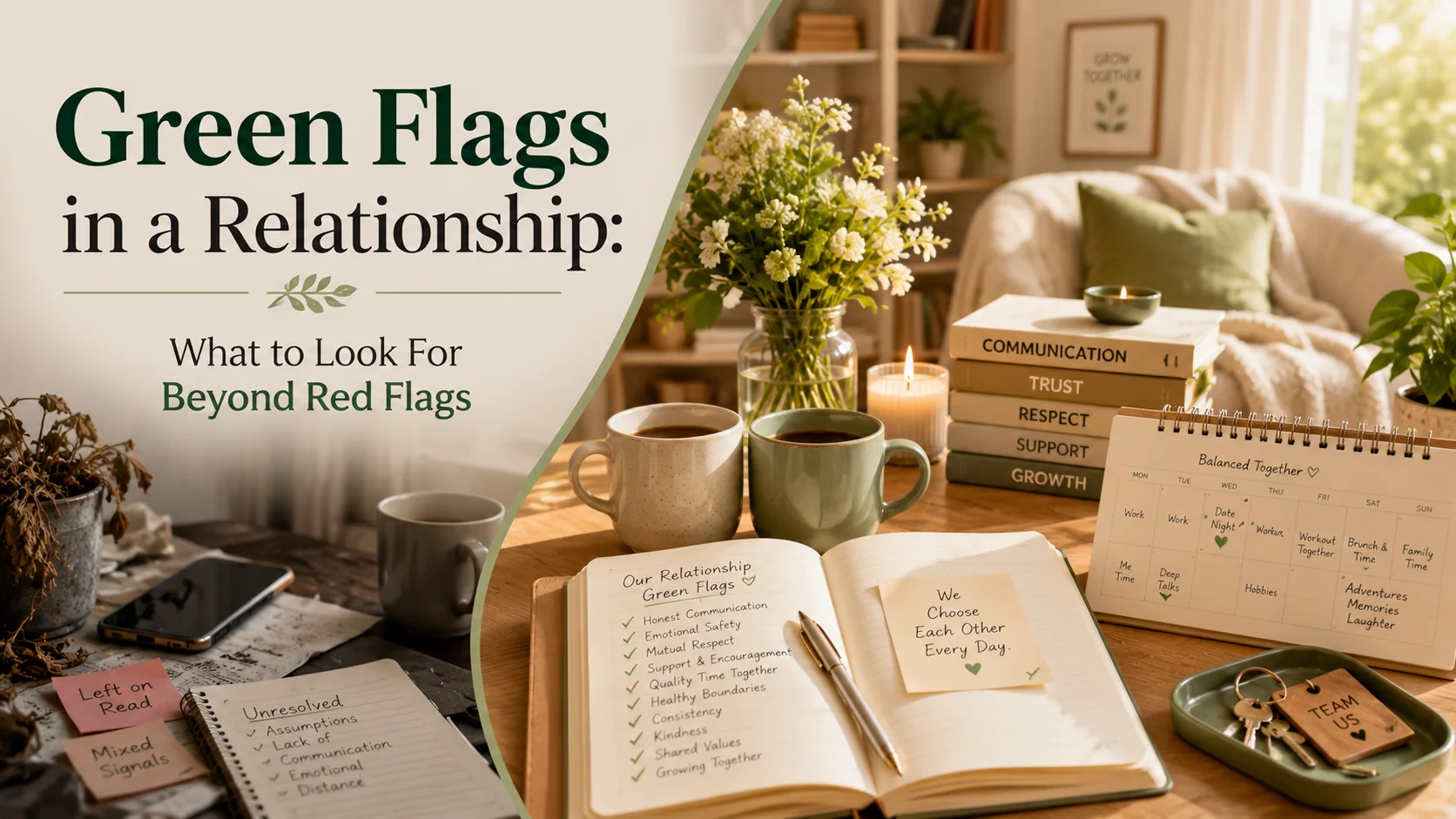
Relationship advice has become fluent in red flags. We are considerably less fluent in what genuinely healthy looks like. Knowing what to avoid is useful. Knowing what to look for is essential.
The red flag framework, while useful for identifying specific concerning behaviours, has a structural limitation: it identifies what to run from rather than what to run toward. Two people who avoid all red flags in each other may still build an anxious, unsatisfying relationship if they do not have the green flag qualities that make connection genuinely sustaining.
These green flags are drawn from relationship psychology research, attachment theory, and the consistent findings on what distinguishes long-term satisfied partnerships from those that either end or persist unhappily.
Green Flags in How They Treat You
They are genuinely curious about you. Genuine curiosity goes beyond polite questions. It means the other person remembers what you told them, follows up on things you mentioned previously, and seems consistently interested in understanding your experience rather than filling conversational time. Gottman’s research on relationships identifies this quality, turning toward rather than away from a partner’s bids for connection, as one of the strongest predictors of long-term relationship satisfaction.
They respect your no without requiring justification. The ability to decline something without extensive explanation and have that respected is a significant green flag. It signals that the other person does not treat your preferences as obstacles to override or as problems to solve. It also reflects their relationship with their own autonomy.
They celebrate your wins without making them about themselves. A partner who is genuinely pleased by your achievements, who can hold space for your successes without redirecting to their own or subtly minimising, demonstrates both secure attachment and genuine care for your flourishing as a person.
They are consistent between who they are in public and private. Substantial differences between how someone presents in social settings and how they behave privately are worth noting. The green flag is not identical behaviour in all contexts, but a recognisable continuity of character regardless of audience.
Green Flags in How They Handle Conflict
Conflict is not a sign of incompatibility. How conflict is handled is one of the strongest indicators of relationship health. The green flags here are not about never arguing, but about what happens during and after disagreements.
They can name their own contributions to a problem. ‘I reacted badly because I was already stressed’ is a green flag. It demonstrates the self-awareness and accountability that allows conflict to conclude rather than cycle. The opposite pattern, conflict that consistently ends with one person’s responsibility being identified and the other’s absent, is a significant predictor of relationship dissatisfaction.
They engage with your perspective rather than winning arguments. A partner who argues to understand rather than to prevail changes the function of disagreement entirely. The goal becomes mutual clarity rather than victory, which produces conflicts that actually resolve.
They repair after difficult exchanges. Repair attempts, the bids for reconnection after conflict, are one of the most researched predictors of relationship longevity. The green flag is not that conflict never produces hurt feelings. It is that both people make genuine efforts to return to connection afterwards, rather than allowing resentment to accumulate.
Green Flags in Their Relationship With Themselves
A person’s relationship with themselves is a significant predictor of how they relate to a partner. These internal green flags are among the most important and least visible in early dating.
They have genuine interests and priorities outside the relationship. An identity that exists independently of any partnership is a green flag for multiple reasons. It signals that the person’s wellbeing does not depend entirely on the relationship’s state, reduces codependency risk, and produces an ongoing source of new perspectives and experiences that sustain long-term connection.
They take responsibility for their emotional state without expecting others to manage it. Emotional regulation is one of the most practically important qualities in a long-term partner. A person who processes difficult emotions and communicates needs without making the partner responsible for their feelings is demonstrating emotional maturity that is genuinely rare and genuinely valuable.
They have examined their own patterns. Someone who can reflect on their past relationships and experiences without either excessive blame of others or harsh self-criticism, who has learned from difficulty rather than either avoiding it or being defined by it, is demonstrating the kind of psychological growth that produces good partnership.
Green Flags in How the Relationship Functions
You feel safe bringing difficult things to them. Psychological safety within a relationship, the confidence that raising concerns or needs will not result in defensiveness, dismissal, or punishment, is a foundational green flag. Without it, genuine intimacy is not possible because honest communication becomes too costly.
Both people’s needs are genuinely considered in decisions. Not always equally, and not without negotiation, but neither person’s needs are systematically treated as irrelevant. The pattern over time shows genuine reciprocity rather than one person’s preferences consistently prevailing.
The relationship adds to both people’s lives rather than requiring both to contract them. A healthy relationship expands rather than constricts. The green flag is that both people maintain friendships, pursue goals, and continue developing outside the relationship, supported rather than hindered by the partnership.
What are green flags in a relationship?
Green flags are specific, observable behaviours and qualities that indicate a genuinely healthy relationship. They include genuine curiosity about your experience, respectful handling of disagreement, ability to take responsibility for one’s contributions to problems, emotional maturity, psychological safety to raise difficult things, and reciprocal consideration of both people’s needs.
How do you know if a relationship is genuinely healthy?
Key indicators from relationship research include: you feel safe raising concerns without fear of disproportionate reaction, conflict is resolved rather than accumulated, both people’s perspectives are genuinely considered, both maintain identity and interests outside the relationship, and repair attempts after disagreements are made and received.
What is the difference between green flags and just feeling good about someone?
Feeling good about someone is a first-person experience about your own emotional state. Green flags are observable qualities in the other person’s behaviour that predict long-term relationship health based on research. A green flag can be present even when you feel uncertain, and the absence of green flags can be present even when everything feels exciting.
Why do people focus more on red flags than green flags?
Loss aversion psychology: humans are more sensitive to potential harm than equivalent potential gain. Red flags are easier to define because they describe clear problematic behaviours. Green flags require more nuance to describe because healthy relationship qualities exist on spectrums rather than as binary present or absent features.
What does emotional maturity look like in a relationship partner?
Emotional maturity includes: taking responsibility for one’s own emotional state without requiring the partner to manage it, being able to name and communicate needs clearly, regulating strong emotions without disproportionate expressions that damage the relationship, engaging with a partner’s perspective in conflict rather than only defending one’s own, and making repair attempts after difficult exchanges.
Can someone have mostly green flags but still be wrong for you?
Yes. Green flags indicate a person’s capacity for healthy relationship generally. They do not guarantee compatibility with a specific person, shared life goals, attraction, or timing alignment. A person with abundant green flags who wants fundamentally different things is not a good match regardless of their relational qualities.
Look for What Builds, Not Just What to Avoid
The shift from red-flag scanning to green-flag recognition requires a different observational posture. Red flags are identifiable in early interactions. Green flags often reveal themselves over time and under pressure: in how someone handles disappointment, what they do when you need something inconvenient, and who they are after the initial performance of courtship fades.
The qualities above do not guarantee a perfect relationship. They describe the foundation that makes a relationship worth building.