
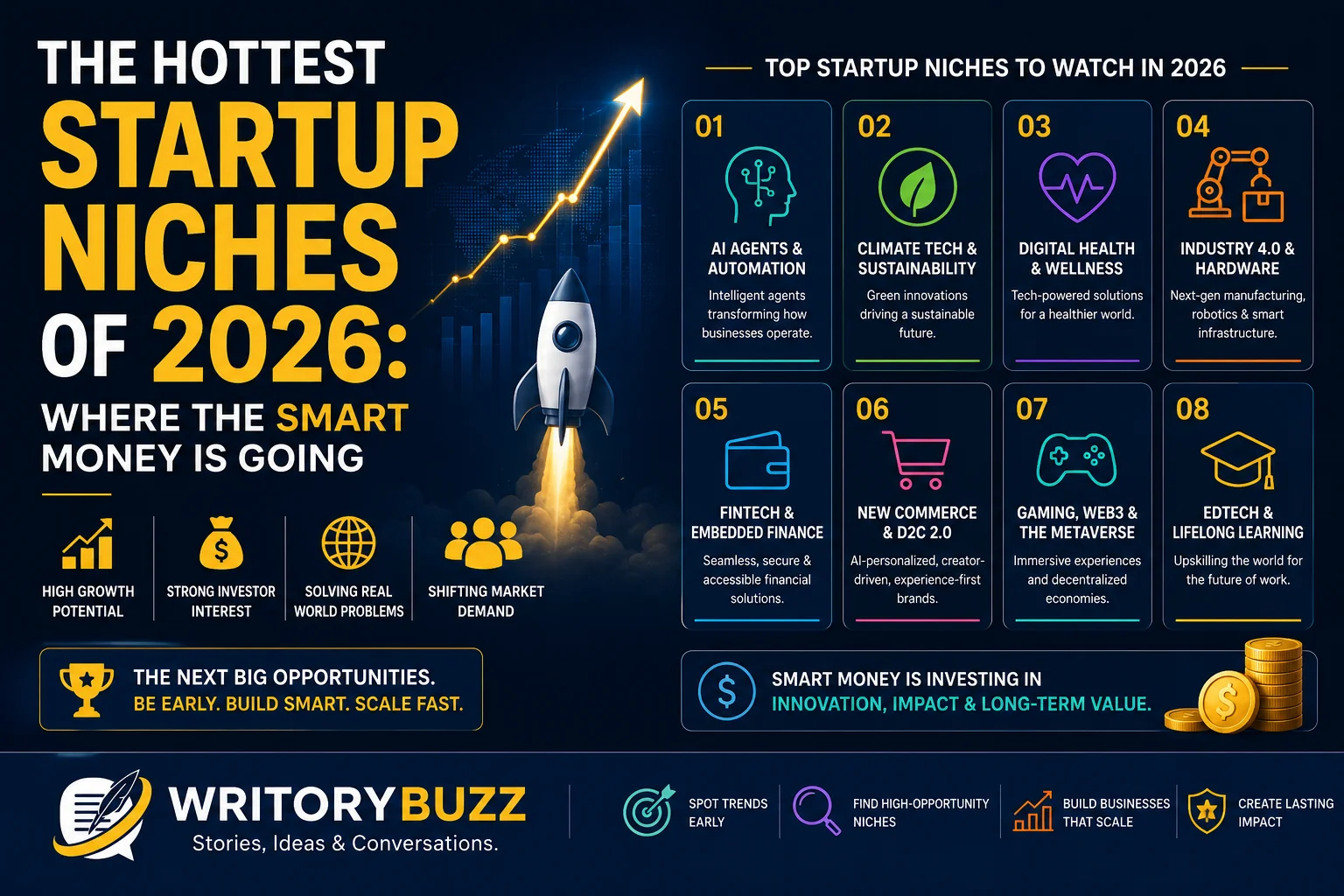
Q1 2026 saw the highest level of VC investment of any quarter on record, totaling close to 70 percent of all VC spending in the whole of 2025. OpenAI raised $122 billion. Anthropic raised $30.6 billion. AI megadeals dominated, but the real opportunity for new entrants is not in competing with foundation model companies. It is in the vertical AI applications and adjacent niches where specialisation beats generalisation.
The smartest VC money in 2026 is not going to generic AI companies. It is going to specialists: healthcare AI that owns a specific workflow, climate tech with paying customers, defense tech with government contracts, and vertical SaaS that is genuinely 10x better at a specific task than a horizontal tool. The pattern from venture data is consistent: niche clarity, proprietary data, and embedded distribution win.
1. Vertical AI SaaS: Specialists Over Generalists
The fastest-growing AI startups in 2026 are solving niche problems with focused excellence. Harvey AI (legal), Ambience Healthcare (clinical documentation), Glean (enterprise search), and Sierra (customer service AI) each dominated a vertical rather than competing horizontally.
What is working: Vertical AI SaaS that owns a specific workflow, has proprietary training data from that workflow, and integrates directly into the tools its users already use. Harvey AI’s legal LLM performs better on legal tasks than a general LLM trained on broader data. Ambience produces better medical documentation than generic AI because it was trained specifically on clinical workflows.
Opportunity signal: Any professional services vertical where documentation, research, compliance, or client communication is a significant time cost and where current tools are generic. Healthcare documentation, legal research, insurance underwriting, financial advisory compliance, and architecture/engineering are all at various stages of vertical AI penetration.
VC validation: Anysphere, Sierra, and Glean all hit $100 million ARR in under 2 years. Vertical AI is the fastest path to revenue in the current funding environment.
2. Defense Tech: The Capital Wave No One Is Ignoring
Defense tech has moved from a niche VC category to a mainstream one. The Ukraine conflict, Taiwan Strait tensions, and NATO resourcing discussions have created unprecedented government procurement appetite for technology that traditional defense contractors cannot deliver at speed. Government contracts provide the revenue predictability that growth investors value.
Specific niches attracting capital: Drone systems and counter-drone technology, autonomous logistics for military supply chains, AI-assisted intelligence analysis, cybersecurity for critical infrastructure, and satellite communications for contested environments.
Entry considerations: Defense tech requires security clearances for key personnel, government sales cycles that run 18 to 36 months, and regulatory complexity that filters out opportunistic entrants. These barriers also protect incumbents once established. The most successful defense tech startups have former military or intelligence founders who understand procurement.
3. Climate Fintech: Where Climate Meets Finance
Global energy transition investment hit a record $2.3 trillion in 2025. Climate fintech captures the financial infrastructure layer of this transition: carbon accounting platforms, green bond structuring tools, ESG data verification, climate risk modelling for insurance and lending, and voluntary carbon market infrastructure.
Why now: EU CSRD requires 50,000 companies to report detailed climate data from 2026. SEC climate disclosure rules affect US public companies. Corporate sustainability reporting is shifting from voluntary to mandatory at scale, creating massive demand for the infrastructure to produce, verify, and report that data.
Specific opportunities: Automated Scope 3 emissions measurement (still unsolved at scale), supply chain carbon data collection tools, AI-powered physical climate risk assessment for real estate and infrastructure lending, and corporate sustainability report generation tools.
4. Healthcare AI: Clinical Workflow Automation
Healthcare AI attracted significant capital concentration in 2026, specifically in clinical workflow automation. Administrative burden is the most visible problem in US healthcare: physicians spend an average of 1 to 2 hours on administrative documentation for every hour with patients. This is expensive, clinically inefficient, and deeply unpopular with clinicians.
Funded areas: AI medical scribes (Ambience, Nuance DAX), prior authorisation automation, clinical decision support, medical coding, revenue cycle automation, and patient communication tools.
The regulatory moat: Healthcare AI requires FDA clearance or CE marking for clinical decision tools, HIPAA compliance, and integration with fragmented EHR systems (Epic, Cerner, athenahealth). These regulatory and integration requirements are genuine barriers that protect incumbents and make the category defensible once the regulatory hurdles are cleared.
5. Agentic AI Infrastructure
As AI agents move from demos to production deployments, the infrastructure layer required to run them reliably and safely has become a significant capital destination. Monitoring and observability for AI agents, guardrail and safety infrastructure, memory and context management for long-running agents, and orchestration frameworks for multi-agent systems all represent nascent but fast-growing categories.
The investment thesis: Every enterprise deploying AI agents at scale needs the same infrastructure: logging what agents do, testing that they behave correctly, managing costs, and maintaining human oversight. This infrastructure does not yet exist as mature products. The companies building it now are building early positions in what will be large markets.
6. Quantum Computing Applications
PsiQuantum raised $1 billion in its latest funding round. The global deep tech investment market targeting quantum computing is projected to reach $127.8 billion by 2032. Quantum computing hardware is still a decade from broad commercial availability, but quantum software and applications targeting the near-term noisy intermediate-scale quantum (NISQ) era are attracting early investment.
Realistic 2026 applications: Quantum optimisation for logistics and supply chains (portfolio optimisation, route planning), quantum chemistry simulation for drug discovery and materials science, and quantum-safe cryptography (preparing classical systems for post-quantum security threats).
What are the hottest startup niches for investment in 2026?
Based on 2026 VC activity: vertical AI SaaS (Harvey AI, Ambience, Glean model), defense tech (drones, autonomous logistics, cyber for critical infrastructure), climate fintech (ESG data, carbon accounting, physical climate risk), healthcare AI (clinical workflow automation, AI medical scribes), and agentic AI infrastructure (monitoring, guardrails, orchestration for AI agents).
How much VC funding is going into AI startups in 2026?
Q1 2026 was the highest VC investment quarter on record, with AI megadeals dominant. OpenAI raised $122 billion and Anthropic raised $30.6 billion. In 2025 alone, top AI startups raised nearly $150 billion, over 40 percent of global VC. Foundation model funding is concentrated; the opportunity for new entrants is in vertical applications.
What makes a startup attractive to VCs in 2026?
Vertical focus rather than horizontal generalisation, proprietary data from the specific workflow being automated, embedded distribution into existing tools the target customer uses, and a clear measurable outcome that justifies the price. In regulated markets (healthcare, finance, defense), regulatory progress and compliance infrastructure also strongly signal defensibility.
Is defense tech a viable startup niche in 2026?
Yes, with specific requirements. Defense tech requires security-cleared personnel, 18 to 36-month government sales cycles, and deep regulatory knowledge. Founders with military or intelligence backgrounds have significant advantages. The barriers to entry also provide defensibility: once procurement relationships and security clearances are established, they are difficult to replicate.
What is climate fintech and why is it growing?
Climate fintech builds financial infrastructure for the energy transition: carbon accounting platforms, ESG data verification, green bond structuring, and climate risk modelling. The EU CSRD requiring 50,000 companies to report detailed climate data from 2026 creates massive demand for these tools. Global energy transition investment at $2.3 trillion annually is the underlying market.
What vertical AI SaaS niches are most underpenetrated in 2026?
Based on current AI penetration analysis: architecture and engineering documentation, legal contract lifecycle management, insurance claims automation beyond simple cases, financial advisory compliance documentation, and SMB accounting and bookkeeping. These verticals have the same documentation and compliance burden as the funded leaders but have received less venture attention.
Niche Beats Generic at Every Stage
The consistent pattern across 2026 VC data is that specialist beats generalist. An AI company that owns one workflow for one professional vertical with proprietary training data raises capital more easily, commands higher multiples, and achieves product-market fit faster than one attempting to build another horizontal AI layer. The market for ‘AI for everything’ is owned by OpenAI and Anthropic. The market for AI for your specific workflow is still wide open.
The startup landscape is evolving rapidly, and choosing the right niche can make all the difference. Stay informed with the latest business trends, practical startup insights, and expert guidance from WritoryBuzz to help you make smarter decisions and build with confidence.