
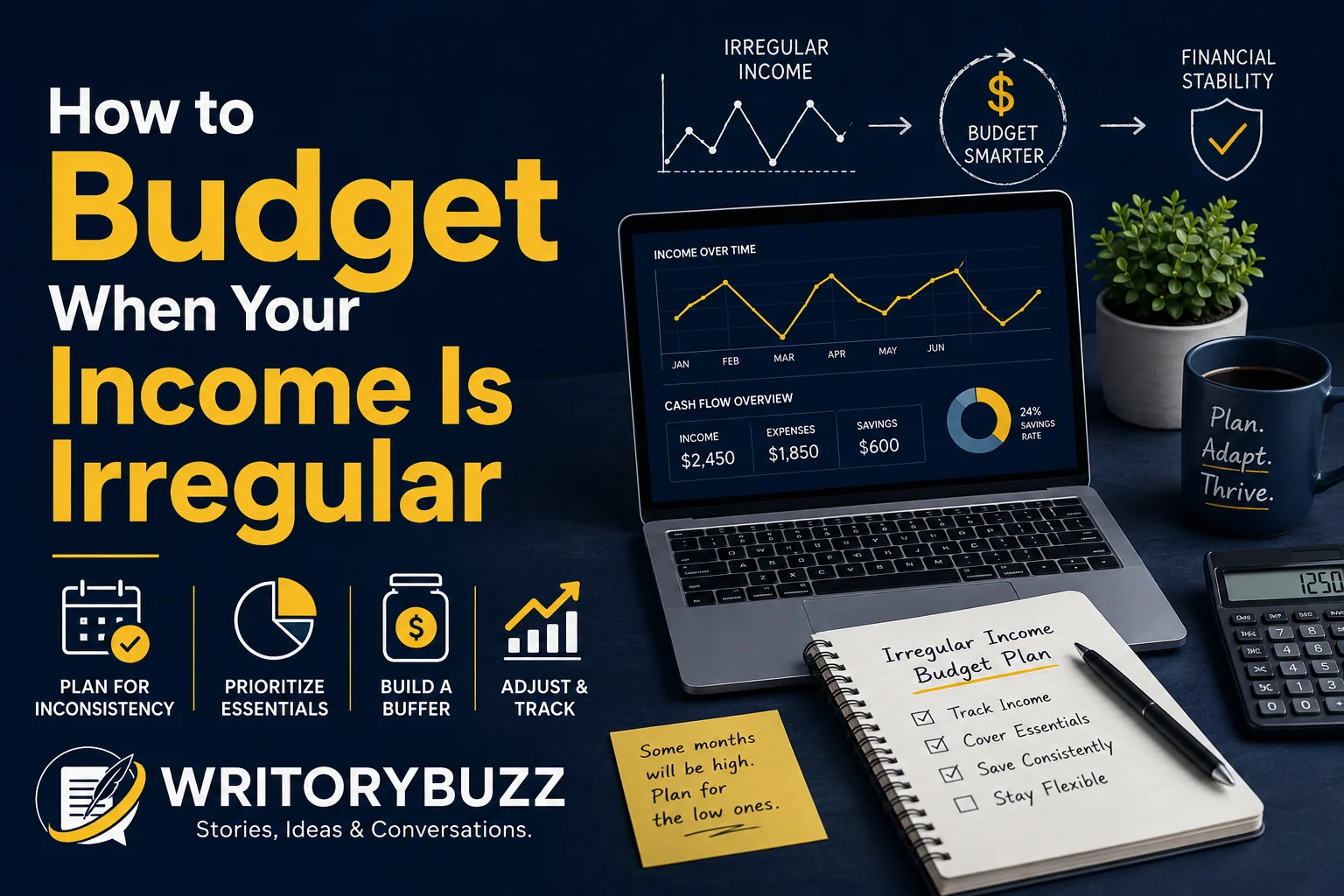
Traditional budgeting assumes a predictable monthly income. For the 59 million Americans who freelance, contract, or run businesses with variable revenue, that assumption fails immediately. A freelancer budgeting system that works is built on a different principle: separate what you earn from what you spend, and manage the gap between them deliberately.
Irregular income budgeting in 2026 covers a wide range of situations: freelancers with month-to-month variation, sales professionals with commission-heavy compensation, seasonal business owners, portfolio career workers combining multiple income streams, and self-employed professionals whose revenue fluctuates with client activity. Each has a different income pattern but the same structural budgeting problem.
The Core Problem With Standard Budgets for Irregular Income
Standard percentage-based budgets (50/30/20 or similar) allocate this month’s income to this month’s expenses. When income is $8,000 in March and $3,000 in April, a percentage-based budget requires either scaling expenses up and down with income (impractical) or constantly adjusting category allocations (exhausting and unrealistic for most people).
The solution is not a different percentage formula. It is a different system architecture: decouple earning from spending by routing all income through a holding buffer, paying yourself a consistent monthly amount from that buffer, and managing your actual expenses against that consistent self-salary.
The Baseline Income Method
The baseline income method establishes your ‘floor’: the minimum monthly income your business or freelance work reliably generates even in slow months. Budget your essential expenses around this floor rather than around average income or best months.
How to find your baseline: Look at your income for the past 12 months. Identify the 3 lowest months. Average these three months. This is a conservative baseline. Budget your fixed essential expenses at or below this number.
Why this works: Essential expenses paid from a conservative baseline are sustainable regardless of month-to-month variation. Money earned above the baseline goes to the income buffer, taxes, and savings rather than inflating lifestyle. This eliminates the feast-and-famine cycle where good months create obligations that bad months cannot service.
The Income Buffer Account
An income buffer is a separate savings account that receives all your income and pays you a fixed monthly amount. Think of it as an employer who pays you every month regardless of when clients pay you.
How to set it up: Open a separate savings account labelled ‘Income Buffer’. Direct all client payments, invoices, and income to this account. Pay yourself a fixed monthly transfer to your main spending account. The fixed monthly transfer is your self-salary.
How much to set your self-salary: Start at or slightly below your baseline income. As your buffer grows (in good months), you can increase your self-salary. As it shrinks (in slow months), it absorbs the shortfall rather than requiring expense cuts.
Buffer target size: Build the buffer to 2 to 3 months of your self-salary before treating it as stable. This provides the smoothing capacity to handle multiple consecutive slow months without cutting essential expenses.
Tax Management for Irregular Income
The second most common irregular income financial failure after poor cash flow management is tax surprise. Freelancers and self-employed people are responsible for their own tax payments and frequently underpay during good earning periods, creating large bills that destabilise their finances.
The simplest tax system: Open a separate account labelled ‘Tax’. Every time income arrives, immediately transfer 25 to 30 percent to this account (adjust for your actual marginal rate and jurisdiction). Pay quarterly estimated taxes from this account. What remains in this account after quarterly payments is your tax refund buffer.
Self-employment tax note: In the US, self-employed individuals pay both employee and employer portions of Social Security and Medicare taxes (15.3 percent of net self-employment income in addition to income tax). The combined effective tax rate for most self-employed people earning $60,000 to $150,000 is 28 to 35 percent. Setting aside 30 percent of every payment is a reliable starting point.
Variable vs Fixed Expenses for Irregular Income
Maximise fixed expenses reduction: Irregular income earners benefit from minimising fixed monthly commitments (rent, subscriptions, loan payments). Fixed expenses are obligations regardless of monthly income. Lower fixed expenses mean your baseline can be lower, which makes your budget more resilient.
Keep variable expenses truly variable: Eating out, entertainment, travel, clothing, and discretionary spending should scale with income availability. In slow months these contract. In good months they expand. This is the natural variable buffer in the system.
Annual lump sum planning: Irregular income earners frequently forget to budget for annual or irregular expenses: insurance premiums, professional development, equipment replacement, vehicle maintenance. Divide the annual total by 12 and move that amount monthly to a sinking fund account. Treat it as a fixed expense.
Emergency Fund Sizing for Irregular Income
The standard emergency fund guidance (3 to 6 months of expenses) is insufficient for irregular income earners. The appropriate target is 6 to 12 months of essential expenses. This accounts for both genuine emergencies (illness, equipment failure) and the extended slow periods that are a normal feature of self-employed income rather than emergencies.
For freelancers with a single client concentration risk (one client representing more than 30 percent of income), the upper end of this range is appropriate. The emergency fund is your business continuity buffer as well as your personal financial safety net.
How do you budget with irregular freelance income?
Use the income buffer method: direct all income to a holding account and pay yourself a consistent monthly amount. Establish your baseline income from your 3 lowest months of the past year. Budget essential expenses at or below baseline. Let the buffer absorb month-to-month variation rather than adjusting your lifestyle spending each month.
How much should a freelancer set aside for taxes?
A starting point of 25 to 30 percent of all gross income is appropriate for most US freelancers, covering income tax plus self-employment tax (15.3 percent). The precise amount depends on your total income, deductions, and state taxes. Move this percentage to a separate tax account immediately when each payment arrives to prevent spending money you owe.
What is the income buffer method for budgeting?
The income buffer is a separate account that receives all your income and pays you a fixed monthly ‘self-salary’ regardless of when clients pay. In good months, the buffer grows. In slow months, it shrinks to cover your salary. This decouples your spending from income timing variation and eliminates the feast-and-famine cycle.
How large should an emergency fund be for a freelancer?
6 to 12 months of essential expenses, compared to the standard 3 to 6 months for employed people. Irregular income earners face both genuine emergencies and extended slow business periods as normal occurrences. A single-client-concentrated freelancer should target the upper end. Build this gradually from the surplus above your self-salary in good months.
What is a sinking fund and why do irregular income earners need one?
A sinking fund is a savings account where you deposit a fixed monthly amount to cover future irregular but predictable expenses: annual insurance premiums, equipment replacement, tax payments, and professional development. Dividing annual costs by 12 and saving monthly prevents large lump sum expenses from disrupting cash flow.
How do you find your baseline income for budgeting?
Look at your income for the past 12 months and identify the 3 lowest months. Average these three months. This conservative baseline represents what you reliably earn even in slow periods. Budget your essential non-negotiable expenses at or below this amount so that even your worst three months cover your necessities.
Consistency Is the Goal, Not Perfection
The best irregular income budget is the one you actually run for 12 consecutive months. A sophisticated system abandoned after three months produces worse outcomes than a simple system that becomes automatic. Start with the income buffer account and tax account. Add sinking funds and baseline analysis once the core structure is habitual. The discipline compounds faster than the complexity.