Most people choose an online learning platform the same way: they search for a course, see it available on Udemy or Coursera, check the price, and buy. Whether that platform is the right choice for what they are actually trying to accomplish rarely enters the decision.
Coursera, Udemy, and edX are not competing for the same learner doing the same thing. They serve fundamentally different goals. Choosing the wrong one means spending money on a certificate that does not carry weight with employers, completing a course that does not match your actual learning style, or paying a subscription for access you mostly do not use.
Here is the honest breakdown.
The Platform Question Nobody Asks First
Before comparing platforms, the more useful question is: what do you want to happen after you complete the course?
If the answer is ‘I want to be able to do the thing’ a practical skill outcome then the platform matters less than the course quality, and completion matters most. If the answer is ‘I want something that demonstrates competence to an employer’ a credential outcome then the platform and who backs the certificate matters enormously.
These are different problems. Most comparison articles treat them as the same.
The Completion Rate Problem That Changes Everything
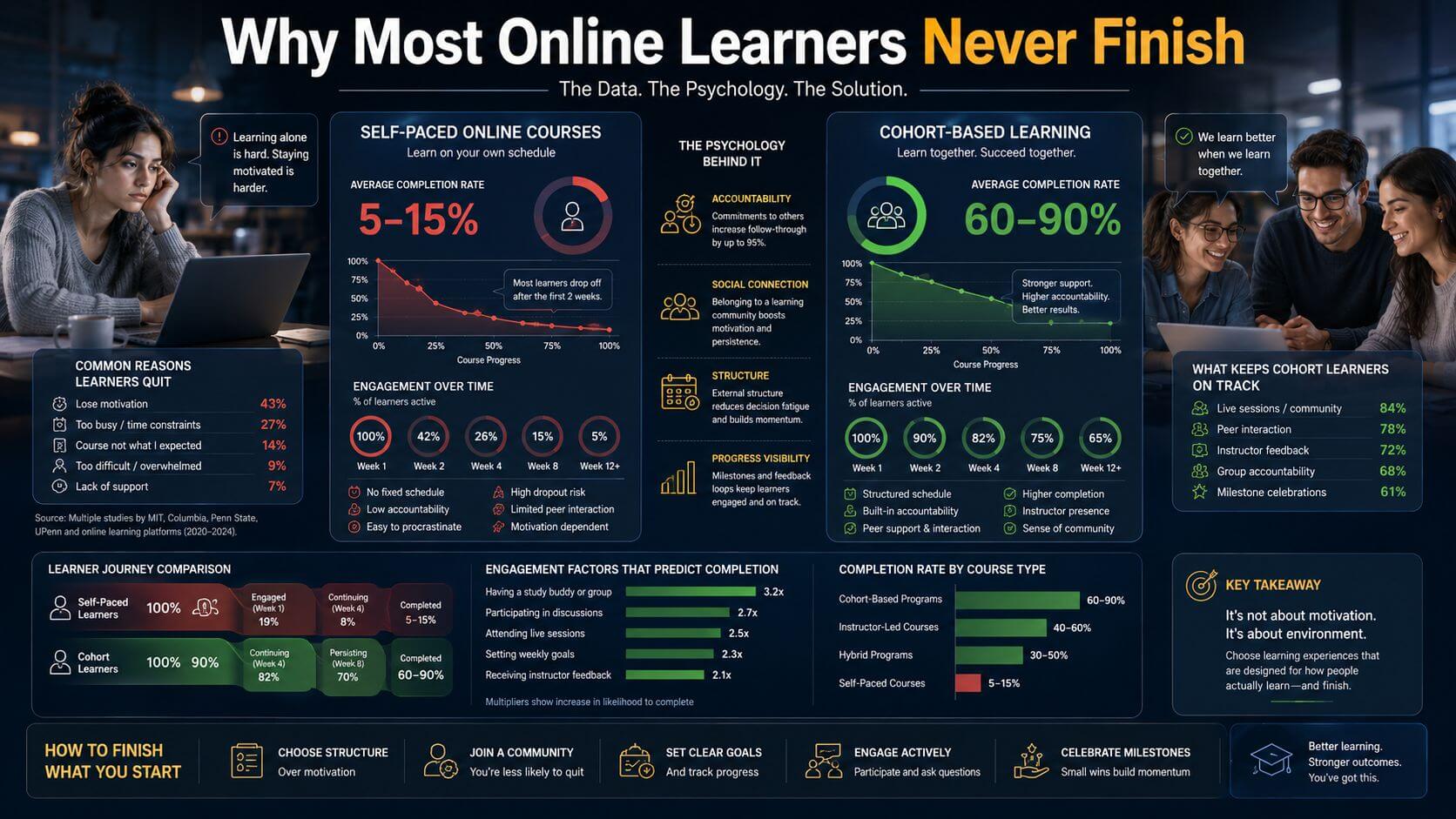
The average completion rate for self-paced online courses across all platforms is around 15 percent. That means for every 100 people who buy or enrol in a course, 85 do not finish it.
Cohort-based courses — where you have a fixed schedule, live sessions, and peers doing the work alongside you — hit 85 to 95 percent completion rates. The format matters more than the content when it comes to whether people actually finish.
This is the most important practical consideration when choosing a platform: if you have a history of not finishing self-paced courses (most people do), a platform with structured cohort options is worth paying more for, not because the content is better, but because the format works with human psychology rather than against it.
What Each Platform Is Actually For
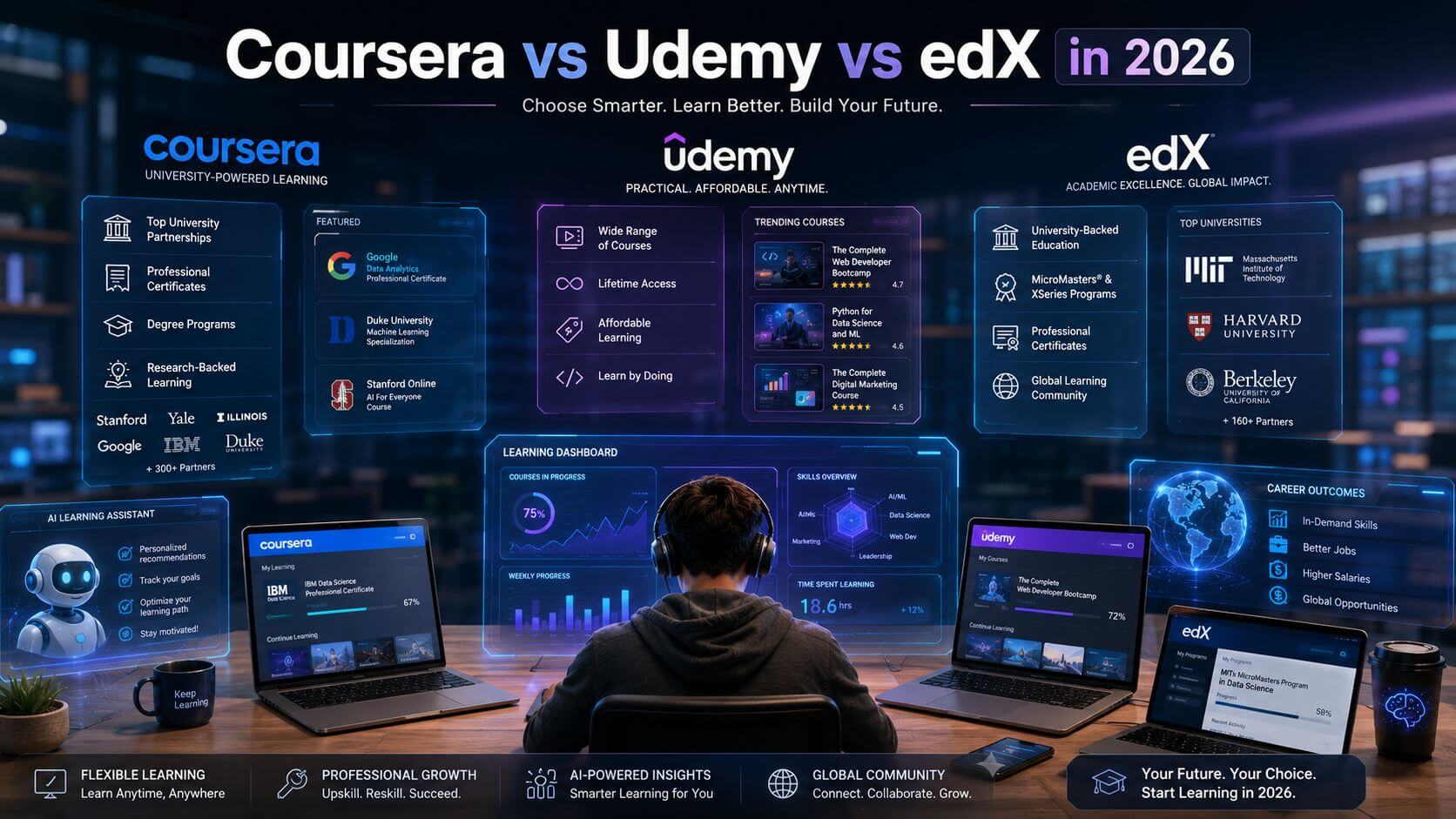
Coursera: University and enterprise-backed learning. The platform for structured career certificates, professional development programmes, and accredited online degrees. The content is curated, instructor-quality is controlled, and the credentials carry genuine employer recognition in many fields.
Udemy: An open marketplace with 250,000+ courses on practically every topic imaginable. The value proposition is volume and affordability. Quality varies significantly because anyone can publish. It works best for learners who know how to evaluate course quality before buying and who need a specific practical skill quickly.
edX: Academic rigour from elite universities. MIT, Harvard, and Berkeley courses. The free audit option makes it the most accessible of the three for pure learning without a credential goal. MicroMasters and online degrees give it real institutional weight for learners who need formal academic recognition.
Head-to-Head Comparison
| Coursera | Udemy | edX | |
| Courses | 10,000+ | 250,000+ | 4,000+ |
| Pricing model | Subscription ($59/mo) or per course | Per course ($10–$200; freq. discounted) | Audit free; cert $50–$300 |
| Accreditation | University-backed (Stanford, Yale, etc.) | Not accredited | MIT, Harvard, Berkeley-backed |
| Degrees offered? | Yes (online bachelor’s and master’s) | No | Yes (MicroMasters, bachelor’s, master’s) |
| Certificate employer weight | High (especially Google/IBM certs) | Low to moderate | High (university-stamped) |
| Course quality control | Curated — must meet standards | Open marketplace — varies widely | Curated — high bar |
| AI tutoring | Coursera Coach (assignment feedback) | Limited | edX AI tutor (expanding) |
| Best for | Career pivots, professional certificates | Affordable skill learning, wide variety | Academic rigour, free auditing |
Coursera in 2026: Career Credentials Done Properly
Coursera’s strongest asset is the institutional backing behind its certificates. A Google Career Certificate in data analytics or a IBM Professional Certificate in AI engineering carries weight with recruiters in a way a Udemy certificate simply does not, because it is backed by a recognisable brand with a verifiable standard.
This matters more in some fields than others. In tech, data, and business roles, hiring managers have become familiar with Coursera’s professional certificate programmes over the past four years. A Google certificate in project management or data analytics on a CV at least gets read. The same skill from a Udemy course may not.
The Google and IBM Certificate Value
The Google Career Certificates on Coursera are the clearest example of credential value on the platform. These are multi-course programmes designed specifically to qualify learners for entry-level roles in IT support, data analytics, UX design, project management, and cybersecurity. Google has made commitments to recognise these certificates in their own hiring and has built employer partnerships around them.
IBM’s equivalent programmes cover AI, cloud computing, and data science. Both programme families have measurably improved job placement outcomes for completers compared to unbranded online learning, based on third-party outcome surveys.
Coursera Plus vs Per-Course: Which Is Better Value
Coursera Plus gives unlimited access to most of the platform’s catalogue for $59 per month or around $399 per year. It makes sense if you are actively working through multiple programmes, likely to complete more than two or three courses in the year, or on a structured learning path that spans several months.
If you are taking one specific course or certificate programme, buying it individually is typically cheaper. The subscription model benefits highly active learners. Casual or one-time learners overpay.
Udemy in 2026: Volume and Affordability, With Caveats
Udemy’s 250,000+ courses represent practically every topic a learner could want. If it exists as a skill, there is almost certainly a Udemy course on it. For fast, affordable skill acquisition on a specific practical topic, nothing touches it for volume and price.
But the volume creates a quality problem that Coursera and edX do not have, because Udemy’s open marketplace model means anyone can publish. For every excellent, well-structured Udemy course there are ten that are rushed, outdated, or superficial. Buying on Udemy without reading reviews carefully is genuinely risky.
The Quality Problem
Concrete buying guidance for Udemy: look for courses with at least 4.4 stars from a minimum of 1,000 reviews. Check the ‘last updated’ date — anything more than 18 months old in a fast-moving technical field (web development, AI, cloud tools) is likely to be at least partially outdated. Read the one-star reviews specifically; they often identify specific problems the overall rating obscures.
The frequent discount sales on Udemy are genuine. Most courses listed at $80 to $200 sell for $10 to $15 on a regular basis. Never pay full price. The discount timing is unpredictable but frequent enough that waiting a week before buying is almost always worth it.
When Udemy Is the Right Answer
- You need to learn a specific practical tool (Excel, Photoshop, Python for beginners, a specific framework) quickly and cheaply.
- You are supplementing other learning rather than seeking a standalone credential.
- You have already assessed course quality carefully and found a highly rated, recently updated option.
- You have Udemy Business access through your employer — the corporate tier gives access to a curated subset of the catalogue with quality filtering applied.
edX in 2026: Academic Rigour and Free Auditing
edX’s distinguishing feature is the free audit option. Most courses on edX can be accessed for free without a certificate. You watch the lectures, work through the material, and gain the knowledge. You only pay if you want the verified certificate.
This makes edX the most accessible platform for pure learning. If your goal is to understand a subject rather than to prove you understand it, edX gives you the content of MIT OpenCourseWare-quality courses at no cost. That is genuinely exceptional value that most learners do not know about.
MicroMasters and Online Degrees
edX’s MicroMasters programmes are graduate-level sequences of courses from universities like MIT, Columbia, and Georgia Tech. They are a standalone credential in their own right and, in some cases, count as credit toward a full master’s degree at the affiliated institution.
The online bachelor’s and master’s degrees on edX are accredited, granted by actual universities, and available for a fraction of on-campus tuition. A master’s degree in computer science from Georgia Tech through edX costs around $7,000 total. The same degree on campus costs significantly more. The credential is identical.
The Decision Framework
| Your Goal | Best Platform |
| Career pivot into tech or data with employer-recognised credentials | Coursera (Google/IBM certificates, university backing) |
| Learn a specific skill cheaply and quickly | Udemy (wait for a sale — courses often drop to $10–$15) |
| Academic learning that counts toward a degree or institutional credit | edX (MicroMasters, accredited degrees) |
| Get a formal online degree at a fraction of campus cost | Coursera or edX (both offer accredited online degrees) |
| Explore a topic before committing money | edX (free audit option) or Coursera (free trial) |
| High-volume learning across many topics | Udemy (lifetime access per course) or Coursera Plus (subscription) |
| Creative skills — design, writing, music | Skillshare or Udemy |
| Coding bootcamp-style structured path | Coursera (professional certificates) or Udacity |
Platforms Competitors Never Mention (But Should)
LinkedIn Learning: Best for professional skills with direct integration to your LinkedIn profile. Courses range from soft skills to specific software tools. Strong for professionals focused on career development in non-technical roles.
Codecademy: For coding specifically, Codecademy’s interactive in-browser learning environment is significantly more effective for beginners than watching video lectures. The hands-on model reduces the gap between ‘watched the course’ and ‘can actually write the code.’
DataCamp: For data science and analytics specifically, DataCamp’s practical, hands-on approach with real datasets outperforms Coursera and Udemy for developing actual working skills in Python, R, and SQL. The learning environment is purpose-built for the subject matter.
Honest Limitations of Each Platform
Coursera: The subscription model encourages signing up and not actively using it. Many learners pay $59 a month for access they barely touch. Courses are longer and more structured than some learners want or need.
Udemy: Certificates have limited employer weight outside of personal verification of the skill. Quality inconsistency requires significant pre-purchase research. Completion rates on self-paced Udemy courses are likely below the industry 15% average for many learners.
edX: The free audit option is powerful but does not include graded assignments or certificates. The platform can feel more academic and less immediately practical than Udemy or Coursera for learners who want direct career application.
Frequently Asked Questions
Does a Udemy certificate mean anything to employers?
In most industries, a Udemy certificate by itself carries limited weight in hiring decisions because Udemy is an open marketplace with no accreditation and no standardised quality bar. The exception is when the certificate demonstrates a specific practical skill that can be tested or verified. Coursera and edX certificates from university-backed or major employer-backed programmes carry significantly more weight.
Is Coursera Plus worth the money?
It depends on your usage. If you are actively working through multiple courses or a structured certificate programme over several months, the $399 annual subscription is good value. If you are taking one specific course, buying it individually is cheaper. Do not subscribe and then passively browse — the value requires active use.
Can I really audit edX courses for free?
Yes. Most edX courses offer a free audit track that gives access to lectures and course materials without the certificate. You pay only if you want the verified credential. This makes edX genuinely the most accessible platform for learning without a credential goal.
Which platform is best for getting a job in tech?
For entry-level tech roles, Coursera’s Google and IBM Professional Certificate programmes have the strongest employer recognition and the most direct hiring pathways. For deeper technical skills, Codecademy or DataCamp may build more practical proficiency faster. For formal credentials that universities recognise, edX MicroMasters and degree programmes are the strongest option.
Choose the Platform That Fits Your Actual Goal
The best platform is the one that matches what you are trying to achieve, not the one with the most courses or the most recognisable name.
Credential with employer weight: Coursera. Cheap practical skill acquisition: Udemy with careful quality filtering. Academic rigour or free learning: edX. Coding specifically: Codecademy. Data skills specifically: DataCamp.
The completion rate data is worth taking seriously before you decide. If you have not finished self-paced courses before, look for structured options with deadlines and cohort accountability, regardless of which platform offers them. A finished course on any platform is worth more than an abandoned course on the ‘best’ platform.
Want to grow your education, technology, or e-learning brand online? Publish high-authority guest posts through WritoryBuzz and improve your SEO, digital visibility, and industry credibility with strategic placements on trusted business and technology websites.