
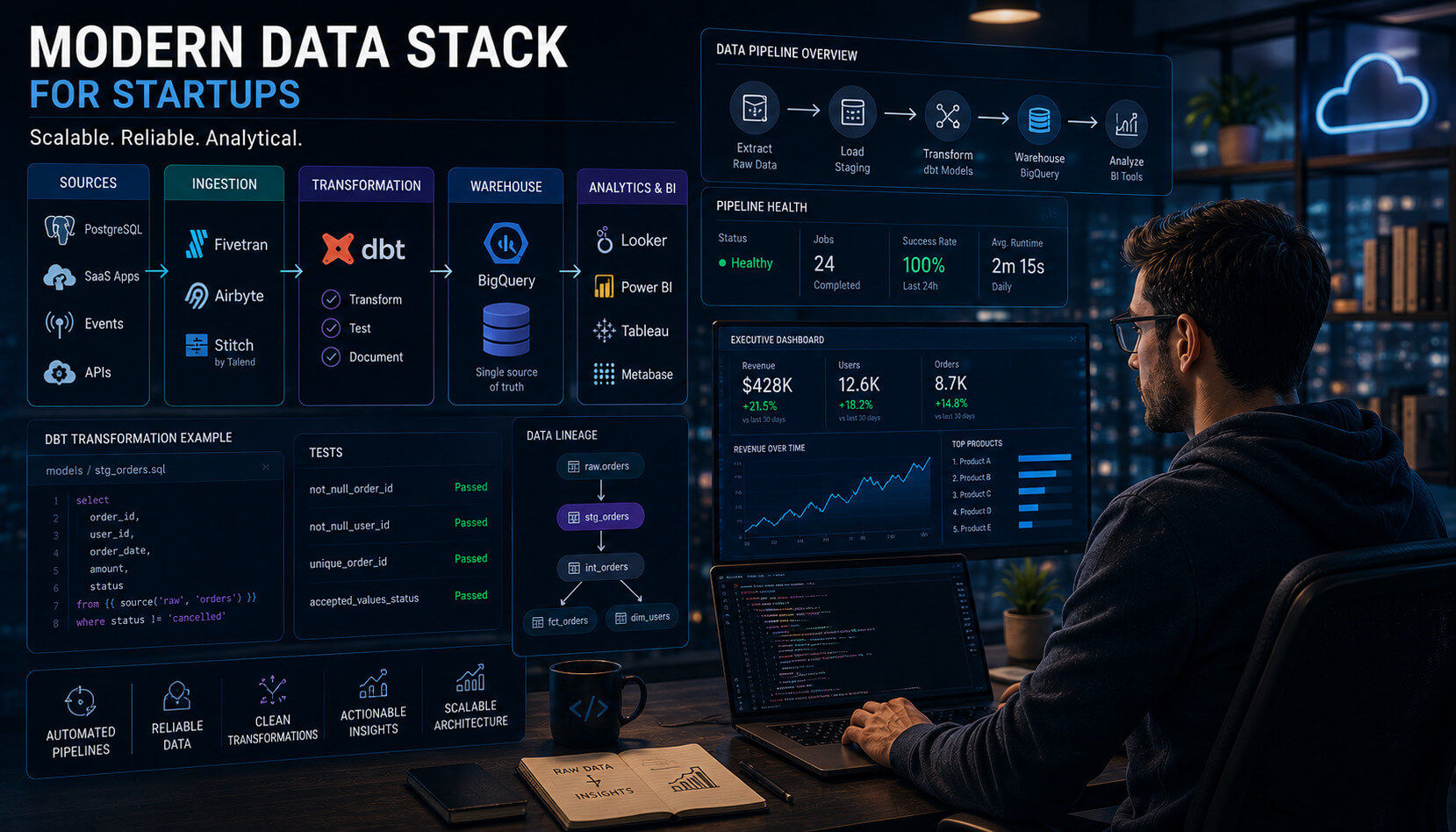
The modern data stack’s reputation is expensive. Fivetran, Snowflake, dbt Cloud, and Looker in their enterprise configurations can run $10,000 to $30,000 per month before counting the headcount to manage them.
That is the scale version. For startups, small teams, and businesses at early data maturity stages, a fully functional modern data stack can be assembled from open-source and free-tier tools for under $100 per month, with managed-service comfort options available for under $500.
The tools are production-grade. The architecture is the same. The costs are a fraction.
What a Modern Data Stack Is
The modern data stack is an approach to data infrastructure that separates the jobs of data movement (extraction and loading), data storage (a cloud data warehouse), and data transformation (converting raw data into clean, analysis-ready tables) into distinct layers with specialised tools for each.
The advantage over traditional monolithic data warehousing is flexibility, scalability, and the ability to use best-in-class tools at each layer rather than being locked into a single vendor’s ecosystem.
The 5 Layers and What They Do
| Layer | Job | Example Tools |
| Ingestion (ELT) | Move raw data from sources into the warehouse | Airbyte, Fivetran, dlt |
| Storage (Warehouse) | Store and query large volumes of structured data | BigQuery, Snowflake, DuckDB |
| Transformation | Clean and model raw data into analysis-ready tables | dbt Core, dbt Cloud, SQLMesh |
| Orchestration | Schedule and monitor pipeline runs | Apache Airflow, Prefect, Dagster |
| BI / Visualisation | Query and visualise data for analysis | Metabase, Looker, Redash |
The Under-$500/Month Stack – Tool by Tool
Ingestion: Airbyte Open Source (Free Self-Hosted)
Airbyte is the default open-source answer to data ingestion for budget-conscious teams. Over 600 connectors covering most common data sources. The self-hosted version is free under Apache 2.0 licence.
Self-hosting requires a server or cloud VM. A small instance on AWS, GCP, or Digital Ocean costs $20 to $50 per month depending on the volume of data moved. For teams moving modest data volumes (under 500GB per month), this is adequate.
If managing infrastructure is genuinely not an option, Airbyte Cloud has a free tier for limited usage. Fivetran (the most common paid alternative) starts at $0 for the starter tier but becomes expensive quickly as connector usage grows.
Warehouse: Google BigQuery (Free Tier)
BigQuery offers a permanently free tier covering 10 GB of storage per month and 1 TB of queries per month. For most startups and small teams at early data maturity, this covers a significant share of their total query volume.
Beyond the free tier, BigQuery charges $0.02 per GB stored per month and $6.25 per TB of queries processed (with on-demand pricing). A team running moderate analytics workloads typically pays $50 to $200 per month in BigQuery costs.
Snowflake is the enterprise alternative and is excellent — but the cost structure scales faster. BigQuery is the more accessible starting point for teams with early-stage data needs.
Transformation: dbt Core (Free Open Source)
dbt Core is free, open-source, and installed via pip. It connects directly to your data warehouse and lets you write SQL transformation models with version control, testing, and documentation built in.
Running dbt Core in production requires an orchestrator to schedule runs. The most lightweight approach: use a GitHub Actions free tier to run dbt on a schedule. Cost: zero.
dbt Cloud, the managed platform, costs $100 per user per month on the Team plan. For a one or two person analytics team, the web IDE, managed scheduling, and documentation hosting may justify the cost. For teams comfortable with the command line, Core plus GitHub Actions is free and nearly as capable.
Orchestration: GitHub Actions or Airflow (Free Tier)
For simple pipelines where you need to run dbt on a schedule, GitHub Actions handles this for free within its free minutes allocation. For more complex multi-step orchestration, Apache Airflow has a free open-source version. Both Astronomer (managed Airflow) and Prefect Cloud have free tiers for small workloads.
BI Layer: Metabase Open Source (Free Self-Hosted)
Metabase is the most widely used open-source BI tool in the modern data stack. Self-hosted, it is free with no user limit. The interface is clean and accessible for non-technical users.
Hosting Metabase on a small cloud VM costs $10 to $20 per month. Metabase Cloud (their managed version) starts at $500 per month, which is why most budget-focused teams self-host.
Actual Monthly Cost Breakdown
| Component | Tool | Monthly Cost |
| Ingestion | Airbyte self-hosted on $30 VM | ~$30 |
| Warehouse | BigQuery (free tier + modest usage) | $0–$100 |
| Transformation | dbt Core + GitHub Actions | $0 |
| Orchestration | GitHub Actions (included in free tier) | $0 |
| BI / Viz | Metabase self-hosted on $15 VM | ~$15 |
| TOTAL | $45–$145/month |
The $500 ceiling allows for significant growth above this baseline — more warehouse compute, upgrading to dbt Cloud for team productivity, or switching specific high-volume connectors to Fivetran for reliability.
When to Scale Up to More Expensive Tooling
- Upgrade from Airbyte self-hosted to Airbyte Cloud or Fivetran when the operational burden of managing connectors consumes more engineering time than the cost difference justifies.
- Move from BigQuery free tier to a paid warehouse configuration or Snowflake when query volumes consistently exceed 1 TB per month or storage exceeds 50 GB.
- Upgrade from dbt Core to dbt Cloud when team size grows beyond two data practitioners and the shared development environment and managed documentation hosting save meaningful coordination time.
- Move to Looker, Power BI, or Tableau when Metabase’s self-service limitations become blocking for business users who need more complex dashboards or embedded analytics.
Expert Tips
- Build the warehouse layer first. Without somewhere to store data, nothing else in the stack is useful. BigQuery’s free tier is a zero-risk entry point.
- The real cost driver is not the tools — it’s how many you adopt before you have clear use cases for each. A simple stack used well beats a complex stack managed poorly.
- dlt (data load tool) is worth knowing about for teams that want a lighter-weight Python-native alternative to Airbyte for simple pipelines. It runs in memory, is easy to customise, and is increasingly popular among data engineers who find Airbyte’s full platform overkill for small workloads.
- DuckDB is a serious alternative warehouse for teams with smaller data volumes (under 100GB). It runs locally or embedded in Python/R scripts, is free, and is fast enough for most analytical workloads at startup scale. No cloud VM required.
FAQ
What is the difference between dbt Core and dbt Cloud?
dbt Core is the free open-source command-line tool. dbt Cloud is a managed platform that adds a web IDE, managed job scheduling, CI/CD integration, and hosted documentation. Core is free but requires more DevOps effort. Cloud costs $100/user/month on the Team plan. Most small teams start on Core and move to Cloud as the team grows.
Is Airbyte really free?
Airbyte Core (open-source, self-hosted) is free under Apache 2.0. You pay only for the cloud infrastructure to run it (typically $20–$50/month for a small VM). Airbyte Cloud has a free tier with limited usage. The enterprise version adds managed connectors and SLAs at higher cost.
Start With Just the Warehouse
Create a BigQuery project, set up one ingestion connection from your most important data source through Airbyte, and write your first dbt model to transform that raw data into a clean table. Connect Metabase and build one dashboard.
That is a complete, functional modern data stack. Expand from there as your actual needs become clearer.
Complex technology topics become more valuable when explained clearly. WritoryBuzz helps SaaS and tech brands create SEO-focused content that builds authority, educates audiences, and supports long-term organic growth.