
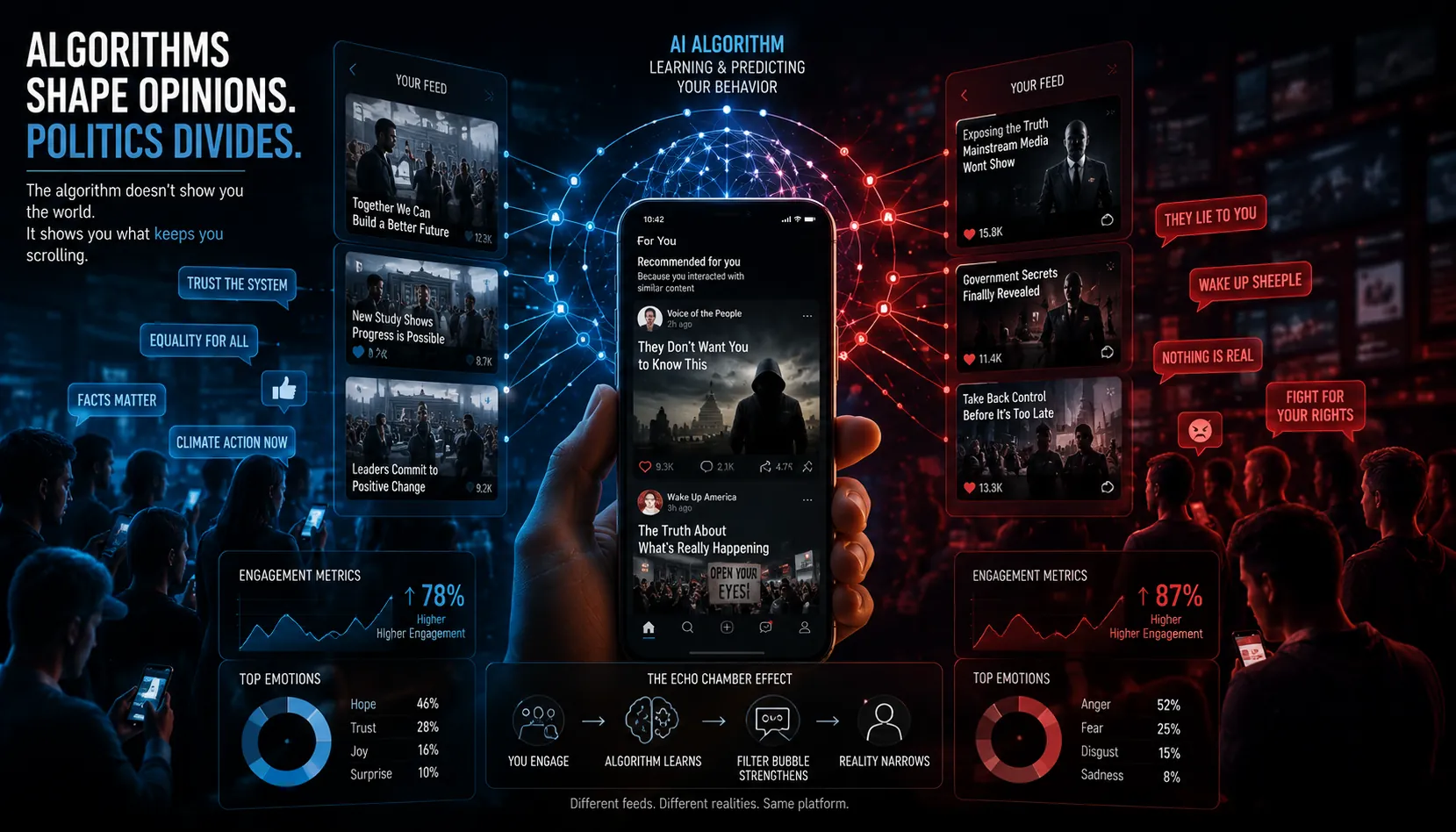
Every time you open a social media app, an algorithm has already decided what you will see. It decided based on your past behaviour: what you clicked, how long you paused, what you shared, what made you react. The algorithm’s job is to maximise your engagement with the platform. Political content, research consistently shows, is highly engaging.
The relationship between social media algorithms and political opinion is one of the most actively researched questions in digital sociology. The answers are more nuanced than either ‘algorithms are destroying democracy’ or ‘filter bubbles are a myth’ – the two most common framings in public debate.
How Recommendation Algorithms Shape What You See
Social media recommendation systems learn from interaction signals: likes, shares, comments, time spent viewing, and the rate at which you scroll past content. Content that generates strong interaction – positive or negative – gets promoted to more users.
Political content tends to generate strong reactions. Outrage and moral emotion are among the most consistent engagement drivers across platforms. An algorithm optimising for engagement therefore tends to amplify political content and, within political content, to amplify the most emotionally charged versions of it.
Crucially, the algorithm does not have a political agenda. It does not prefer left or right. It prefers engagement. The political content that tends to be amplified is not necessarily the most accurate or the most representative of a political position. It is the content that generates the most interaction.
The Filter Bubble vs Echo Chamber – An Important Distinction
These two concepts are often used interchangeably. They describe related but different phenomena.
Filter bubbles are the result of algorithmic personalisation. The platform limits what you see based on your past behaviour. You end up in an information environment that feels familiar and confirming, not through active choice but through automated curation.
Echo chambers are the result of social behaviour. You choose to follow, interact with, and form online communities with people who share your political views. The chamber effect comes from the selective exposure choices you make, not just the algorithm’s choices for you.
In practice, both operate simultaneously. Algorithmic personalisation amplifies the echo chamber effect of social sorting. A person who follows mostly like-minded accounts will receive algorithmically amplified versions of those accounts’ most engaging content, which tends to be the most partisan and emotionally charged.
What the Research Actually Shows
The academic evidence on whether social media algorithms cause political polarisation is more contested than public discourse suggests. Several important findings:
- A large study tracking web browsing data for nearly 200,000 US adults over four years found mixed evidence on whether social media was the primary driver of polarisation. Heavy news media consumption and social sorting within offline social networks were comparably significant factors.
- Research on TikTok and Instagram Reels short-form video found clearer evidence of algorithm-driven political content escalation. The recommendation systems on these platforms surface increasingly partisan content after users engage with initial political content, a pattern called ‘rabbit holing.’
- A 2026 study surveying 390 young adults found strong correlation between algorithm-curated short-form political video exposure and increased affective polarisation (emotional hostility toward the opposing political group), distinct from ideological extremism.
- Research on election-related content specifically finds that social media platforms’ reach effects on election outcomes are significant but contextual, varying substantially by country, platform, media literacy levels, and electoral system.
| The Honest Picture
Social media algorithms appear to contribute to polarisation primarily through the mechanism of emotional amplification — surfacing the most engaging, typically most extreme, versions of political content. The effect is not uniform, varies by platform, and interacts with factors like offline social sorting and media environment. It is real and measurable, but not the sole or dominant cause of political division in most democracies. |
The Engagement Incentive Problem
The structural problem is the incentive. Platforms generate advertising revenue from time spent. Time spent is maximised by engagement. Engagement is maximised by emotional reaction. Political content that generates fear, anger, and moral emotion produces more time spent than moderate, balanced political content.
This is not a conspiracy. It is a predictable consequence of optimising a recommendation system for the wrong metric. The platforms that have moved toward alternative engagement metrics, such as ‘meaningful social interaction’ or content survey responses alongside raw engagement, have seen some reduction in the most polarising content’s reach without equivalent reductions in overall time spent.
Platform Responses and Regulation in 2026
Regulation of social media political content has accelerated in several jurisdictions.
- The EU’s Digital Services Act requires large platforms to provide users with algorithmic transparency options, including at least one recommendation feed not based on user profiling. It also requires risk assessments for potential societal harms from recommendation systems.
- Several platforms have added ‘Why am I seeing this?’ explanations for political content and options to reduce political content in feeds. The implementation quality varies significantly.
- Algorithmic transparency research initiatives have increased access for independent researchers to study platform recommendation systems, producing more rigorous evidence about their effects than was previously available.
What Individuals Can Do
- Use platform tools to reduce political content recommendations. Most major platforms now offer controls to reduce political content in your feed. They are not always prominent, but they exist.
- Deliberately seek out primary sources. When political content reaches you algorithmically, go to the original source rather than relying on the framing in the shared post or the comments below it.
- Notice emotional reactions as signals. Content designed to produce outrage is usually designed to produce engagement, not understanding. Strong emotional reactions to political content are worth pausing on.
- Follow people whose analysis you disagree with but respect. The algorithm learns from your interactions. Deliberately following thoughtful people across the political spectrum shapes what the algorithm serves you over time.
- Use news aggregators or newsletters to supplement social media as a news source. A curated newsletter from a source you chose is a different information environment from an algorithmically selected feed.
FAQ
Do social media algorithms actually cause political polarisation?
They contribute to it, particularly through emotional amplification of extreme content, but they are not the sole cause. Offline social sorting, media environment quality, and structural political factors are comparably significant. The academic evidence is more nuanced than either ‘algorithms are destroying democracy’ or ‘filter bubbles are a myth.’
Can I break out of a political echo chamber on social media?
Yes, with deliberate effort. Use platform controls to reduce political content recommendations. Diversify who you follow to include thoughtful voices across perspectives. Prioritise primary sources over algorithmically amplified shared content. The algorithm learns from your behaviour over time – consistently engaging with more varied content shifts what it surfaces.
Awareness Is Where It Starts
The algorithm that decides what political content reaches you was not designed by anyone who wanted to make you more extreme or more polarised. It was designed to maximise your engagement with the platform. The polarisation effect is a side effect of that incentive, not a goal.
Understanding the mechanism changes how you interact with it. You can choose to engage with the feed the algorithm serves you, or you can choose to shape the feed you receive.
Clear, research-driven content helps audiences understand complex digital trends and social behavior. WritoryBuzz creates engaging SEO-focused articles that build authority, trust, and long-term audience engagement.