
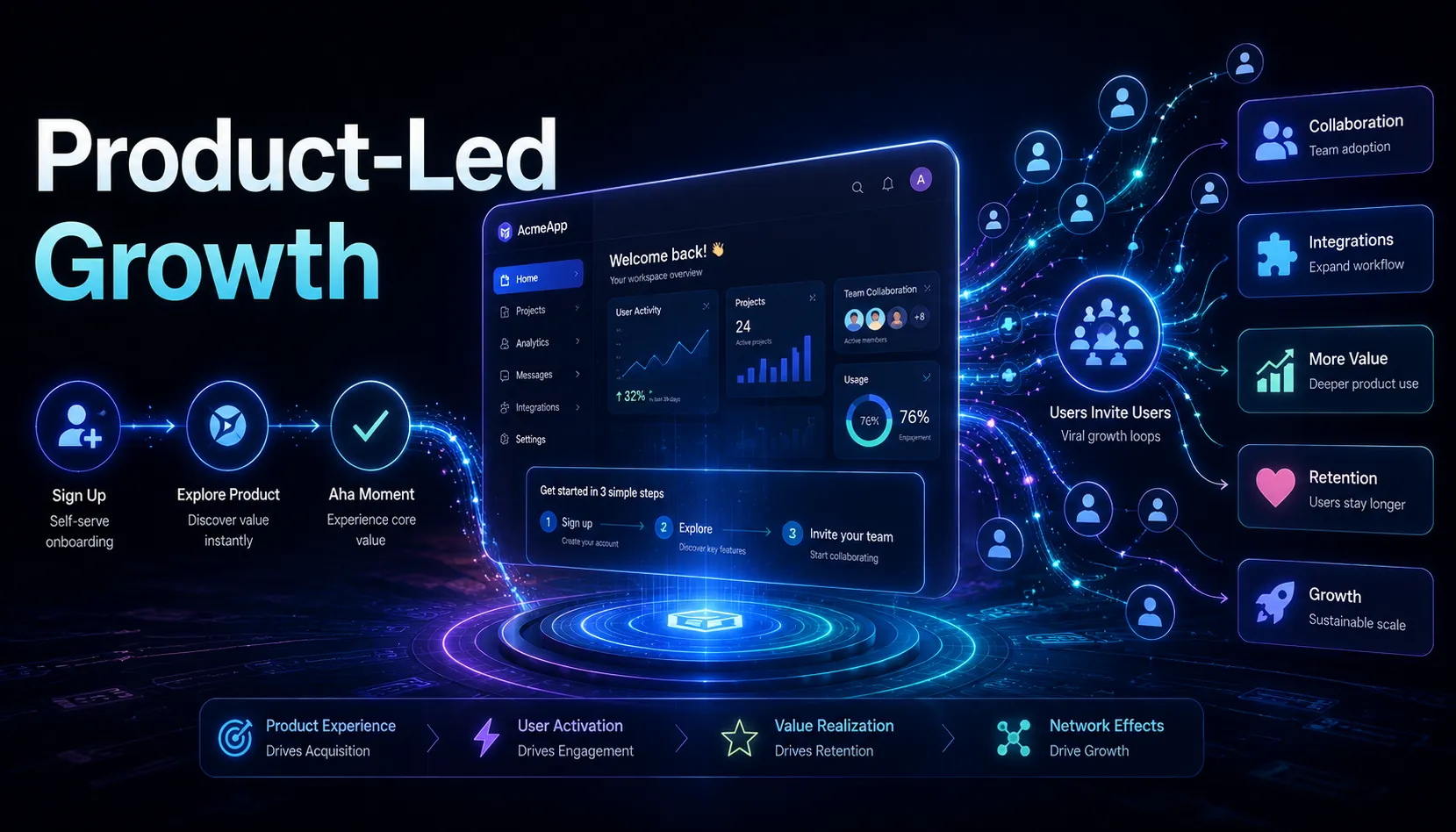
ChatGPT did not grow to 100 million users through cold calls or a sales team. It grew because using the product was the marketing. That is product-led growth in its purest form.
For SaaS companies, PLG is the growth model where the product itself drives acquisition, activation, and retention. Users experience value before they speak to anyone in sales. The product does the convincing.
PLG is not new. Slack, Dropbox, and Calendly all built on these principles. What has changed in 2026 is the sophistication of how it is executed, and the hybrid models that combine self-serve acquisition with targeted sales at exactly the right moment.
How PLG Works
In a traditional sales-led model, a buyer sees a demo, speaks to a salesperson, signs a contract, and then starts using the product. They commit before experiencing real value.
In PLG, the sequence reverses. A user finds the product, signs up for free, starts using it, hits a moment of genuine value (the ‘aha moment’), and eventually hits a natural limit that makes upgrading the obvious next step.
The business impact is significant. PLG companies grow 30 to 50% faster and cut customer acquisition cost by 40 to 60% compared to sales-led equivalents. Trial-to-paid conversion rates reach 15 to 25% for PLG models versus 5 to 10% for sales-led approaches.
Freemium vs Free Trial: Which Model to Use
| Model | When to Use It |
| Freemium (always-free tier) | Best for SMB markets with strong viral potential, lower deal sizes, and products that become more valuable as more team members use them |
| Time-boxed free trial | Better fit for enterprise buyers who need to validate before committing, where a full-feature trial drives faster conversion decisions |
| Usage-based pricing | Works across both segments; ties revenue to realized value, reduces buyer risk, and creates natural expansion revenue as usage grows |
The Product-Qualified Lead (PQL)
The PQL is the PLG equivalent of the marketing qualified lead. Instead of scoring someone based on how many emails they opened, a PQL is scored based on product behavior: how deep into the product they have gone, which features they have used, and whether they are showing signals of wanting to expand.
A user who has invited three teammates, exported twice, and used five core features in their first week is a PQL. They are ready for a sales conversation. A user who logged in once is not.
PQL scoring requires product analytics (Mixpanel, Amplitude, or similar), and it is what separates strategic PLG from simply offering a free tier and hoping for conversion.
The Hybrid Model: PLG + Sales
Pure self-serve PLG works well up to a certain contract value. For higher annual contract values, sales conversations at the right moment improve conversion rates significantly.
The model that most successful PLG companies run in 2026 is product-led sales (PLS): product analytics identify high-intent users (PQLs), and sales teams engage them at exactly the moment they are most likely to convert. Sales calls happen with warm, product-engaged leads instead of cold prospects.
OpenView Venture Capital data shows that PLG companies are valued over 30% higher than their peers. The combination of lower CAC, faster growth, and higher valuation multiples makes PLG the default strategy for modern SaaS.
The Metrics That Matter
| Metric | Target | What It Measures | Action If Off Track |
| Activation Rate | > 20% of signups | % of users reaching the aha moment in first session | Fix onboarding if below 20% |
| Viral Coefficient | > 1.0 | New users acquired per existing user through sharing | Above 1.0 means organic growth |
| PQL Conversion | 15-25% | % of PQLs that convert to paying | Below 15% signals PQL definition needs tightening |
| CAC Reduction | 30-50% vs SLG | Cost to acquire a customer vs sales-led equivalent | Benchmark against your pre-PLG CAC |
Common Mistakes
- Offering a free tier with no natural upgrade pressure, users stay free indefinitely with no reason to pay
- Treating PLG as ‘no sales,’ the most successful PLG companies still use sales for high-value accounts, just at the right moment
- Skipping product analytics and not knowing which features drive conversion and retention
- Making the free tier too limited, users cannot reach the aha moment before hitting a paywall
FAQ
What is product-led growth and how does it work?
PLG is a go-to-market strategy where the product itself drives user acquisition, conversion, and expansion. Users try the product for free, experience genuine value, and upgrade when they hit natural limits. The product does the selling.
What is the difference between PLG and sales-led growth?
In sales-led growth, buyers commit before fully using the product. In PLG, users experience the product first and are converted through product behavior rather than sales conversations. PLG reverses the traditional buying sequence.
How do you measure PLG success?
The four core metrics are activation rate (above 20%), viral coefficient (above 1.0), PQL conversion rate (15 to 25%), and CAC relative to your pre-PLG baseline. These four numbers tell you if the product is doing the growth work.
Product-led growth starts with delivering value, but visibility drives adoption. WritoryBuzz helps SaaS brands create SEO-focused content that attracts qualified users, builds authority, and supports sustainable growth.