
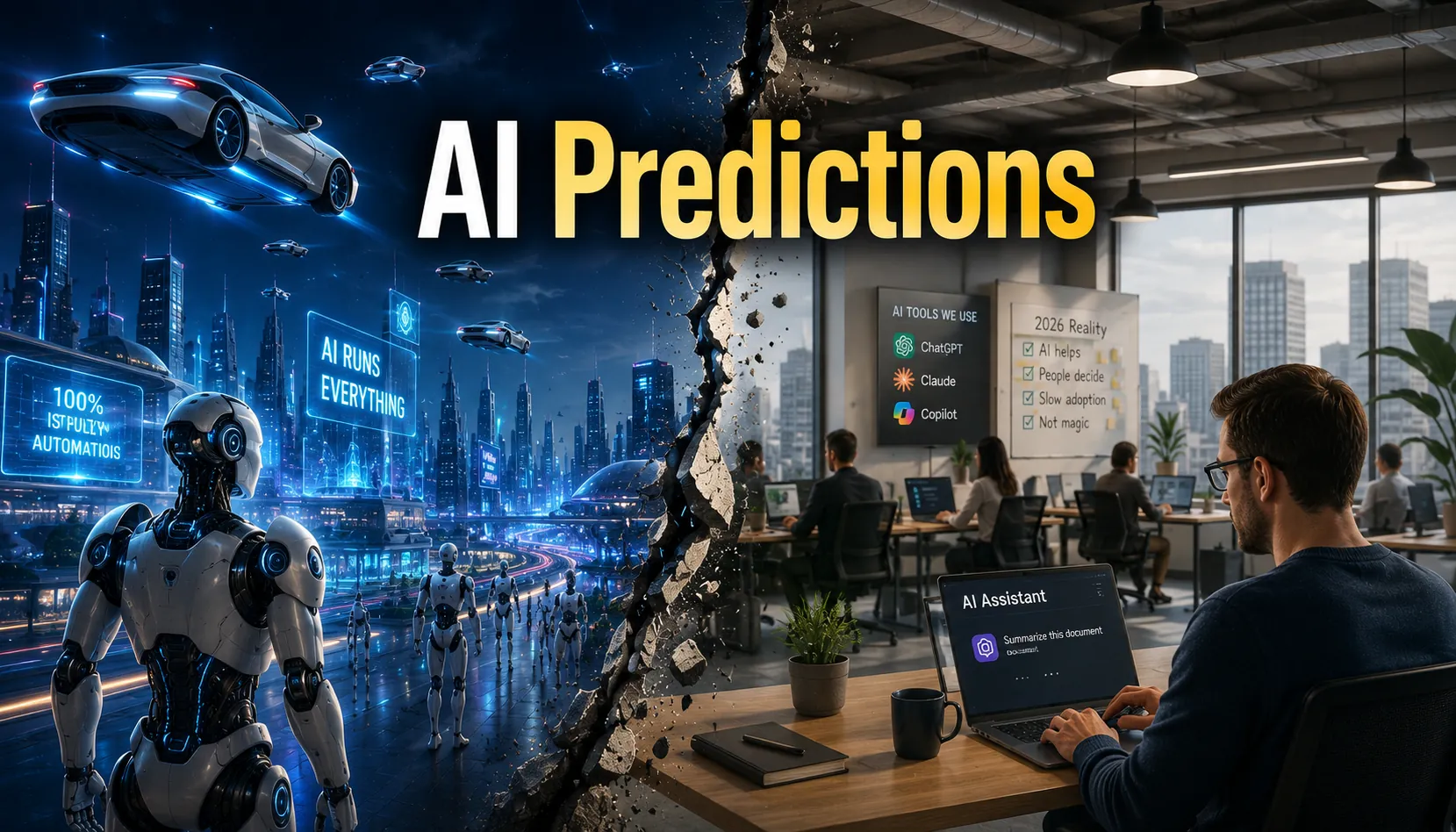
In 2022 and 2023, the predictions for 2026 AI looked something like this: fully autonomous vehicles mainstream, AGI imminent, most white-collar jobs under serious automation threat, and coding effectively solved as a human profession.
We are in June 2026. Let me be direct about what actually happened versus what was predicted.
What Actually Happened
AI made remarkable, genuine progress. Large language models improved dramatically. Multimodal AI became practical. Agentic AI moved from research demos to enterprise production. Code generation became a real productivity multiplier for developers, not a developer replacement.
These are significant achievements. But they are not the predictions that were made.
The predictions were absolute: AGI by 2026 (Elon Musk), most jobs automated by 2025 (various), fully autonomous vehicles standard by 2025 (multiple car executives). These predictions overstated capability and underestimated the remaining problems in specific domains.
Where the Predictions Were Right
Some predictions landed accurately. AI assistants became genuinely useful daily tools, not just demos. Code assistance became standard for developers, with measurable productivity gains. AI image and video generation reached commercial production quality. Agentic AI workflows moved from experimental to deployed in large enterprises.
The people who predicted that AI would change how work gets done were right. The ones who predicted AI would replace entire categories of work by a specific date were mostly wrong.
Where They Were Wrong (And Why)
Self-Driving Vehicles
Autonomous vehicles are still not mainstream in 2026. Robotaxi services operate in specific geofenced areas in specific cities. The prediction of full Level 5 autonomy across mainstream consumer vehicles by now was wrong by years.
The remaining problems are not compute or AI model quality. They are edge case handling, regulatory frameworks, and the catastrophic risk of failure in safety-critical systems. These do not respond to the same scaling dynamics that made language model improvement so rapid.
AGI
AGI has not arrived. Leading researchers disagree sharply on what it would even mean for it to arrive. Demis Hassabis of DeepMind estimates a 50% chance of minimal AGI by 2028. Shane Legg, his co-founder, put the same probability at 2028 in January 2026. These are measured, caveated, probabilistic estimates from people who know the field intimately.
The confident, specific, deadline-driven predictions from entrepreneurs with financial incentives to talk AI up have consistently been wrong. This is a pattern worth noticing.
Job Displacement
Job displacement predictions are the most interesting case because they were neither wrong nor right in the way people expected. Certain tasks have been heavily automated. Entire job categories have not disappeared. What happened instead is that the work changed: what professionals do shifted toward the harder, more judgment-dependent parts that AI handles poorly.
Graphic designers who did not adapt to working with AI tools lost work. Graphic designers who adapted became more productive and took on more projects. The story is not replacement. It is reorganization.
Why AI Predictions Keep Getting the Timeline Wrong
There are structural reasons for this pattern.
Researchers and entrepreneurs making AI predictions have strong incentives to talk up the technology’s progress. Investment flows toward ambitious vision. Media covers the most dramatic predictions.
The technical progress in AI follows exponential curves in some dimensions (training efficiency, benchmark performance) and hits hard walls in others (embodied AI, novel physical world reasoning, reliable high-stakes autonomous operation). Predictions that treat all AI progress as uniformly exponential will always be wrong.
One insight that has held up well: the direction of AI predictions is usually correct, the timeline is usually wrong. If a prediction was made in 2022 about AI by 2025, the capability often arrived, just in 2027 or 2028.
What I Think Comes Next
Agentic AI in constrained, well-defined workflows will continue advancing fast. This is where the evidence of genuine progress is clearest and the safety and reliability bars are manageable.
Physical world AI, including robotics and autonomous vehicles, will advance more slowly than predicted because the remaining problems are qualitatively different from the language modeling problems that scaled so well.
AGI debates will continue without resolution because there is no agreed definition of what AGI is. The most useful question is not ‘when does AGI arrive’ but ‘which specific tasks can AI systems now do reliably that required human judgment before?’
FAQ
Did AI predictions for 2026 come true?
Partially. The direction was right: AI became a significant productivity tool, agentic AI deployed at scale, code generation changed developer workflows. The most dramatic specific predictions (AGI, mainstream autonomous vehicles, mass job displacement) did not materialize on the predicted timelines.
What did AI still fail to do in 2026?
Operate reliably in safety-critical physical systems without geofencing or human oversight. Consistently reason through genuinely novel problems without hallucinating. Replace entire professional workflows end-to-end, versus assisting with specific tasks within them.
Why do experts keep getting AI timelines wrong?
Because AI progress is uneven: exponential in some dimensions (benchmark performance, language tasks) and slow in others (physical world reasoning, edge case handling). Predictions that treat it as uniformly fast consistently overshoot in the near term. The direction is usually right. The deadline is usually wrong.
The most valuable technology insights separate hype from reality. WritoryBuzz creates research-driven content that helps readers understand emerging technologies, market shifts, and long-term industry trends.