
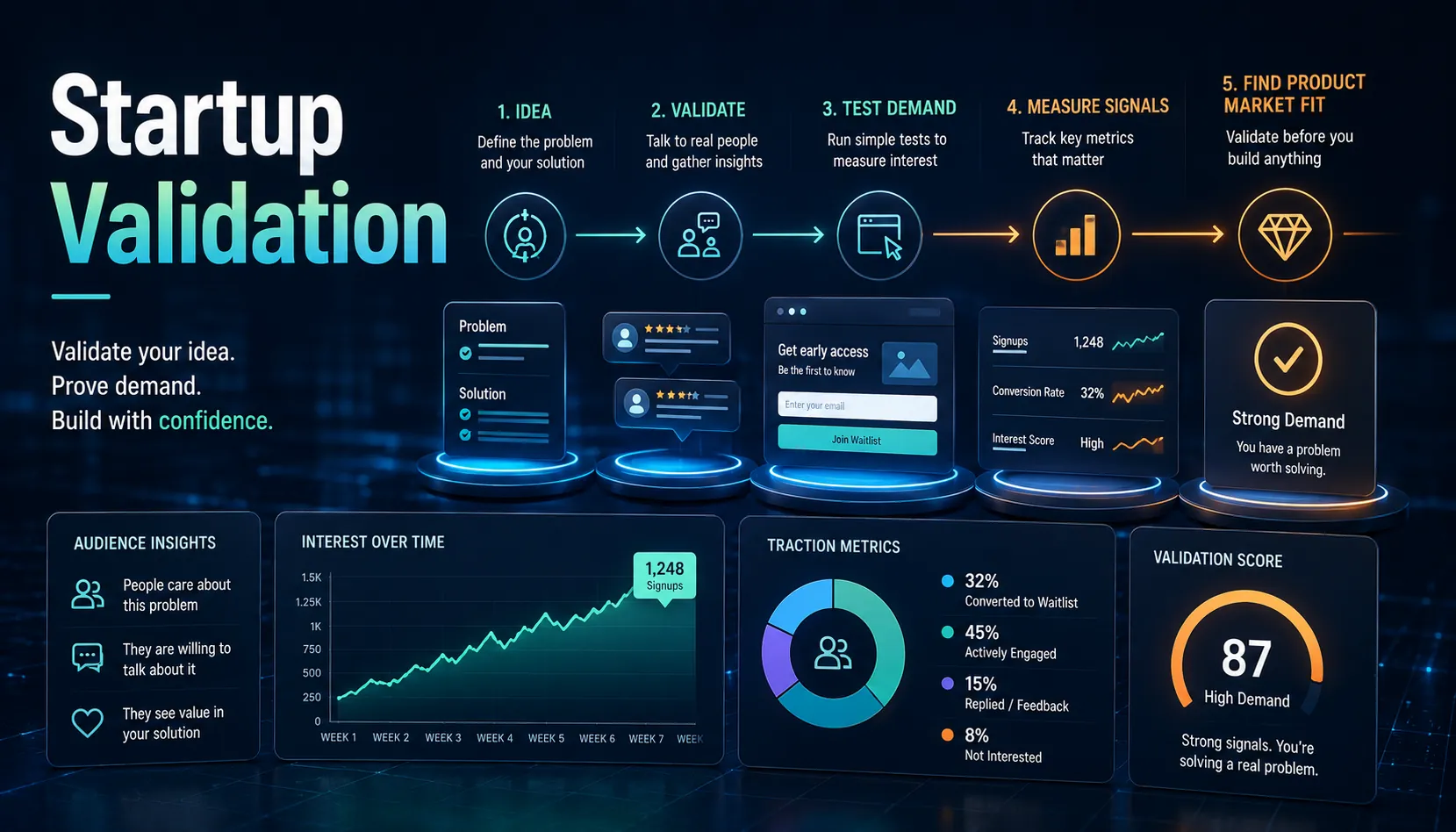
42% of startups fail because they built something nobody wanted. Not because the team was bad. Not because the market was too competitive. Because they built before they checked.
Validation is the process of gathering evidence that your idea solves a real problem for a defined audience who will pay for the solution. In 2026, with free AI tools, open community access, and smoke test platforms, you can validate almost any business idea in one to two weeks without writing a line of code.
Here is the framework that works, in order.
Step 1: Write Your Assumptions Down (Day 1)
Most founders treat their idea as a fact. It is a hypothesis. Write out the specific assumptions your business depends on:
- Who specifically has this problem (not ‘small businesses’, but ‘solo freelance designers who charge under $5,000 per project’)
- How much pain the problem causes (is it a ten-dollar problem or a thousand-dollar problem?)
- Whether they are actively looking for a solution or tolerating the status quo
- What they would pay, roughly, for a solution that worked
Your job in validation is to test these assumptions, not to prove them right. Seek disconfirming evidence. Patterns that show up in three interviews are noise. Patterns that appear in ten or more are signal.
Step 2: Customer Discovery Interviews (Days 1-7)
This is the most important and most skipped validation stage. Talk to potential customers before you build anything. The goal is not to pitch your idea. The goal is to understand their problem.
Aim for 15 to 30 conversations for a meaningful sample. In 2026, AI tools like Apollo or Clay can help build a prospect list in your target segment. Tools like Otter transcribe calls. You can then ask an AI to identify patterns across transcripts. What used to take two weeks takes three days.
The interviews themselves still need to be done by you. The best interview question in customer discovery: ‘Tell me about the last time you experienced this problem.’ Let them describe the situation. Do not describe your solution.
What Good Signals Look Like
- They describe the problem in detail without prompting
- They rate the pain 7 or higher out of 10 when asked
- They have already tried to solve it with a workaround or competing tool
- They ask when your solution will be ready
What Weak Signals Look Like
- They say ‘yes I might use that’ without describing a specific instance of the problem
- They cannot recall a concrete recent example
- They compare the pain to a minor annoyance rather than a meaningful cost
Step 3: Define Your Target Customer More Narrowly
After 8 to 10 interviews, patterns emerge. The people with the strongest pain tend to share specific characteristics. Narrow your initial target to the most acute segment rather than trying to address the broadest possible market.
A narrowly defined target customer produces clearer messaging, more focused conversations, and better conversion from any landing page you build. The most common mistake: targeting ‘anyone who has problem X’ when the people who feel it most are a specific subset.
Step 4: Smoke Test (Days 7-14)
A smoke test is a landing page describing your product as if it already exists, with a call to action measuring genuine interest.
You are not taking money yet (unless you are ready to follow through). You are measuring whether people who match your target customer will take an action: sign up for a waitlist, click ‘learn more’, or enter their email for early access.
Tools: Carrd ($19/year), Notion with a form, or a basic WordPress page with a typeform. Google Analytics or Plausible for traffic tracking. Drive targeted traffic from the communities where your target customer already spends time, Reddit threads, LinkedIn groups, relevant Slack communities, not paid ads yet.
A conversion rate above 10% on waitlist signups from cold traffic is a meaningful positive signal. Below 3% suggests either the messaging is unclear or the pain is not acute enough.
Step 5: Pre-Sell if You Can (Most Powerful Validation)
Someone typing their email into a form is easy. Someone paying $49, $99, or $199 before the product exists is genuinely hard, and genuinely meaningful.
Pre-selling proves willingness to pay rather than willingness to express interest. Use Gumroad, Stripe, or a simple invoice to sell founding member access at a visible discount from the planned full price. Be transparent about the timeline (‘shipping Q3 2026’) and offer a no-questions refund policy.
If three people pre-order at $99, you have $297 in revenue and three motivated beta users. If nobody pre-orders at any price, you have data: rethink the problem, the audience, or the solution before building.
What Validation Is Not
| What Founders Mistake for Validation | What It Actually Is |
| Asking friends and family if they like your idea | They will say yes to spare your feelings; talk to strangers who match your ICP |
| Getting lots of ‘that sounds interesting’ in interviews | Vague enthusiasm is not demand; look for described pain and willingness to pay |
| Building an MVP and then validating | You have already built; now you are not validating, you are hoping. Validate before you build. |
| Survey responses | Good for quantitative patterns but terrible for understanding the depth of pain |
FAQ
How do you validate a startup idea for free?
Customer discovery interviews (free, done on calls), smoke test landing pages (under $20 with Carrd or free with Notion), community research on Reddit and LinkedIn (free), and Google Keyword Planner for search demand (free). The entire validation framework described above costs under $50 and can run in two weeks.
How many customer interviews do you need before building?
15 to 30 for most B2C ideas. 20 to 50 for serious B2B products. Patterns become clear by interview 8 to 10. Anything below 10 interviews is insufficient for confident decision-making. Anything above 30 without a clear pattern suggests the problem is not well-defined.
What is a smoke test for a startup?
A landing page describing your product as if it exists, with a call to action measuring real interest. You are testing whether your target audience responds to your value proposition before you spend time building. A signup rate above 10% from cold targeted traffic is a positive signal.
The strongest startups solve real problems for real customers. WritoryBuzz helps founders and businesses create insightful content that builds credibility, attracts audiences, and supports long-term growth.