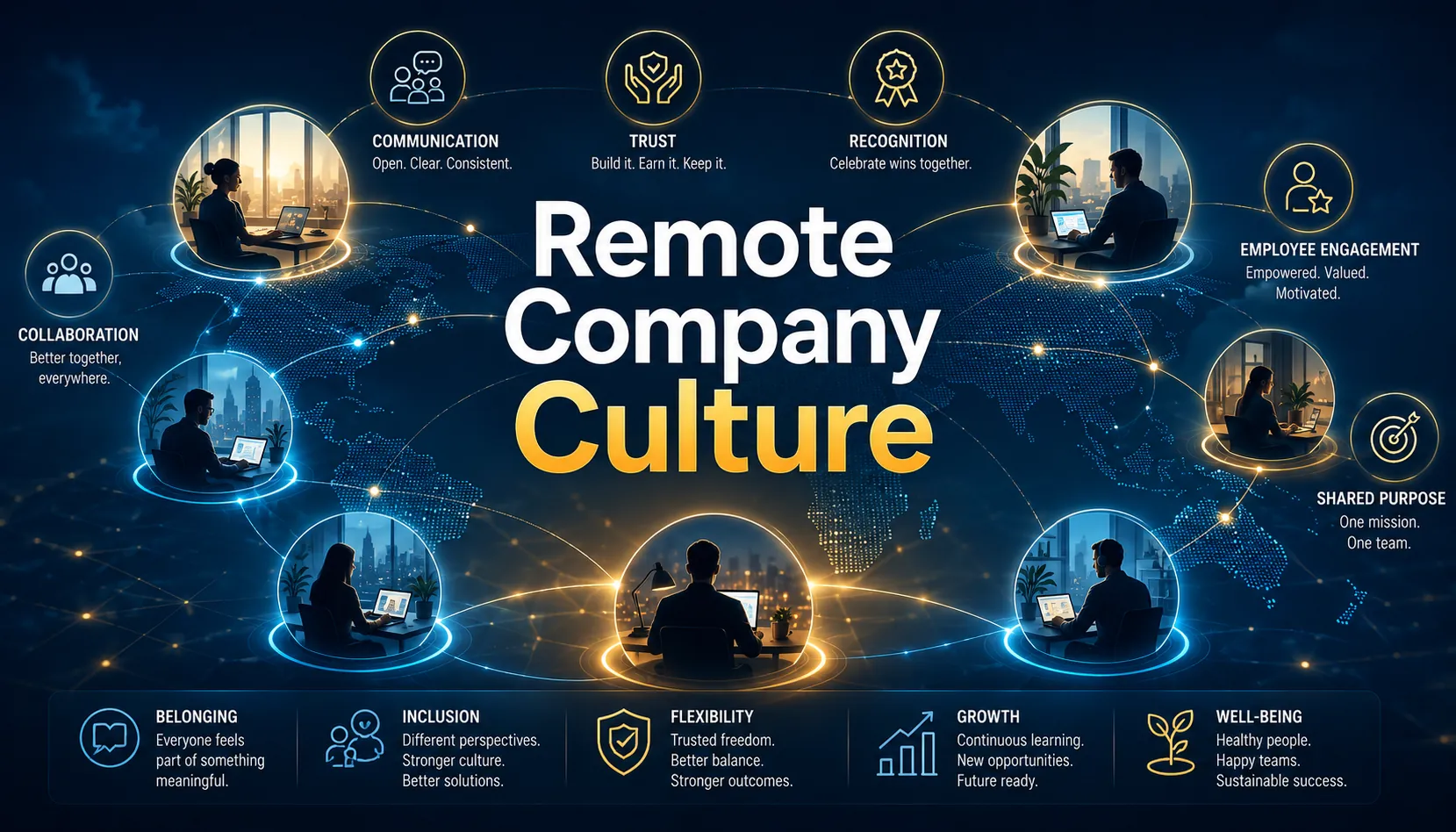
Only 28% of remote employees feel genuinely connected to their company’s mission or purpose.
That number is not a communication problem. It is a culture architecture problem. Engaged remote employees are 87% less likely to quit – but building that engagement when people rarely share physical space requires deliberate design, not accident.
Here is what actually works.
Keyword Research
| Keyword | Monthly Searches | Difficulty | Intent |
| remote company culture 2026 | 8,200 | Medium | Informational |
| how to engage remote employees | 11,500 | Medium | Informational |
| remote team engagement ideas | 9,100 | Low | Informational |
| distributed team culture building | 4,300 | Low | Informational |
| remote employee retention strategies | 6,700 | Medium | Commercial |
Why Remote Culture Breaks Down
Most remote engagement failures trace to one mistake: copying office habits into digital channels.
Weekly all-hands become broadcast sessions where employees mute themselves and catch up on email. Slack channels designed to replace hallway conversation become high-volume noise nobody reads. Culture initiatives launched in January disappear by March.
The solution is not more tools. It is different rituals.
The Foundations of Remote Culture That Sticks
- Async-First Communication
Effective distributed teams in 2026 have moved to async-first communication models that respect different time zones, work styles, and energy patterns. This means:
- Documentation over meetings: Default to written communication that anyone can read on their schedule.
- Fewer real-time requirements: Real-time collaboration is reserved for creative problem-solving, relationship building, and decisions that genuinely need synchronous input.
- Clear async norms: Every team needs a written guide to response time expectations by channel and urgency level.
- Intentional Rituals
Culture in an office happens organically — at the coffee machine, before meetings start, in the elevator. Remote culture requires engineering those moments deliberately.
- Virtual coffee chats: Weekly 15-minute informal video calls between rotating team members. Not about work. Reduces isolation and builds the lateral relationships that make collaboration easier.
- Weekly check-in questions: A simple Slack prompt each Monday asking one non-work question. Teams that do this consistently report higher belonging scores.
- All-hands that spotlight teams outside HQ: Culture moments, not update dumps. Keep them concise, include Q&A, and feature contributions from across the organization.
- Recognition That Reaches Remote Workers
In an office, someone overhears you praise a colleague. That ambient recognition reinforces values constantly. Remote teams need explicit systems.
- Monthly gratitude rounds: Structured shout-out sessions where employees recognize colleagues who went beyond expectations.
- Public recognition channels: A dedicated Slack channel where wins get shared company-wide. The act of sharing reinforces the behavior being recognized.
- Manager-driven specific praise: ‘Good job’ does not land. ‘The way you restructured that proposal helped us close the deal’ lands.
The 30-60-90 Day Remote Onboarding Problem
Disconnected remote employees often trace their disconnection back to a weak onboarding experience. The first 90 days are when culture is either absorbed or rejected.
| Phase | Focus | Key Actions |
| Day 1-30 | Connection and context | Dedicated buddy, intro calls with key team members, culture guide |
| Day 31-60 | Contribution | First project ownership, manager check-ins twice weekly, clear 60-day goals |
| Day 61-90 | Belonging | Cross-team project, feedback on culture, 90-day review with both parties speaking |
Tools That Support Remote Culture (Without Creating Tool Sprawl)
Every new tool is adoption overhead. Pick the minimum that covers the jobs:
| Job to Be Done | Tools Worth Considering |
| Async video communication | Loom, Mmhmm |
| Team recognition | Bonusly, Kudos, Slack’s built-in recognition |
| Virtual team bonding | Donut (Slack), TeamBuilding.com |
| Employee feedback | Lattice, Culture Amp, 15Five |
| Documentation culture | Notion, Confluence, Coda |
What Managers Get Wrong
Most remote culture failures happen at the manager level, not the policy level.
- Micromanagement disguised as check-ins: Sending ‘just checking in’ messages every few hours destroys autonomy. Companies that foster autonomy show higher engagement rates and lower turnover.
- Only communicating about work: Managers who never ask about the person outside their role lose credibility as culture carriers.
- Skipping 1:1s under workload pressure: 1:1s are the primary relationship-building mechanism for remote managers. Canceling them signals that the relationship is optional.
- Inconsistent communication cadence: Predictable routines help remote employees feel connected and clear on priorities. Erratic communication creates ambient anxiety.
Structured Hybrid Models Boost Engagement 20%
For teams that can gather occasionally, structured hybrid models – where in-person time is planned and purposeful, not mandated – show 20% higher engagement than fully remote or fully office-first setups.
The key word is structured. An office mandate without clear reasons creates resentment. In-person sessions designed specifically for the things remote cannot replicate — creative problem-solving, relationship investment, culture onboarding – earn engagement.
Strong culture does not happen by accident—especially in distributed workplaces. WritoryBuzz creates practical business and workplace content that helps leaders build engaged teams, improve communication, and strengthen employee retention.
FAQ
How often should remote teams meet in person?
There is no universal answer, but quarterly team offsites with clear purpose tend to show the highest engagement and retention return. More frequent is not always better if the purpose is not clear.
Can remote culture be as strong as office culture?
Yes – but it takes more intentional design. The advantage of remote culture is that it is explicit. Nothing relies on osmosis. When built well, it can be more consistent across locations than office culture, which varies by floor and manager.
What is the single highest-impact thing a remote manager can do?
Hold and protect weekly 1:1s. The research is consistent: the manager relationship is the strongest predictor of remote employee engagement and retention.