
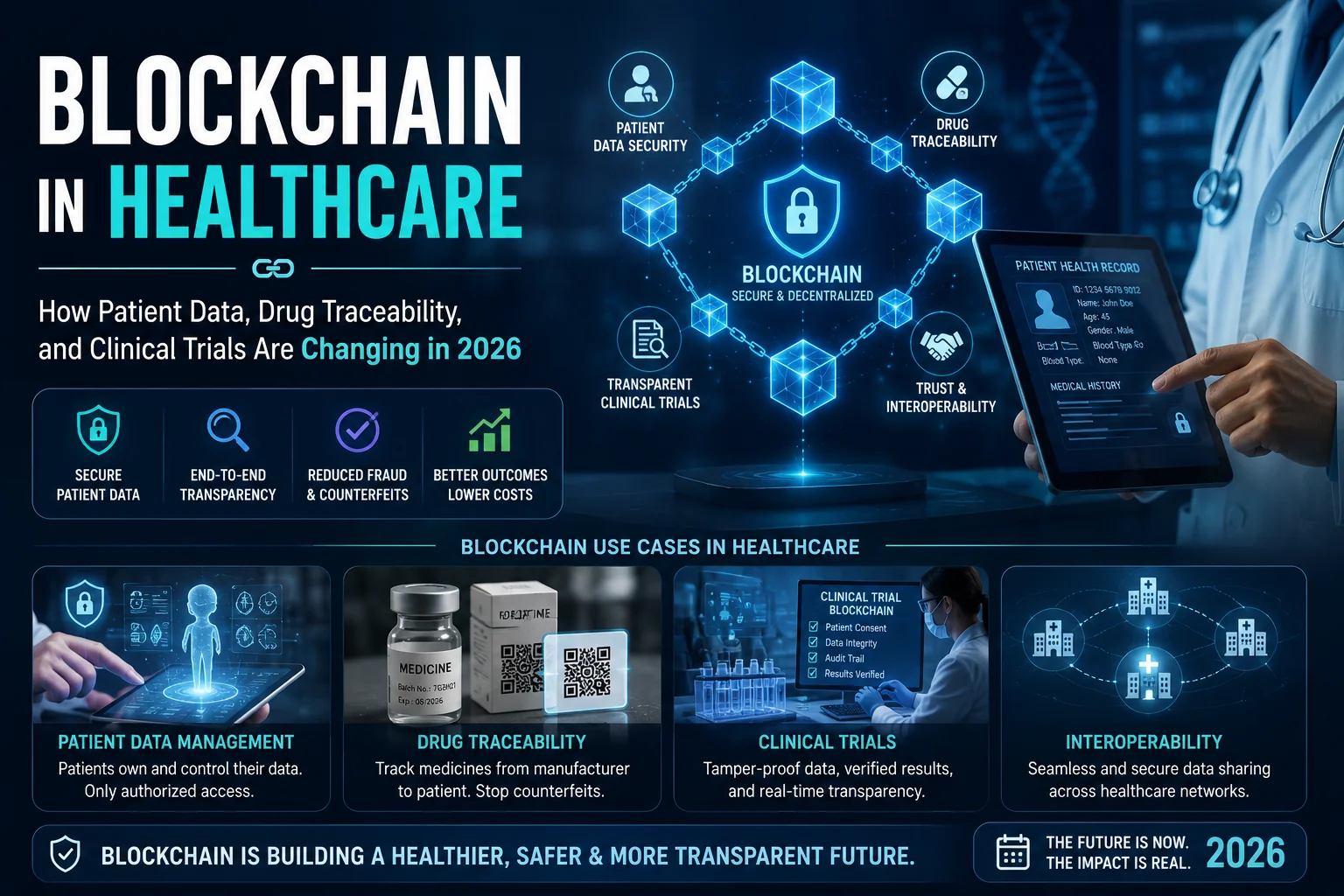
Healthcare data is among the most sensitive information generated in modern society. It is also among the most poorly managed. Patient records fragment across hospitals, pharmacies, and insurance systems. Drug counterfeiting causes hundreds of thousands of deaths each year globally. Clinical trial data gets manipulated in ways that take years to detect.
Blockchain does not solve all of these problems. But it addresses specific, serious gaps in ways that no previous technology has managed. The question is not whether blockchain belongs in healthcare, it is which applications are worth building first.
This piece covers the three highest-impact areas: patient data portability, pharmaceutical supply chain verification, and clinical trial integrity.
The Three Core Problems Blockchain Addresses in Healthcare
| Problem | Current Cost | What Blockchain Changes |
|---|---|---|
| Fragmented patient records | Missed diagnoses, duplicate tests | Unified, permission-controlled record access |
| Drug counterfeiting | $200B lost globally per year | Real-time supply chain tracing |
| Clinical trial fraud | Billions in wasted trials | Immutable audit trails for data |
Patient Data: Who Owns Your Health Records?
The short answer is that most patients do not fully control their own health data. Records live in the systems of whichever hospital or clinic created them. When a patient moves city, switches insurance, or visits a specialist in a different network, records rarely follow cleanly.
Blockchain-based patient data systems give each patient a private key that controls access to their records. A hospital, GP, or specialist receives read access only when the patient explicitly grants it. The patient can revoke that access at any time.
Estonia’s national health record system, built on blockchain infrastructure, has run this model since 2016. Over 99% of Estonian health data is now accessible across the national system, and patients control every access request. The system sees roughly 40,000 blockchain-verified queries daily.
Drug Traceability: Following a Medicine From Factory to Patient
The World Health Organisation estimates that 10% of medicines in low and middle-income countries are either substandard or falsified. In some regions, particularly for antimalarials and antibiotics, the figure runs higher. Counterfeit drugs kill patients directly and generate antibiotic resistance indirectly.
Blockchain-based drug tracing records every step of a medicine’s journey: manufacturer batch, packaging, customs clearance, warehouse storage, pharmacy receipt, and final dispensing. Each step is timestamped and immutable. A pharmacist with a scanner can verify a drug’s complete history in seconds.
The US Drug Supply Chain Security Act mandated electronic tracing by 2023. Several large distributors, including McKesson and Cardinal Health, now run blockchain-adjacent systems to meet compliance. The EU’s Falsified Medicines Directive runs a parallel verification model across member states.
How Drug Blockchain Tracing Works
| Stage | Data Recorded | Who Adds the Record |
|---|---|---|
| Manufacturing | Batch number, expiry, composition | Pharmaceutical manufacturer |
| Export/Customs | Departure, arrival, cold chain data | Logistics and border authority |
| Wholesale | Receipt, storage conditions, dispatch | Distributor |
| Pharmacy | Receipt, dispensing date, patient ID | Pharmacy system |
Clinical Trials: The Integrity Problem
Clinical trial fraud is more common than most people realise. Data manipulation, selective reporting, and protocol deviations that are not disclosed can take years to uncover. By then, flawed drugs may be in widespread use.
The typical problem is that trial protocols and interim results are recorded in systems that can be edited after the fact. A researcher who sees a weak result in an interim analysis can, in some systems, alter the protocol retrospectively to make the final result look preregistered.
Blockchain changes this by timestamping every protocol submission, every data entry, and every amendment. Nothing can be backdated. Independent auditors can see the full chronological record. The Innovative Medicines Initiative in Europe has run several blockchain-verified trial registries since 2022, and early data shows measurably better protocol adherence.
Real Deployments Worth Knowing
MediLedger is a permissioned blockchain network used by major pharmaceutical companies in the US to verify prescription medicine supply chains. As of 2026, it processes millions of verifications monthly across over 40 participating companies.
Health Nexus, a Canadian platform, runs a consent management layer on blockchain for patient data. Patients control their data across multiple healthcare providers through a single wallet-style interface. Several provincial health authorities now integrate with it.
The WHO Vaccine Passport project, piloted across several African Union member states, uses blockchain to verify vaccination records that are tamper-evident and readable across borders without requiring a central server.
Limits of Blockchain in Healthcare
Blockchain secures what goes on the chain, not what goes into it. If a healthcare worker enters incorrect data, that incorrect data is stored immutably. The technology does not solve data quality problems at the point of entry.
Interoperability remains fragmented. Different blockchains, from Hyperledger Fabric to Ethereum-based systems, do not naturally communicate. A patient whose records sit on one national blockchain cannot easily share them with a hospital on a different network.
Regulatory clarity is still developing. What counts as consent under GDPR when a record is immutable? Can a patient exercise their right to be forgotten when their data is on a permanent ledger? These legal questions have partial answers in some jurisdictions and none in others.
FAQs
Is blockchain the same as a national health record system?
No. A national health record system is a centralised database managed by a government or authority. Blockchain is a distributed ledger where no single party controls the data. Some national systems use blockchain as their underlying technology, but most centralised health record systems do not.
Can hospitals access my blockchain health record without my consent?
In a properly designed patient-controlled blockchain system, no. Access requires your private key or an explicit grant you make. Emergency access protocols exist in some systems for unconscious patients, but these are designed with consent withdrawal built in.
Which blockchain platforms are used in healthcare?
Hyperledger Fabric is the most common enterprise healthcare blockchain platform because it is permissioned, meaning access is controlled, unlike public blockchains. IBM, SAP, and Oracle all offer Hyperledger-based healthcare modules.
Where Healthcare Blockchain Goes Next
The next three years will likely see convergence between AI health diagnostic systems and blockchain record systems. AI needs clean, verified data to work well. Blockchain provides the verification layer. The combination could give clinicians genuinely reliable data for AI-assisted diagnosis for the first time.
Real-time insurance claims processing is also close. Several insurers in Singapore and Germany are piloting blockchain-connected claims systems where a verified hospital record triggers an automatic claim payment, cutting processing time from weeks to hours.
Stay updated on how blockchain is reshaping healthcare systems and data infrastructure at WritoryBuzz, where we track these developments as they move from pilot to production.