Most early-stage SaaS companies do not have a sales process. They have a collection of individual founder-led deals where success depends on the founder’s personal network, instincts, and energy. That works until it does not, typically when the founder needs to hire a first sales person and cannot explain what they actually do to close deals.
Building a repeatable sales process is the transition from founder-dependent growth to scalable growth. It is also one of the most underestimated operational challenges in early SaaS, because the process that closes deals for a founder selling to their own network rarely transfers directly to a sales hire who lacks those relationships.
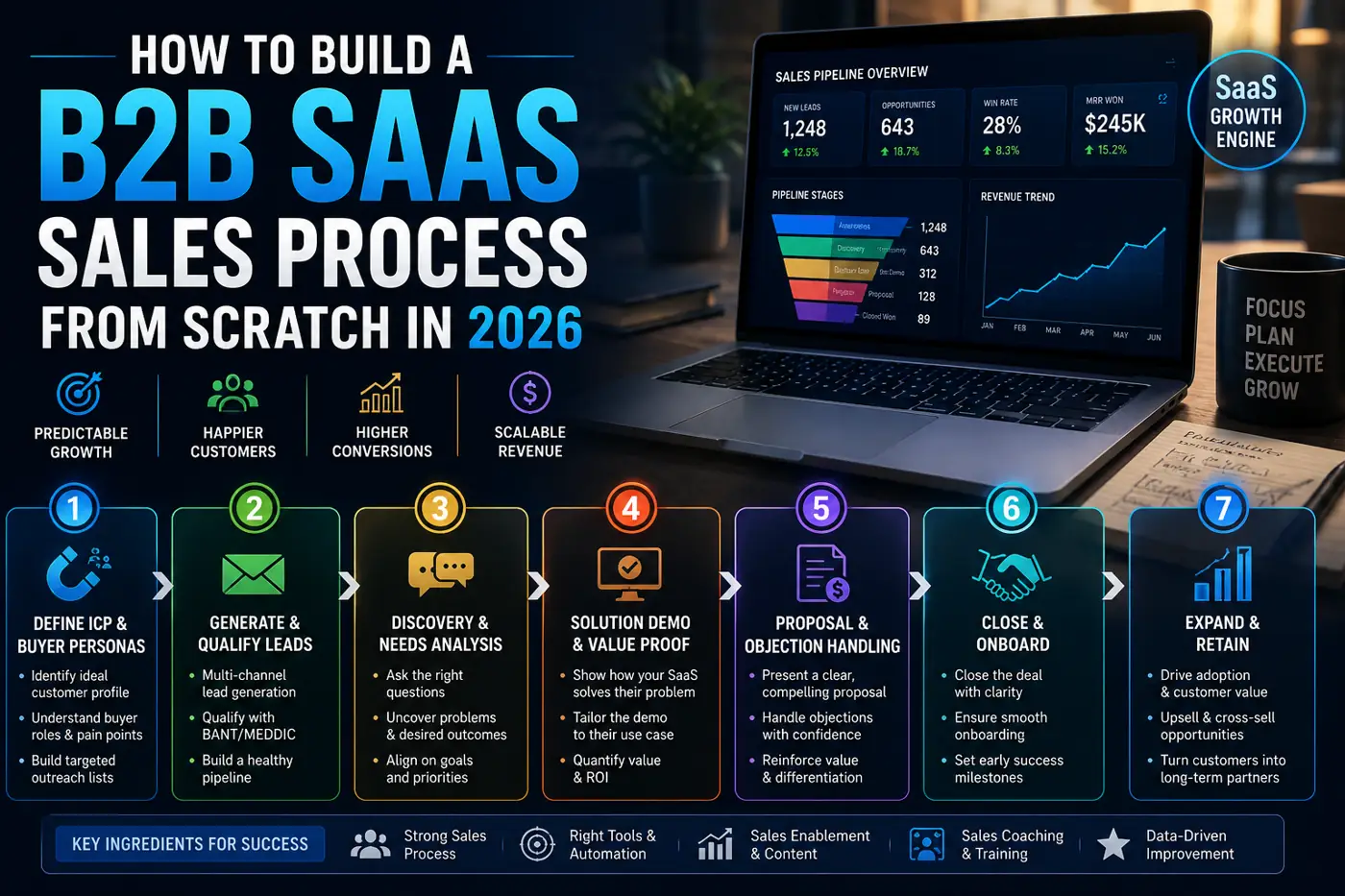
This guide builds the process from the ground up: starting with who you are selling to, through the specific stages and activities that move a deal, to the metrics that tell you whether the process is working.
Step 1: Define Your Ideal Customer Profile With Precision
An Ideal Customer Profile (ICP) is not a persona. It is a description of the specific type of organisation that gets the most value from your product, buys reliably, and stays. A good ICP includes firmographic criteria (company size, industry, geography, tech stack), situational criteria (the specific circumstances that make a company a buyer right now), and exclusion criteria (the profile of organisations that look like buyers but are not).
The exclusion criteria are as important as the inclusion criteria. Companies that are too small to afford the implementation work your product requires, too large to make decisions without a procurement process your sales cycle cannot support, or in industries where your specific use case does not apply clearly: all of these should be defined and removed from your target list.
Your first ICP should be built from your existing customers. Who among your current customers is happiest, gets the most value, expands their contract, and refers others? Find the common characteristics of that group. That is your ICP.
Step 2: Choose Your Sales Motion
| Motion | How It Works | Best For | CAC Profile |
|---|---|---|---|
| Inbound-led | Marketing generates leads; sales qualifies and closes | Strong content/brand, clear buyer journey | Lower CAC, longer build time |
| Outbound-led | Sales team proactively identifies and contacts ICP | Clear ICP, specific use case, no established brand | Higher CAC, faster pipeline build |
| Product-led growth (PLG) | Free trial or freemium converts users to paying | Broad user appeal, short time-to-value | Lowest CAC, requires product investment |
| Partner-led | Resellers, integrations, or ecosystem partners drive deals | Platform dependency, ecosystem network effects | Variable, depends on partner quality |
Most B2B SaaS companies run a combination of motions, but the dominant motion should be chosen based on ACV (Annual Contract Value). Deals below $5,000 ACV generally require PLG or a pure inbound motion because the economics of a sales team cannot support the cost of human-led acquisition at that deal size. Deals above $25,000 ACV typically require outbound or a direct sales motion because buyers at that level need a human to navigate the purchase.
Step 3: Design the Sales Stages
A sales stage represents a meaningful change in deal status based on buyer action, not seller activity. A stage is completed when the buyer has done something, not when you have sent an email. This distinction prevents pipeline inflation, where deals are advanced through stages based on optimism rather than evidence.
The Six Standard B2B SaaS Stages
Stage 1: Qualified. The prospect matches your ICP criteria and has acknowledged a problem your product solves. Entry criterion: ICP match confirmed plus initial interest expressed.
Stage 2: Discovery complete. You understand the prospect’s specific problem, the business impact of not solving it, the decision-making process, and the timeline. Entry criterion: discovery call completed and documented.
Stage 3: Technical validation. The prospect has seen a relevant demo or run a trial and confirmed the product can solve their specific problem. Entry criterion: demo or trial feedback received.
Stage 4: Champion confirmed. An internal advocate who will drive the purchase decision has been identified and is actively supporting the deal. Entry criterion: champion has taken a specific action to advance the deal internally.
Stage 5: Commercial agreement. Pricing has been discussed, objections addressed, and a proposal has been sent. Entry criterion: proposal sent and acknowledged.
Stage 6: Closed/Won or Closed/Lost. Contract signed or deal officially lost with reason documented.
Step 4: The Discovery Call
Discovery is the most important conversation in the B2B SaaS sales process. Most salespeople treat it as qualification. The best salespeople treat it as both qualification and value creation: a conversation that helps the prospect understand their own problem more clearly than before the call.
The MEDDIC framework (Metrics, Economic Buyer, Decision Criteria, Decision Process, Identify Pain, Champion) is the most widely used discovery structure in enterprise B2B SaaS. It ensures you gather the information required to navigate a complex buying process without relying on the champion to do all the internal work for you.
The question that most salespeople skip: what happens if you do nothing? If the prospect cannot articulate the cost of not solving the problem, the deal lacks urgency. Urgency is not manufactured; it is uncovered by helping the prospect quantify the impact of the status quo.
Step 5: The Demo That Advances Deals
A demo that shows every feature of the product is not a sales demo. It is a product tour. Sales demos show specifically how the product solves the problems identified in discovery, in the order of the prospect’s stated priorities, using scenarios that reflect their actual use case.
The preparation for a strong demo takes as long as the demo itself. Map each discovery finding to a specific product capability. Build a demo environment with data that reflects the prospect’s industry. Prepare for the three most likely objections that emerge from what you learned in discovery.
End every demo with a question: based on what you have seen today, does this solve the problem you described? A yes advances the deal. A no or a partial yes is discovery that should have happened earlier, but is better surfaced now than at the proposal stage.
Step 6: Proposal and Negotiation
The proposal should not introduce anything new. Every element of the commercial offer should have been discussed informally before a formal proposal is sent. A prospect who sees pricing for the first time in a proposal has not been properly prepared, and the deal is likely to stall while they process the number without context.
Three-tier pricing structures, good/better/best or named tiers, anchor the buyer’s consideration in the middle option and reduce the likelihood of a race to the cheapest available option. Presenting only one price gives the buyer a yes/no decision; presenting three gives them a choice that keeps more deals alive.
The most common negotiation dynamic in B2B SaaS is the request for discount in exchange for faster close. Accept this trade-off when the discount is tied to a specific signature date in the proposal. Decline discounts that are not attached to a commitment, as they simply lower the price without accelerating the deal.
The Metrics That Tell You If the Process Works
| Metric | What It Measures | Warning Signal |
|---|---|---|
| Stage conversion rates | % of deals advancing from each stage to next | Any stage below 50% conversion needs investigation |
| Average sales cycle length | Days from Qualified to Closed/Won | Lengthening cycle suggests later-stage friction |
| Win rate vs ICP | % of ICP-matched deals won | Below 25% suggests positioning or product-market fit problem |
| Pipeline coverage ratio | Total pipeline value / Revenue target | Below 3x suggests insufficient top-of-funnel |
| Average deal size | Mean ACV of closed/won deals | Significant variance suggests ICP is too broad |
FAQs
When should a founder stop doing sales and hire a salesperson?
When the founder can document the sales process clearly enough that a new person could follow it, when there are enough inbound leads or outbound targets to keep a full-time salesperson busy, and when the founder’s time is more valuable in other functions. Hiring a salesperson before the process is documented produces a salesperson who cannot replicate the founder’s results and a founder who blames the salesperson rather than the absence of a repeatable process.
How do you handle multi-stakeholder B2B deals?
Multi-stakeholder deals require a champion who is willing to navigate the internal process on your behalf. Identify the champion early, equip them with the business case materials, competitor comparisons, and ROI calculations they need to make the internal case, and maintain regular contact throughout the internal review period. Deals that go silent at the champion stage typically mean the champion is not actually championing internally.
Should early-stage SaaS companies use a CRM?
Yes, from the first sales conversation. The discipline of documenting deals, recording discovery findings, and tracking stage advancement is as important as the software. HubSpot offers a free CRM that is sufficient for most companies until they reach 20 to 50 active deals simultaneously. Salesforce is appropriate for more complex multi-stage, multi-stakeholder processes.
Building the Process in Practice
Start with your last ten closed deals. Write down what happened at each stage, what the buyer did to advance each stage, and what you did that worked. Find the pattern. The repeatable process is already implicit in your best deals; the work is making it explicit enough to train and evaluate others on.
Run a new sales hire through the documented process for their first three months, reviewing every stage entry decision together. This builds their judgment and validates whether the criteria are working as designed or need adjustment based on real deal experience.
For B2B sales strategy, SaaS go-to-market resources, and revenue operations guidance throughout 2026, WritoryBuzz covers the full range of early and growth-stage commercial challenges.