
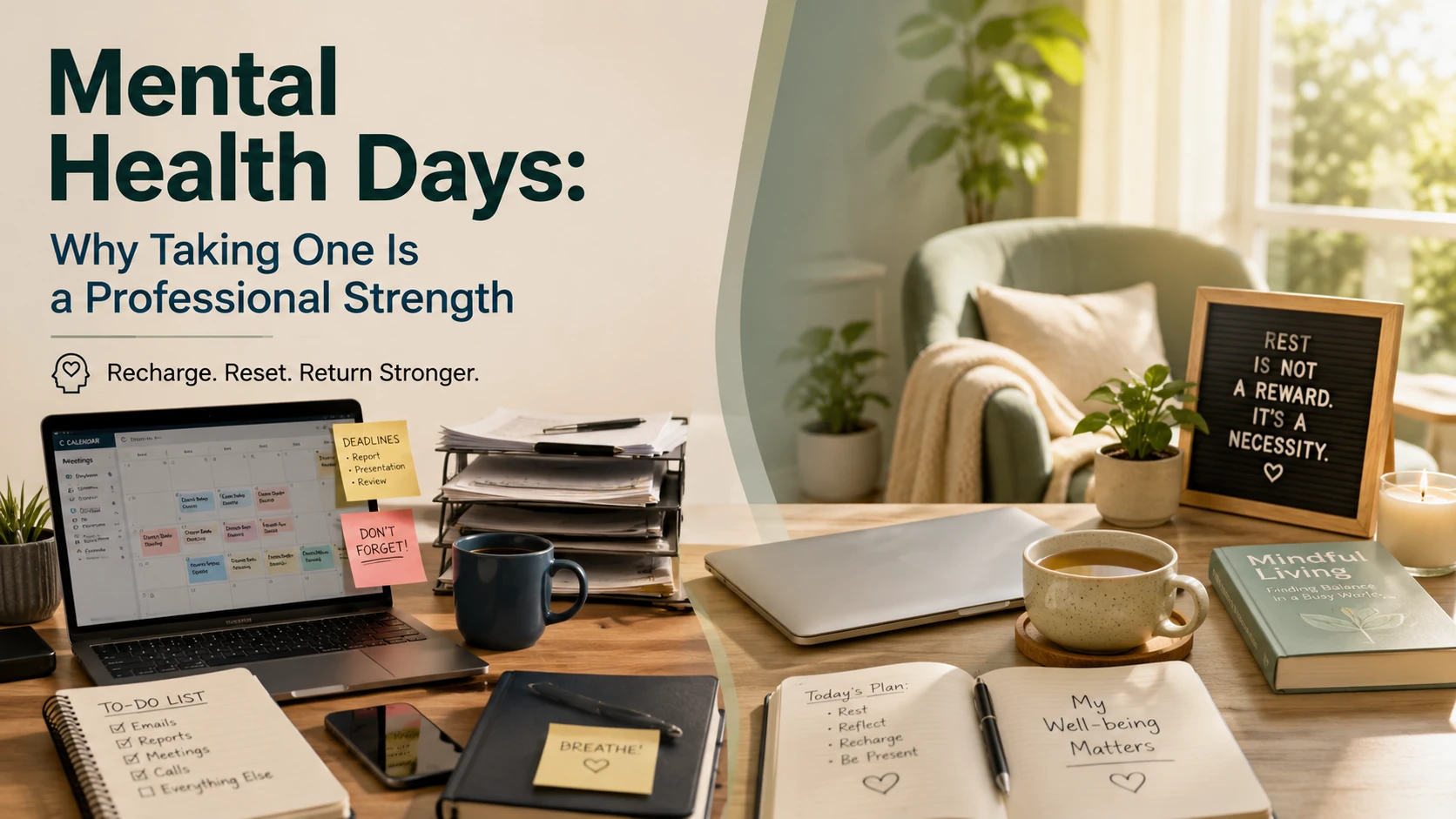
Presenteeism, working while mentally unfit, costs organisations 6 to 10 times more than absenteeism. A worker struggling with burnout who pushes through produces lower quality work, makes more errors, and takes longer to recover than one who takes a day to reset. The research on this is consistent and the logic is straightforward.
A mental health day is a day taken deliberately to address psychological wellbeing before it deteriorates further. It is distinct from sick leave, though it belongs in the same category of necessary health maintenance. The cultural reluctance to take mental health days, more pronounced than the reluctance to take a sick day for a physical illness, reflects a persistent and unhelpful distinction between mental and physical health.
The evidence increasingly supports treating mental health days as preventive care rather than indulgence. Here is what that evidence actually says.
The Business Case: What Presenteeism Actually Costs
Presenteeism refers to being physically present at work while cognitively or emotionally impaired. The Centre for Mental Health in the UK estimates that presenteeism costs UK employers approximately 15 billion pounds annually. The American Institute of Stress estimates the annual cost of workplace stress in the US at 300 billion dollars, including healthcare costs and lost productivity.
The reason presenteeism is so expensive is that mental impairment from stress, anxiety, depression, or burnout affects precisely the capacities most valued in knowledge workers: decision quality, creative problem-solving, communication, and sustained focus. A physically present but mentally exhausted worker does not deliver 70 percent output. Research suggests cognitive performance under significant stress or fatigue declines non-linearly, with the most complex tasks degrading first and fastest.
What Happens in Your Body When You Are Chronically Stressed
The physiological case for mental health days is straightforward. Chronic stress maintains elevated cortisol levels, which impair the prefrontal cortex (responsible for decision-making and complex reasoning), disrupt sleep quality, suppress immune function, and increase inflammatory markers associated with long-term disease risk.
A day of genuine psychological rest, whether through low-stimulation activity, time in nature, social connection with supportive people, or simply absence of work-related demands, allows the HPA axis (the body’s stress response system) to return toward baseline. This is not a luxury. It is how the system is designed to function.
Who Benefits Most From Mental Health Days
High-responsibility knowledge workers: People making consequential decisions regularly are most susceptible to decision fatigue and least able to compensate for it through low-effort tasks. The executive, the clinician, the teacher, the carer, and the engineer all benefit disproportionately from deliberate rest.
People in early burnout: Burnout progresses through recognisable stages. Taking a mental health day in the early-exhaustion phase is considerably more effective than attempting to address full burnout syndrome, which typically requires weeks rather than a day.
People whose output quality has visibly declined: A temporary drop in work quality, concentration, or motivation that appears alongside stress symptoms is a clear signal that restoration, not further pressure, is the appropriate response.
How to Actually Take a Mental Health Day (Not Just a Bad Day)
A mental health day that is spent anxiously monitoring email, feeling guilty about colleagues, or simply relocating your stress to a different environment delivers limited benefit. The purpose is genuine restoration, which requires actually disengaging from work demands.
The night before: Set an out-of-office. Inform your manager if your workplace culture requires it. Do this without excessive explanation. ‘I am not well and will be out tomorrow’ is sufficient.
During the day: Do not check work email or messaging. This single decision determines whether the day functions as restoration or simply relocated anxiety. Spend time in activities that genuinely reduce cortisol: physical movement in nature, social connection with people outside work, activities requiring gentle focus (cooking, gardening, craft), or genuine rest.
After: Return with the expectation that the work waited, not that you need to make up for absence. A well-taken mental health day should produce measurably better cognitive function the following day.
Talking to Your Employer: How to Frame It
In most jurisdictions, mental health is covered under the same sick leave provisions as physical illness. You are not typically required to disclose a specific diagnosis to take a sick day. ‘I am unwell and need to take a sick day’ is complete.
For workplaces that have normalised open discussion of mental health, being more specific is fine. The framing that tends to land best in professional contexts: ‘I have noticed my stress levels are affecting my focus and decision quality. I am going to take a day to recover properly rather than pushing through and producing subpar work.’ This frames the mental health day as a professional decision, not a personal indulgence.
The research on psychological safety in workplaces where leaders model taking mental health days is consistent: employees in those environments take leave earlier in the stress cycle and return to full productivity faster. Leadership behaviour on this question is the single most powerful signal an organisation can send.
When a Day Is Not Enough
Mental health days are appropriate for manageable, temporary stress responses. They are not a substitute for professional support when symptoms are persistent, severe, or significantly impairing daily function. Depression, anxiety disorders, burnout syndrome, and trauma require professional treatment, not just rest.
If symptoms persist beyond two to three weeks despite rest and self-care, or if they are interfering significantly with daily life, consulting a GP or mental health professional is the appropriate next step.
What is a mental health day and when should you take one?
A mental health day is a day taken deliberately to address psychological wellbeing before it deteriorates further. It is appropriate when stress, exhaustion, or emotional depletion is noticeably affecting your cognitive function, mood, or work quality. Taking one early in a stress cycle prevents the more severe and longer recovery required by burnout.
Is taking a mental health day professional or unprofessional?
Professional. A worker who recognises impairment and takes appropriate corrective action is making a sound professional decision. Presenteeism (working while mentally impaired) costs organisations significantly more than a day of absence and produces lower quality output. Taking a mental health day before performance suffers is the more responsible professional choice.
How do you tell your employer you need a mental health day?
In most jurisdictions, you can say ‘I am unwell and need to take a sick day’ without specifying a mental health reason. For workplaces with open culture around mental health, framing it as a professional decision works well: ‘My stress levels are affecting my focus and I am going to take a day to recover properly.’
What should you do on a mental health day?
Genuinely disengage from work including email and messaging. Engage in activities that reduce cortisol: movement in nature, social connection with supportive people, gentle-focus activities, or genuine rest. Avoid passive high-stimulation activities like doom-scrolling that maintain stress activation rather than reducing it.
How often should you take a mental health day?
There is no prescribed frequency. They are most useful as a deliberate intervention when stress or exhaustion is building and proactively addressed before reaching unsustainable levels. Most workplace cultures support one to two mental health days per quarter for people experiencing above-baseline stress. Sustainable workload management is the goal, not periodic emergency recovery.
What is the difference between a mental health day and burnout?
A mental health day addresses manageable, temporary stress and provides meaningful restoration in one to two days. Burnout syndrome is a chronic state of emotional exhaustion, depersonalisation, and reduced professional efficacy that typically requires weeks of reduced workload, professional support, and sustained lifestyle changes to recover from. Mental health days are most effective as prevention; they are insufficient treatment for established burnout.
The Highest Performers Protect Their Recovery
The most consistent finding across performance psychology research is that sustainable high performance requires deliberate recovery built into the system. Athletes periodise training and rest. High-performing executives manage their schedule around energy rather than just time. The mental health day is not a retreat from performance. It is part of the performance architecture.