
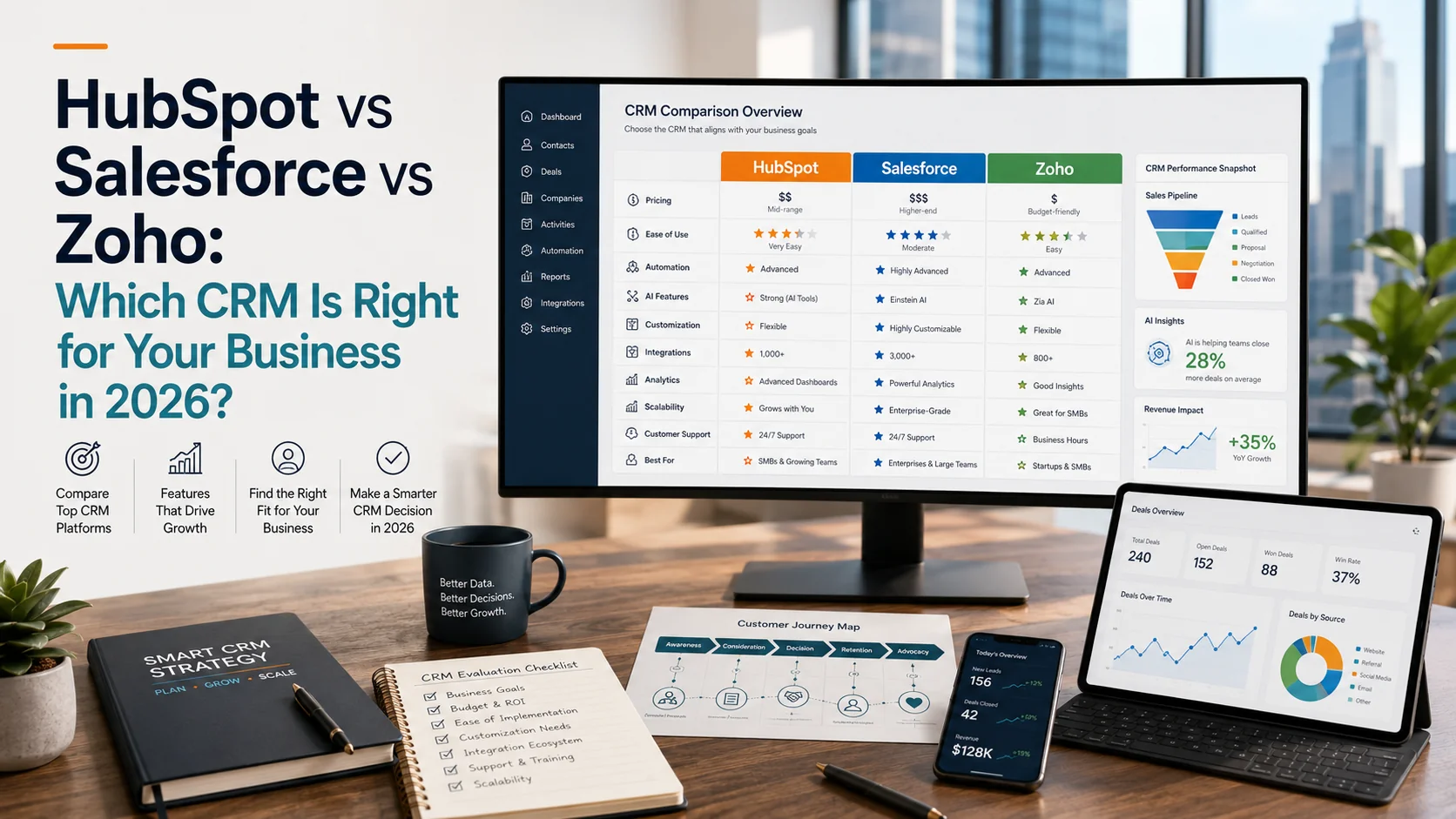
With over 800 CRM products available in 2026, the three dominant options for most businesses remain HubSpot, Salesforce, and Zoho. They serve fundamentally different use cases. Choosing based on brand name or sales demos rather than genuine fit is one of the most expensive software decisions small and mid-size businesses make.
The 30-second honest verdict: HubSpot for under-50-person companies prioritising marketing and inbound sales. Salesforce for 200-plus user organisations with complex, multi-territory deal cycles and the budget and internal resources to run it properly. Zoho for 5-to-50 person companies that want robust automation and customisation at a fraction of the cost.
The nuance behind that verdict is what determines whether you get value from the tool you choose.
HubSpot: The Inbound Marketing CRM
HubSpot was built to serve inbound marketing-led sales: attract prospects through content, convert them through the website, nurture them through email, and close them through a simple pipeline. If this describes your sales motion, HubSpot’s integrated approach produces the smoothest path from marketing activity to closed deal.
Strengths: The free CRM is genuinely capable and used profitably by many small businesses for years. The user interface is the cleanest and most intuitive of the three. Marketing, sales, and service tools integrate natively rather than requiring third-party connections.
The pricing cliff: HubSpot’s pricing is the most important limitation to understand before committing. The Starter plan ($20/user/month) lacks the automation depth most businesses need. Professional ($800/month flat for Marketing Hub) is where serious automation becomes available. The jump from Starter to Professional is the largest pricing discontinuity in CRM software and catches many businesses by surprise after the free tier becomes insufficient.
Best for: Content-driven B2B companies, marketing agencies, SaaS businesses, and any organisation where the marketing and sales funnel need to work as an integrated system.
Salesforce: The Enterprise Standard
Salesforce is the market leader by enterprise CRM share for reasons that are legitimate at the right scale. It handles complex sales hierarchies, multi-territory operations, advanced forecasting, custom object modelling, and integrations with virtually any enterprise software through an ecosystem of 3,000-plus apps.
Strengths: Depth of customisation that no other CRM matches. The talent market for Salesforce administrators and developers is larger than for any other CRM. At enterprise scale, the platform’s configurability handles use cases that other CRMs cannot.
The true cost reality: Salesforce always costs more than the listed price. The Salesforce Starter suite begins at $25/user/month but the Sales Cloud Professional plan required for most standard sales operations runs $75/user/month. Add-ons, implementation consultants (typically $150 to $300/hour), and ongoing admin costs frequently double or triple the licence fee. The $40,000 to $50,000 annual cost for 20 seats is a realistic all-in figure for most mid-market Salesforce deployments.
Requirement for success: A dedicated Salesforce administrator or implementation partner. Salesforce without adequate admin resources consistently underperforms, and the investment in licences without investment in configuration produces expensive underutilised software.
Best for: Companies with 200-plus users, complex multi-team or multi-territory sales, significant customisation requirements, and either an in-house Salesforce admin or budget for ongoing external support.
Zoho CRM: The Best Value in the Market
Zoho CRM is consistently underestimated. It was built to be the affordable, feature-rich alternative to Salesforce, and it succeeds at that positioning in 2026. For businesses that have outgrown basic contact management but cannot justify enterprise pricing, Zoho delivers the most automation and customisation per dollar of any major CRM.
Pricing: Zoho CRM Professional at $23/user/month includes workflow automation, inventory management, scoring rules, and custom reports. The features at this price point cost $75-plus per user per month on Salesforce. The Zoho One bundle at $45/user/month adds 45-plus apps including email, project management, finance, and HR, which is difficult to match on value for small-to-mid businesses.
Zia AI: Zoho’s AI assistant provides lead scoring, email sentiment analysis, and anomaly detection. These AI features are available at price points significantly below competitors.
Limitations: Less polished interface than HubSpot. Fewer enterprise-level integrations than Salesforce. Finding Zoho-specialist developers for custom work is harder than finding Salesforce talent. Support quality is inconsistent according to customer reviews.
Best for: Companies under $10M revenue, small sales teams of under 15 reps, businesses wanting robust automation at accessible cost, and organisations heavily using other Zoho apps where the ecosystem value is high.
| Criteria | HubSpot | Salesforce | Zoho CRM |
| Starting price (useful tier) | $800/mo (Marketing Pro) | $75/user/mo (Sales Pro) | $23/user/mo (Professional) |
| Free tier | Yes (capable) | No (trial only) | Free for 3 users |
| Ease of use | Best in class | Complex | Moderate |
| Admin requirement | Low | High | Moderate |
| Marketing integration | Native, excellent | Requires Marketing Cloud | Good via Zoho ecosystem |
| Best company size | 1-200 employees | 200+ employees | 5-100 employees |
| Implementation time | Days to weeks | Weeks to months | Days to weeks |
| The Hidden Cost Nobody Mentions
The largest CRM cost for most businesses is not licences. It is data migration, staff training, adoption time, and ongoing administration. A $50/user/month CRM that your team actually uses produces far more value than a $25/user/month CRM that is poorly configured and avoided. Factor in realistic implementation and adoption costs, not just the monthly licence fee, when comparing options. |
Which CRM is best for small businesses in 2026?
HubSpot’s free CRM is the easiest starting point for very small teams. Zoho CRM Professional at $23/user/month provides the best feature-to-cost ratio for growing small businesses that need automation and customisation. HubSpot becomes more compelling once marketing automation is a priority and the budget for Professional tier exists.
Is Salesforce worth the cost for mid-sized companies?
For companies with complex multi-team sales processes, 50-plus users, and dedicated admin resources, Salesforce delivers strong ROI. For companies without a dedicated Salesforce admin, the platform consistently underperforms because it requires significant configuration to function well. HubSpot or Zoho cover 80 percent of the same functionality at a fraction of the total cost of ownership for most mid-sized companies.
What is the real cost of HubSpot?
HubSpot’s free CRM is genuinely free and capable. The significant cost jump occurs at Marketing Hub Professional ($800/month flat fee, not per user) required for serious marketing automation. Sales Hub Professional adds $90/user/month. The total cost for a 10-person sales and marketing team with full automation capability can exceed $2,000/month.
Can you switch from Salesforce to HubSpot or Zoho?
Yes, and many companies do. Salesforce to HubSpot migration has a dedicated industry of consultants. The main migration challenge is custom object data and complex workflow logic that does not have direct equivalents in the target platform. Plan for 4 to 12 weeks of migration and testing time depending on data volume and customisation complexity.
What is the Zoho One bundle and is it worth it?
Zoho One at $45/user/month provides access to 45-plus Zoho applications including CRM, email marketing, project management, invoicing, HR, and helpdesk tools. For businesses currently paying for several separate SaaS tools covering these functions, the bundle provides exceptional value. It is most worth it for businesses that will genuinely use at least 4 to 5 of the included applications.
What CRM do startups typically use?
HubSpot’s free CRM is the most common starting point for startups due to zero cost and ease of use. Many startups stay with HubSpot through their first 50 employees, migrating to Salesforce only when complexity and scale genuinely requires it. Zoho is increasingly chosen by startups that need automation capabilities earlier and want to avoid HubSpot’s sharp pricing step-up.
Choose Based on Today’s Real Needs, Not Future Aspirations
The most common CRM mistake is selecting for a future scale that may or may not materialise, rather than for the team and processes that exist today. A Salesforce implementation at 10 employees in anticipation of 200-employee operations produces expensive complexity that impedes rather than enables growth.
Start with what your current team will actually use. Migrate when genuine complexity demands it. The best CRM is the one your team uses consistently.