
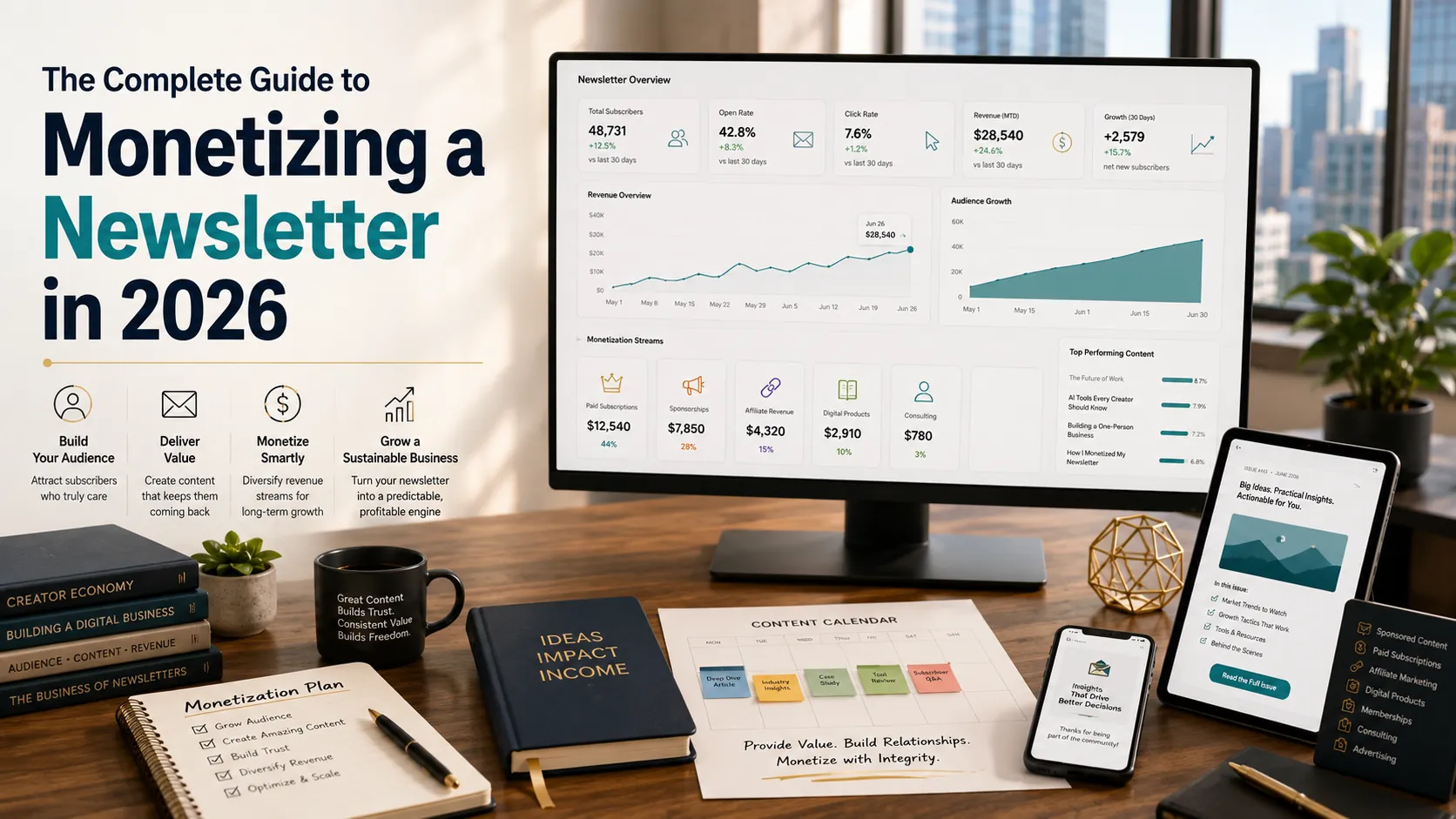
The total addressable market for newsletter monetization exceeded $2 billion annually in 2026. Substack alone reported $300 million in annual subscription revenue flowing to creators. Creators with 1,000 engaged subscribers are earning $200 to $500 per month from newsletter advertising. This is not a future opportunity. It is a current one.
Newsletter monetization in 2026 works best as a stack of two to three revenue streams rather than a single model. The highest-earning newsletters combine owned revenue (subscriptions, products) with advertising income (sponsorships, affiliate commissions), producing resilience that single-stream newsletters lack.
This guide covers the four primary monetization models, the subscriber thresholds at which each becomes viable, and the platform landscape for 2026.
Model 1: Paid Subscriptions
The most direct monetization model: some or all content sits behind a paywall, and readers pay monthly or annually to access it. Substack takes 10 percent of subscription revenue. Beehiiv and Kit charge platform fees rather than revenue cuts, which becomes more favourable at higher revenue.
Pricing: Typically $7 to $15 per month or $75 to $175 per year. Annual plans are more economical for readers and reduce churn, but some readers prefer the lower commitment of monthly.
Conversion rates: A realistic conversion rate from free to paid subscribers is 3 to 10 percent for newsletters with genuine audience trust. At 1,000 free subscribers and 5 percent conversion, you have 50 paid subscribers. At $10 per month, that is $500 monthly before platform fees.
The hybrid approach: The most common and most effective structure is free content published two to three times per week with paid content once per week and paywalled archives. This provides enough free value to grow the list while giving paid subscribers genuinely differentiated access.
When it works: Paid subscriptions work best when the newsletter provides information, analysis, or entertainment that readers cannot get elsewhere and are willing to pay specifically for. Niche expertise newsletters (specific investment strategies, deep industry analysis, specialist creative writing) convert significantly better than general interest newsletters.
Model 2: Sponsorships
Sponsorships pay a flat rate for an advertisement placement in one or more newsletter issues. They are the most scalable monetization model because revenue grows with list size without requiring more subscriber conversions.
Pricing calculation: Use CPM (cost per mille, cost per 1,000 impressions). Effective impressions are typically calculated as total subscribers multiplied by open rate. At 8,000 subscribers with a 42 percent open rate and a $40 CPM, one sponsored placement generates $134. B2B newsletters command $50 to $150 CPM for premium audiences.
When sponsorships become viable: Sponsorships work at lower subscriber counts if your audience is highly targeted and valuable to specific advertisers. A 1,500-subscriber newsletter for software engineers can command more per placement than a 15,000-subscriber general consumer newsletter. Viability starts around 1,000 to 2,500 subscribers for most niches.
Platforms: Beehiiv’s ad network, Paved, and Swapstack connect newsletters with relevant advertisers without cold outreach. Direct sponsorships (negotiated directly with brands) command higher rates but require more sales effort.
Model 3: Digital Products
Email converts digital product sales at 40 times the rate of social media, making newsletters an exceptional distribution channel for digital products. The product does not need to be elaborate: a specific guide, template, course, or workshop directly addressing a problem your audience actively has.
The sequence that works: Survey your list or analyse which topics generate the most replies and engagement. Build a product addressing the most common high-value need. Launch with a discount for newsletter subscribers. The email list provides a warm audience that understands your value before the purchase.
Consulting and services: Many newsletter creators discovered, often by accident, that the most direct monetization path is consulting. Readers who follow your thinking trust your expertise before you have exchanged a word. A newsletter on pricing strategy that naturally generates $3,000-per-day consulting engagements often produces more revenue per newsletter send than any advertising model.
Model 4: Affiliate Income
Recommending relevant tools, services, or products and earning a commission when subscribers purchase through your affiliate link. This is the most passive model: once links are in content, they continue earning without active management.
Effective affiliate strategy: Only recommend products you have genuinely used and would recommend without payment. Readers detect forced recommendations immediately. A single authentic product recommendation to 10,000 subscribers converts at higher rates than an obvious paid placement.
Revenue expectations: Affiliate income at 3,000 to 10,000 subscribers typically ranges from $300 to $1,500 per month for active affiliate newsletters in product-rich niches. SaaS affiliate programmes paying 20 to 40 percent recurring commissions on referred customers produce the highest lifetime affiliate value.
Platform Comparison 2026
| Platform | Revenue Cut | Ad Network | Best For |
| Substack | 10% of subscriptions | No (direct only) | Writers, journalists, paid-first model |
| Beehiiv | 0% (paid plans from $42/mo) | Yes — built-in | Growth-focused, ad monetization |
| Kit (ConvertKit) | 0% | Referral programme | Creators with existing product sales |
| Ghost | 0% (hosting costs) | No | Technical users, fully owned |
| Mailchimp | 0% | No | Simple start, limited monetization tools |
The Stacking Approach: Why Multiple Streams Win
Sponsorship-only newsletters are vulnerable to advertising market downturns. Subscription-only newsletters cap growth because list size directly limits revenue when most readers do not convert. The newsletters generating consistent high income in 2026 use two to three streams: sponsorships providing a predictable base, subscriptions providing high-margin recurring revenue, and digital products or consulting providing occasional large income events.
The practical starting path: build to 500 to 1,000 engaged subscribers before aggressively monetising. During this phase, test which content drives the most engagement and replies to identify the niche value that will underpin your monetization. The monetization strategies that work are those that match what readers already show they value.
How many subscribers do you need to monetize a newsletter?
Sponsorships become viable around 1,000 to 2,500 subscribers with strong engagement. Paid subscriptions can work with 300 to 500 subscribers if the niche and value proposition are strong, though meaningful revenue typically requires 500-plus free subscribers to convert from. Affiliate income and digital products have no minimum if the audience is genuinely engaged.
How much money can a newsletter make?
The range is from $0 to millions annually. Creators with 1,000 engaged subscribers realistically earn $200 to $500 monthly from advertising. At 10,000 subscribers, monthly revenue of $2,000 to $8,000 is achievable with active monetization. Six-figure annual newsletter businesses typically have 15,000 to 50,000 subscribers with strong engagement and multiple revenue streams.
Is Substack or Beehiiv better for monetization in 2026?
Beehiiv has become the preferred growth platform in 2026 due to its 0 percent revenue cut on subscriptions (versus Substack’s 10 percent), built-in ad network, and referral boost features. Substack retains advantages in its reader discovery ecosystem and community features. High-revenue newsletters on both platforms exist, but the economics at scale favour Beehiiv for subscription-heavy models.
What is newsletter CPM and how do you calculate it?
CPM is cost per mille, the rate charged per 1,000 effective ad impressions. Effective impressions equal total subscribers multiplied by open rate. At 10,000 subscribers with 35 percent open rate and $50 CPM, one sponsored placement earns $175. B2B newsletters with specialist audiences command $50 to $150 CPM. General consumer newsletters typically achieve $15 to $40 CPM.
How do you get your first newsletter sponsor?
Build a simple media kit with subscriber count, open rate, audience demographics, and past engagement data. Approach brands advertising in your niche on social media or in other newsletters with similar audiences. Beehiiv’s ad network and Paved provide automated matching without cold outreach. An engaged list of 1,500 subscribers in a valuable niche is more attractive to relevant sponsors than a larger disengaged list.
Should you charge monthly or annually for newsletter subscriptions?
Offer both. Annual subscriptions at roughly 20 percent below the monthly equivalent reduce churn, improve cash flow predictability, and increase subscriber lifetime value. Monthly plans reduce the commitment barrier and bring subscribers who convert to annual after the initial period. Most newsletters earn more from annual subscribers over 12 months than from monthly subscribers who churn within six.
Start With Value, Monetize What Already Works
The most common newsletter monetization failure is attempting to monetize before building genuine audience trust and engagement. The monetization strategies that work are those layered onto a newsletter readers already value and would miss if it stopped.
Publish consistently for 12 to 16 weeks. Track which topics produce replies and forwards. Monetize around that demonstrated value rather than what you assumed readers would pay for.