
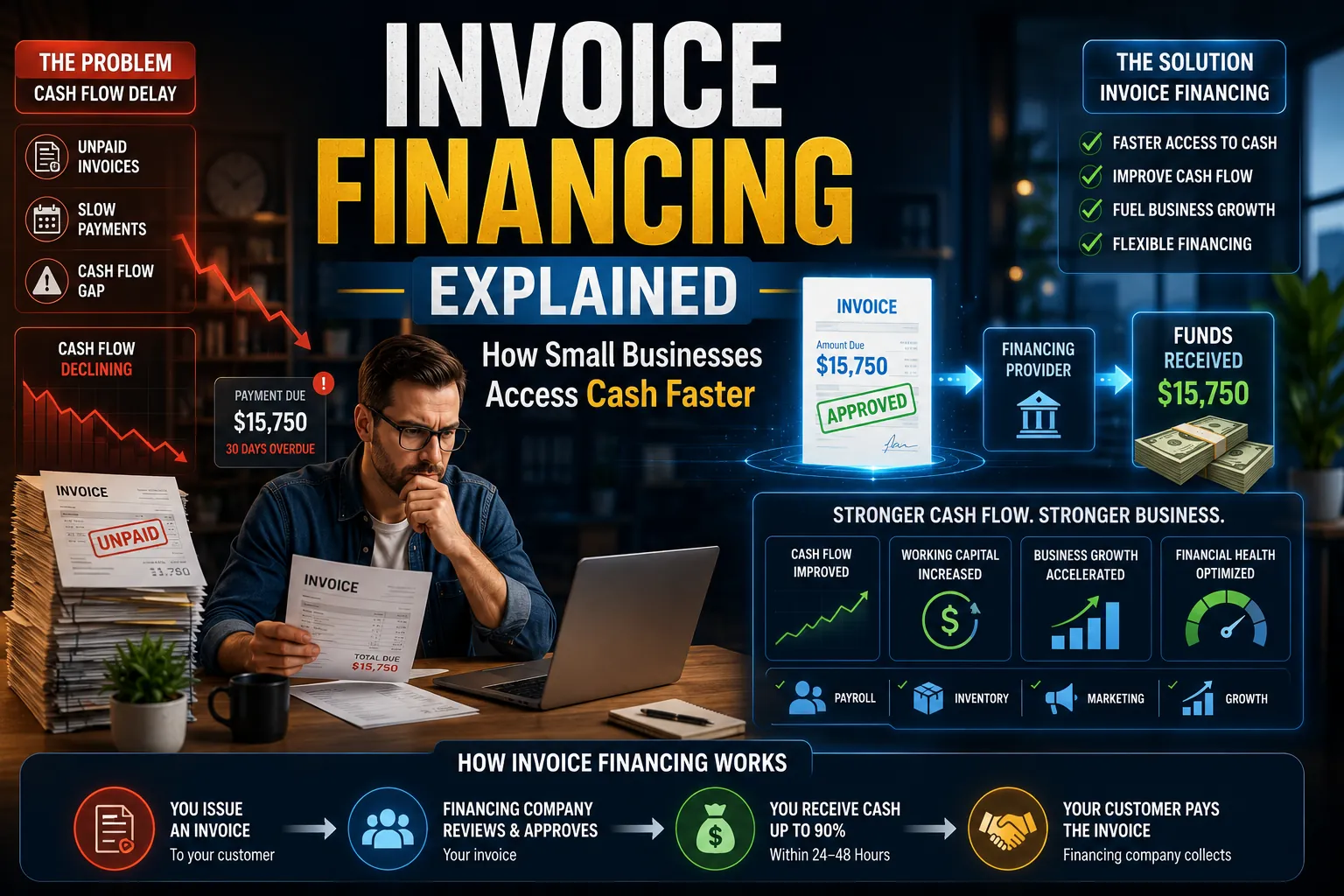
Invoice financing unlocks cash tied up in unpaid invoices without waiting 30, 60, or 90 days for customers to pay. For small businesses with B2B clients, it is one of the most accessible working capital tools available, often requiring no assets as collateral beyond the invoices themselves.
Cash flow, not profitability, kills most small businesses. A company can be profitable on paper and insolvent in practice if customers pay slowly while suppliers demand payment promptly. Invoice financing addresses this timing gap directly by advancing funds against outstanding invoices rather than waiting for payment.
How Invoice Financing Works
The basic mechanism: you issue an invoice to a business customer for goods or services delivered. Instead of waiting for the customer to pay in 30 to 90 days, you sell or pledge that invoice to a financing provider who advances you a percentage of its value immediately, typically 70 to 95 percent.
When your customer pays the invoice, the full amount goes to the financing provider (or directly to you if you collected it). The provider deducts their fee and remits the remaining balance to you.
The Two Main Types: Factoring vs Discounting
Invoice factoring: You sell your invoices to the factor outright. The factor takes over collection responsibility, chasing your customer for payment. Most factors do not notify your customers that the invoice has been sold (confidential factoring), though some do. Best for businesses that want to outsource credit control alongside the financing.
Invoice discounting: You retain control of credit control and collections. The financing provider advances cash against your invoices but your customers pay you directly. You maintain the customer relationship. Best for businesses with established credit control processes that simply want the working capital advance without outsourcing collections.
Selective invoice finance: A flexible version allowing you to choose specific invoices to finance rather than your entire ledger. Useful for smoothing cash flow around specific large invoices or customers rather than a whole-ledger arrangement.
The Costs: What You Actually Pay
Invoice financing costs typically have two components: a service fee and a discount rate.
Service fee: A percentage of the invoice value, typically 0.5 to 3 percent, charged once when the invoice is submitted. Covers administration and risk assessment.
Discount rate: An interest rate charged on the amount advanced, typically 1 to 3 percent per month or 10 to 30 percent annualised. Charged on the days funds are outstanding until the invoice is paid.
Example: You submit a £50,000 invoice. The provider advances 85 percent (£42,500) at a 1.5 percent service fee and 1.8 percent monthly discount rate. Your customer pays in 45 days. Service fee: £750. Discount rate: £1,912.50 (1.8% x 1.5 months x £42,500). Total cost: £2,662.50 to access £42,500 for 45 days.
Annualised, this is approximately 20 to 25 percent. This is higher than a bank term loan but significantly more accessible for businesses that cannot secure traditional lending, and the cost is proportional to the timing gap rather than a fixed annual commitment.
When Invoice Financing Makes Sense
Seasonal businesses with lumpy cash flow: A business that generates most revenue in specific months but has year-round expenses benefits from financing the large invoices generated in peak season to smooth cash flow across the year.
Rapid growth: Fast-growing businesses often face the paradox of needing cash to fund new orders while their capital is tied up in unpaid invoices from existing orders. Invoice financing funds the working capital gap without diluting equity.
Long customer payment terms: B2B businesses with customers who pay on 60 or 90-day terms structurally need working capital solutions. Invoice financing is purpose-built for this gap.
When traditional loans are not available: New businesses without trading history, or businesses with poor credit histories, often cannot access traditional bank facilities. Invoice financing is secured against receivables rather than the business’s credit history, making it more accessible.
When Invoice Financing Is the Wrong Solution
Low-margin businesses: The 1 to 3 percent service fee and 10 to 30 percent annualised discount rate can eliminate margins on thin-margin businesses. Calculate whether the cost of financing produces net positive cash flow impact before committing.
B2C businesses: Most invoice financing providers serve B2B invoicing. Consumer invoices are typically not suitable because they represent individual debt rather than business-to-business contractual payment obligations.
Very small invoice values: The administration overhead of invoice financing makes it impractical for invoices below approximately £1,000 to £2,000. Most providers have minimum invoice value requirements.
What is invoice financing and how does it work?
Invoice financing advances cash against outstanding invoices issued to business customers. You submit invoices to a financing provider who advances 70 to 95 percent of the invoice value immediately. When your customer pays, the provider deducts fees and remits the balance. It converts unpaid invoices to immediate cash without waiting for customer payment.
What is the difference between invoice factoring and invoice discounting?
In invoice factoring, you sell invoices to the provider who takes over collections. In invoice discounting, you retain control of collections and the provider simply advances cash. Factoring outsources credit control. Discounting provides funding while you maintain the customer relationship. Both advance a percentage of invoice value against future payment.
How much does invoice financing cost?
Typically 1 to 3 percent service fee plus 1 to 3 percent monthly discount rate on advanced funds. Annualised, this represents approximately 15 to 35 percent. Costs vary by provider, invoice volume, customer creditworthiness, and industry sector.
Do customers know their invoices have been financed?
In confidential invoice financing, customers are typically not notified. In disclosed factoring, customers pay directly to the factor and are aware of the arrangement. Confidential arrangements are more common for businesses concerned about customer perception.
What businesses are eligible for invoice financing?
Most B2B businesses with creditworthy customers and invoices with clear payment terms are eligible. Lenders assess the creditworthiness of your customers rather than primarily your own business credit history. New businesses and those with limited trading history can access invoice financing when traditional loans are unavailable.
Is invoice financing the same as a business loan?
No. A business loan provides a fixed sum repaid over a fixed term with interest. Invoice financing is revolving working capital tied to specific outstanding invoices. There is no fixed repayment schedule: the invoice value itself repays the advance when your customer pays.
A Tool for the Timing Gap, Not the Profit Gap
Invoice financing is a working capital solution, not a profitability solution. It addresses the timing difference between delivering work and receiving payment. It does not fix businesses where costs exceed revenues.
For B2B businesses with good customers who pay slowly, invoice financing converts a structural cash flow constraint into a manageable cost of doing business. Calculate the annualised cost against the value of the working capital and the alternative cost of the constraint it removes.