
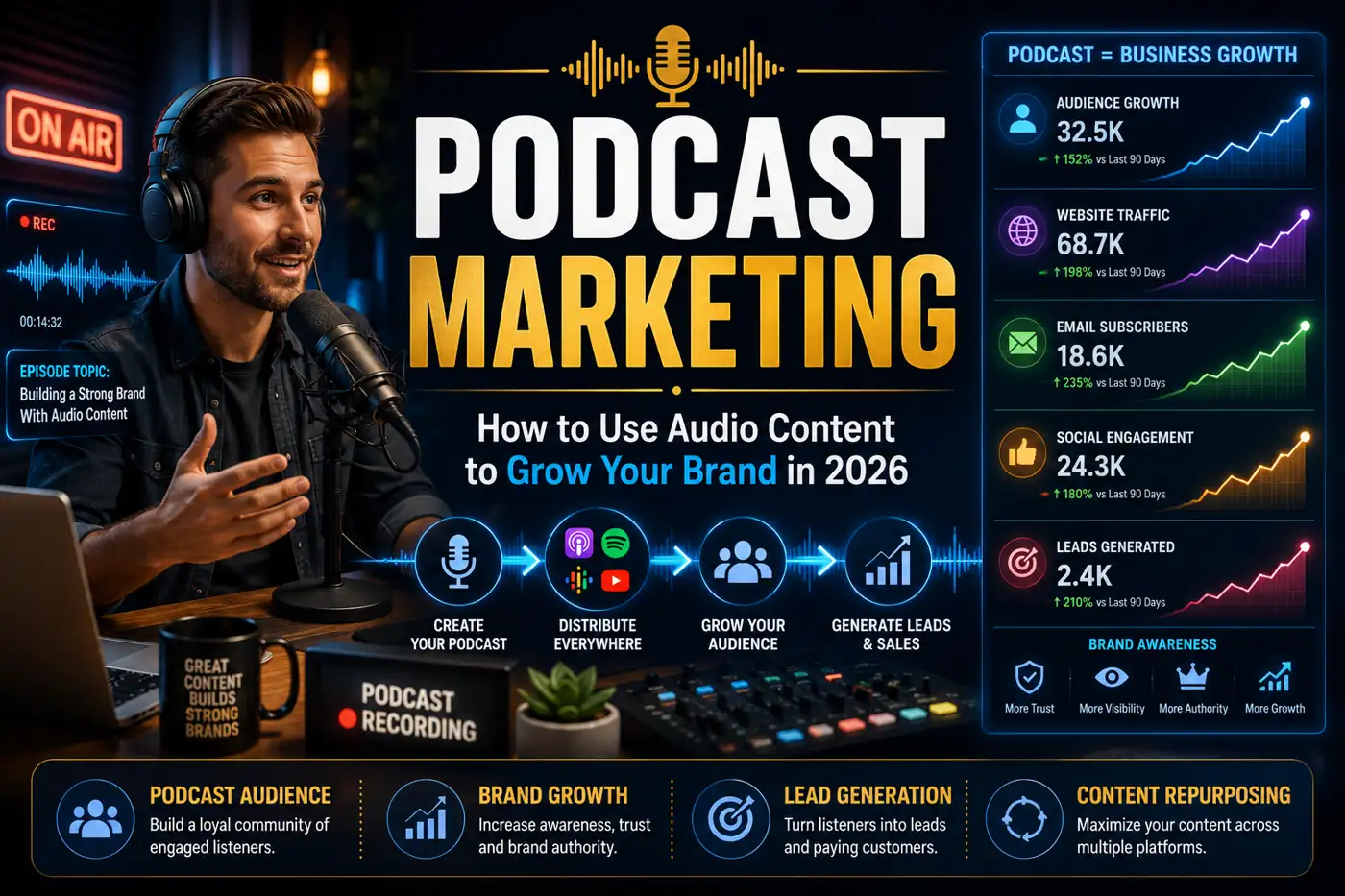
Podcast advertising spend is projected to reach $4.1 billion globally in 2026. Monthly podcast listeners in the US alone have reached 135 million. More importantly for marketers: podcast listeners are the most engaged media audience available, with 80 percent listening to all or most of each episode they start.
Podcast marketing in 2026 encompasses two distinct strategies:
starting or running your own branded podcast, and leveraging other podcasts as a distribution channel through advertising and guesting. Each serves different goals at different investment levels, and the choice between them should be deliberate rather than default.
Why Podcasts Build Brand Trust Faster Than Most Channels
The distinctive quality of podcast attention is immersion. A podcast listener typically cannot simultaneously scroll, browse, or give visual attention to something else. They are in the car, at the gym, doing housework. This captive, focused attention state produces engagement depth that no visual digital channel matches.
The average podcast episode listen is 28 minutes. Compare this to 1.7 seconds on Twitter, 11 seconds on Instagram, and 1.5 to 3 minutes on YouTube. A 30-minute branded podcast episode that a listener completes represents 28 minutes of undivided brand interaction. Building that level of sustained attention through any other channel is either impossible or enormously expensive.
Strategy 1: Starting a Branded Podcast
When a Branded Podcast Makes Sense
A branded podcast makes sense when you have a topic that genuinely serves an audience rather than primarily promotes a product, a production team willing to sustain consistent episode output (minimum 12 to 18 months of consistent publishing before significant audience builds), and a content strategy where thought leadership and audience trust are primary goals.
The most successful branded podcasts make the brand secondary to the content. HubSpot’s My First Million, A16Z’s podcast series, and Shopify’s Masters podcast all work because they provide genuine value to their audience regardless of the brand association. Podcasts that are primarily advertisements in episode format consistently fail to build audiences.
Getting Started: The Technical Minimum
Equipment: A USB condenser microphone ($80 to $150 for a Blue Yeti or Rode PodMic) produces professional-quality audio. Recording in a room with soft furnishings reduces echo. Dedicated recording software is not required: Riverside.fm or Squadcast handle remote recordings; Audacity or GarageBand handle editing at zero cost.
Hosting: RSS feed and distribution is handled by podcast hosts. Buzzsprout, Transistor, and Captivate all distribute to Spotify, Apple Podcasts, and other platforms automatically for $19 to $49 per month. Choosing a host that provides per-episode and episode-completion analytics is important for understanding what content performs.
Consistency over perfection: The most common branded podcast failure is producing high-quality initial episodes and stopping. Weekly or fortnightly publishing sustained for 12 to 18 months builds audience. Podcast discovery algorithms, particularly Spotify’s, reward consistent publishing.
Podcast SEO: The Underused Growth Channel
Podcast SEO is significantly less competitive than standard web SEO. Spotify now indexes podcast episode transcripts for search. Apple Podcasts indexes show descriptions and episode notes. Optimising episode titles and descriptions with specific keywords produces discovery for highly relevant queries with far less competition than equivalent web content.
Best practice: publish episode transcripts as blog posts. This dual-channel approach captures podcast listeners and web search traffic from the same content. The SEO value of consistent podcast content publishing, especially for long-tail informational queries, is substantially underutilised by most branded podcast producers.
Strategy 2: Podcast Advertising and Guesting
Podcast Advertising
Podcast advertising uses host-read ads, which perform better than pre-produced spots because listener trust in the host transfers to the endorsement. Podcast advertising CPMs range from $18 to $60 for mid-roll placements depending on niche and audience size. Business and entrepreneurship podcasts command premiums ($40 to $60 CPM) while entertainment and general interest podcasts are lower.
Attribution is the primary challenge in podcast advertising. Promo codes and unique landing page URLs provide attribution tracking. Podscribe and Chartable offer more sophisticated attribution that connects download events to downstream conversions.
Podcast Guesting
Appearing as a guest on relevant podcasts is one of the highest-ROI marketing activities available on a per-hour basis. A well-executed 45-minute guest appearance on a podcast with 5,000 to 50,000 listeners delivers brand reach, credibility transfer from the host, a permanent asset available at the podcast’s URL, and typically a backlink to the guest’s website.
Pitching effectively: identify podcasts your target customer listens to. Research recent episodes to understand the host’s angle and what their audience engages with. Pitch a specific topic with a clear angle that serves the podcast’s existing audience, not just your expertise. Include listener value before your credentials.
Measurement: What to Track
For branded podcasts: Episode downloads per episode (industry benchmark: 1,000 downloads within 30 days puts an episode in the top 20 percent of all podcasts), episode completion rate (above 70 percent is strong), subscriber growth rate, and qualitative listener feedback including reviews and direct emails.
For podcast advertising: Promo code redemptions, unique URL visits, and post-exposure conversion tracking using pixel-based measurement where available. Compare cost per attributed conversion against other paid channels.
For podcast guesting: Website traffic spikes in the week following episode release, direct inbound contact mentioning the specific podcast, and backlink quality from episode show notes.
Does podcast marketing work for B2B brands?
Very effectively. Business and professional podcasts have highly engaged, senior audiences that are difficult to reach through other channels. Podcast listeners in professional verticals are often decision-makers and high-income earners. The listening context (commuting, exercising, focused work periods) also means less distraction than other media.
How long does it take to grow a branded podcast audience?
Meaningful audience growth typically requires 12 to 18 months of consistent publishing. Most podcasts that succeed take 6 to 12 months to gain algorithmic momentum on Spotify and Apple. The growth curve is back-loaded: early months produce slow growth, then momentum accelerates as discovery increases. Consistency matters more than production quality in the growth phase.
What is the best equipment to start a podcast?
A USB condenser microphone ($80 to $150 range: Blue Yeti, Rode PodMic, Audio-Technica ATR2100) and a quiet room with soft furnishings. Recording software: Audacity (free, desktop), Riverside.fm or Squadcast for remote guest recordings. A podcasting microphone and quiet recording environment produce 90 percent of the audio quality improvement over built-in microphones at minimal cost.
How much does podcast advertising cost?
Mid-roll host-read ads typically range from $18 to $60 CPM (cost per thousand downloads). A podcast with 10,000 episode downloads charging $40 CPM generates $400 per mid-roll placement. Prices vary significantly by niche: business and investment podcasts command premiums while entertainment podcasts are lower. Minimum budgets typically start at $500 to $1,000 per placement.
What makes a podcast guest pitch successful?
A successful pitch identifies a specific, concrete topic that genuinely serves the podcast’s existing audience. It includes a one-sentence description of the episode angle, two to three specific talking points, and social proof of the guest’s credibility on that topic. Pitches focused on what the listener will learn consistently outperform pitches about the guest’s credentials or story.
How do you measure podcast marketing ROI?
For branded podcasts: episode downloads, completion rates, subscriber growth, and attribution to website traffic and inbound inquiries. For podcast advertising: promo code redemptions, unique URL visits, and post-exposure conversion tracking. The most common attribution method is unique promo codes per podcast because they work without tracking technology.
Audio Is the Attention Channel Most Brands Have Ignored
The combination of captive attention, high completion rates, and trusted host relationships makes podcast the most underutilised marketing channel relative to its audience quality. Most brands over-invest in social media where attention is fragmented and under-invest in audio where attention is sustained.
Starting with a clear strategy, either branded podcast for thought leadership or podcast advertising and guesting for immediate reach, produces better results than hedging between the two without committing to either.