
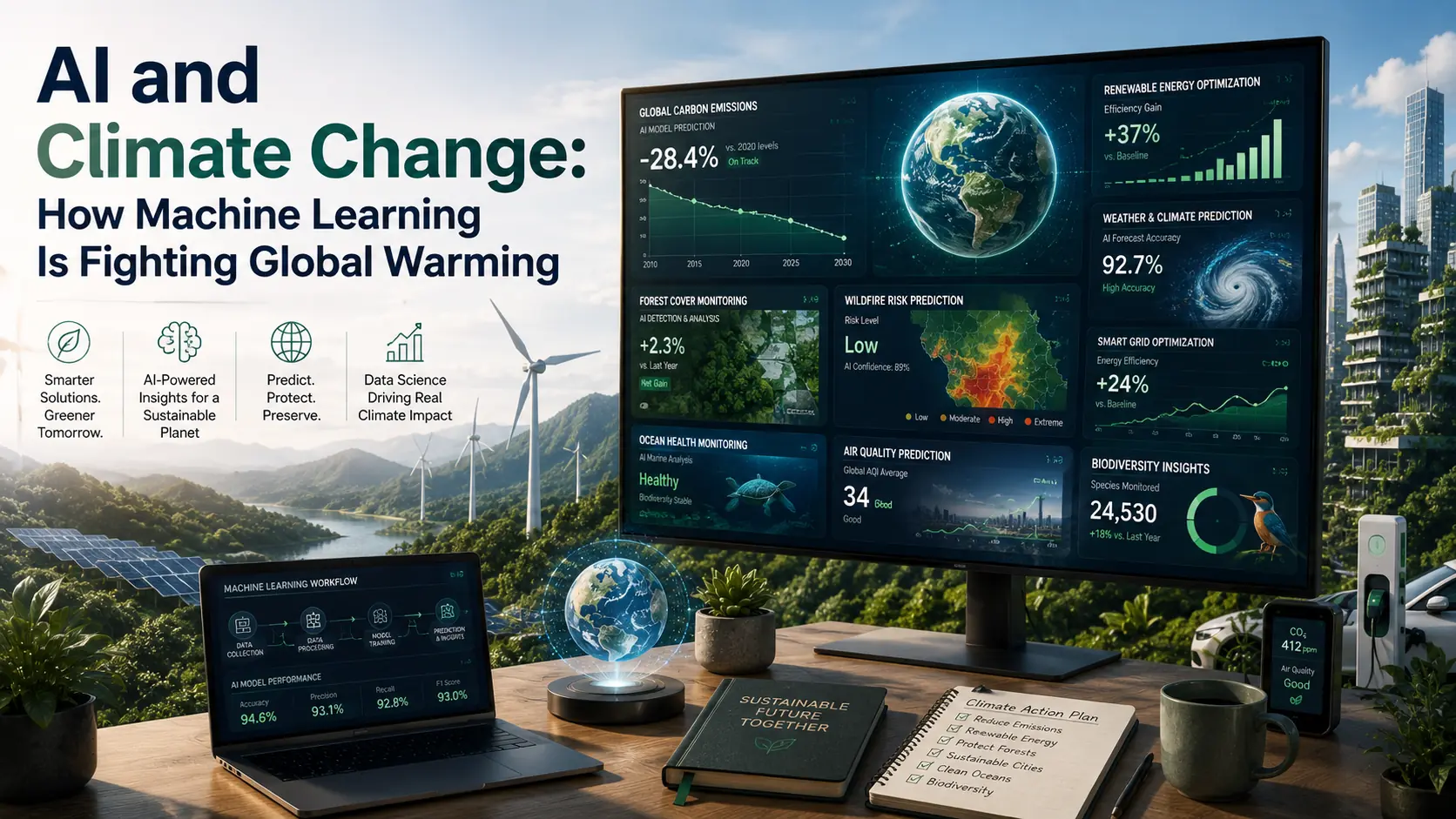
The IEA estimates widespread AI adoption in energy and transport could reduce CO2 emissions by 1,400 million tonnes annually by 2035. A Grantham Institute study projects AI could cut 3.2 to 5.4 billion tonnes of carbon per year by 2035 compared to current trajectories — more than the entire European Union’s annual emissions.
The climate AI story in 2026 has an honest tension at its centre. AI reduces emissions across multiple sectors simultaneously while also driving the rapid expansion of energy-hungry data centres. Data centres account for 0.5 percent of global combustion emissions today. That share grows to 1 to 1.4 percent by 2030 under IEA projections. Whether AI is a net climate positive depends entirely on which applications are prioritised and how the energy powering those data centres is generated.
Renewable Energy Grid Optimisation
The intermittency problem is the primary constraint on renewable energy adoption. Solar generates power when the sun shines. Wind generates when the wind blows. Neither matches exactly when demand peaks. AI addresses this by predicting supply and demand fluctuations with enough accuracy and lead time to manage the mismatch – reducing the need for fossil fuel backup generation that exists to cover renewable variability.
Google’s DeepMind wind power: DeepMind applied machine learning to wind farm management at 700MW of US wind capacity. The AI predicted wind output 36 hours ahead, enabling the facility to commit to power delivery contracts and reduce reliance on fossil backup. The result was a 20 percent increase in wind power value compared to unforecast wind generation.
Real-time carbon intensity routing: AI systems now route electricity demand toward times and locations where the grid’s carbon intensity is lowest. A data centre that shifts non-urgent computing tasks to moments when the local grid is predominantly renewable rather than fossil-powered reduces its effective carbon footprint without reducing computing output.
Battery storage optimisation: Grid-scale battery systems use AI to decide when to store energy (during renewable surpluses) and when to release it (during peak demand when fossil generation would otherwise activate). The AI manages thousands of variables simultaneously to maximise renewable utilisation.
Climate Modelling and Weather Prediction
Traditional numerical weather prediction models run on supercomputers for hours to produce forecasts. Google’s GraphCast and Huawei’s Pangu-Weather produce 10-day forecasts in under a minute at comparable or superior accuracy to the best operational models. DeepMind’s GenCast extends this to probabilistic ensemble forecasts that quantify uncertainty.
The practical climate impact: better forecasting allows energy operators to plan renewable generation more accurately days in advance, reducing the scheduled fossil backup capacity required as insurance. It also enables more accurate flood and extreme weather modelling that helps communities adapt to climate impacts already locked in by past emissions.
Carbon Monitoring and Forest Protection
Monitoring global deforestation manually is impossible at scale. Satellite imagery combined with computer vision makes it feasible. WattTime’s open-source Automated Emissions Reduction system combines real-time grid carbon intensity data with energy management to automatically shift flexible loads to low-carbon moments. Global Forest Watch uses satellite data and AI to detect deforestation events within days rather than months, enabling faster regulatory response.
For carbon offset integrity, AI is now being deployed to verify that claimed carbon sequestration in forests and soils is real and sustained. The carbon credit market has faced credibility problems from poorly verified offsets. ML models trained on multi-year satellite data provide objective, continuous monitoring that makes fraudulent credit claims more detectable.
Materials Discovery and Industry Decarbonisation
Developing new materials for batteries, solar cells, and industrial processes typically takes years of laboratory experimentation. AI accelerates this by predicting which molecular structures are promising before physical synthesis. Google DeepMind’s GNoME model discovered 2.2 million new stable crystal structures, representing a 45x expansion of known stable materials relevant to battery and semiconductor development.
For heavy industry, process AI optimises energy-intensive operations including steel smelting, cement production, and chemical manufacturing. Emissions reductions of 10 to 20 percent from AI-optimised process control in industrial settings are documented across multiple implementations. These industries account for roughly 30 percent of global CO2 emissions and have few technological decarbonisation options beyond efficiency.
Agriculture and Land Use
Agriculture accounts for approximately 10 to 12 percent of global greenhouse gas emissions. AI applications in precision agriculture reduce this through targeted fertiliser application (reducing nitrous oxide emissions from over-application), early detection of crop disease (reducing methane from decomposing crops), and optimised irrigation (reducing energy for pumping and methane from flooded fields).
Satellite and drone imagery combined with ML models detects crop stress and disease at individual plant level across thousands of hectares, enabling interventions before losses compound and reducing the waste and emissions associated with failed harvests.
The Honest Tension: AI’s Own Energy Footprint
Training a large language model produces hundreds of tonnes of CO2 equivalent. Inference at scale across millions of daily users consumes significant electricity continuously. Data centres are projected to double their electricity consumption by 2030. This is a real cost, not a theoretical one.
The net calculation depends on what the AI is being used for. An AI system that reduces 1,000 tonnes of CO2 while emitting 10 tonnes in inference costs is strongly net positive. An AI system primarily generating marketing copy or cat pictures has a different calculation. The IEA’s conclusion is that AI’s net impact on climate depends on whether adoption focuses on high-value climate applications and whether data centre electricity is sourced from renewables.
| The Most Important Variable
The electricity powering AI data centres determines more of AI’s climate impact than any other factor. A data centre running on 100 percent renewable energy has near-zero operational carbon footprint regardless of compute intensity. The same facility powered by coal-heavy grid electricity produces significant emissions. Google, Microsoft, and Amazon have made net-zero energy commitments. Their delivery on those commitments matters more than the AI applications they run. |
Can AI actually reduce climate change?
Yes, with meaningful caveats. IEA estimates widespread AI adoption in key sectors could reduce CO2 emissions by 1,400 million tonnes annually by 2035. The Grantham Institute projects 3.2 to 5.4 billion tonnes of annual reduction by 2035. The net impact depends on whether high-value climate applications are prioritised and whether data centres powering AI are renewable-energy-powered.
How does AI help with renewable energy?
AI improves renewable energy value by predicting supply and demand fluctuations with high accuracy, enabling better grid management. It optimises battery storage decisions, routes demand toward low-carbon grid moments, and increases wind and solar farm output value through better forecasting. DeepMind’s wind power AI increased wind facility value by 20 percent.
What is the carbon footprint of AI?
Data centres account for approximately 0.5 percent of global combustion CO2 emissions today, projected to reach 1 to 1.4 percent by 2030 under IEA analysis. Training large AI models produces hundreds of tonnes of CO2 equivalent. Inference costs are ongoing. The net climate impact of AI depends on what applications the compute is used for and whether the energy source is renewable.
How is AI used for climate monitoring?
AI processes satellite imagery to detect deforestation events within days. Computer vision combined with multi-year satellite data monitors carbon storage in forests and soils. WattTime’s system uses real-time grid carbon intensity to shift flexible electricity loads to low-carbon moments. These monitoring applications improve the accuracy and integrity of climate and carbon accounting.
Did DeepMind discover new materials for climate technology?
Google DeepMind’s GNoME model identified 2.2 million new stable crystal structures in 2023, representing a 45x expansion of known stable materials. These are relevant to battery, semiconductor, and solar cell development. Materials discovery is a key bottleneck in climate technology development that AI is accelerating significantly.
What are the biggest AI climate applications in 2026?
Grid-scale renewable energy optimisation (demand and supply forecasting), climate and weather modelling (GraphCast, GenCast), deforestation monitoring via satellite computer vision, industrial process efficiency (steel, cement, chemicals), precision agriculture, and materials discovery for clean energy technology.
The Net Calculation Is Positive, With Conditions
AI’s net climate impact in 2026 is positive when deployed for high-value climate applications and when the underlying compute infrastructure is powered by clean energy. The technology enables emissions reductions at speed and scale that no previous tool achieved. The conditions are real: prioritising climate applications over entertainment and powering data centres with renewables are not guaranteed without deliberate policy and corporate choices.