
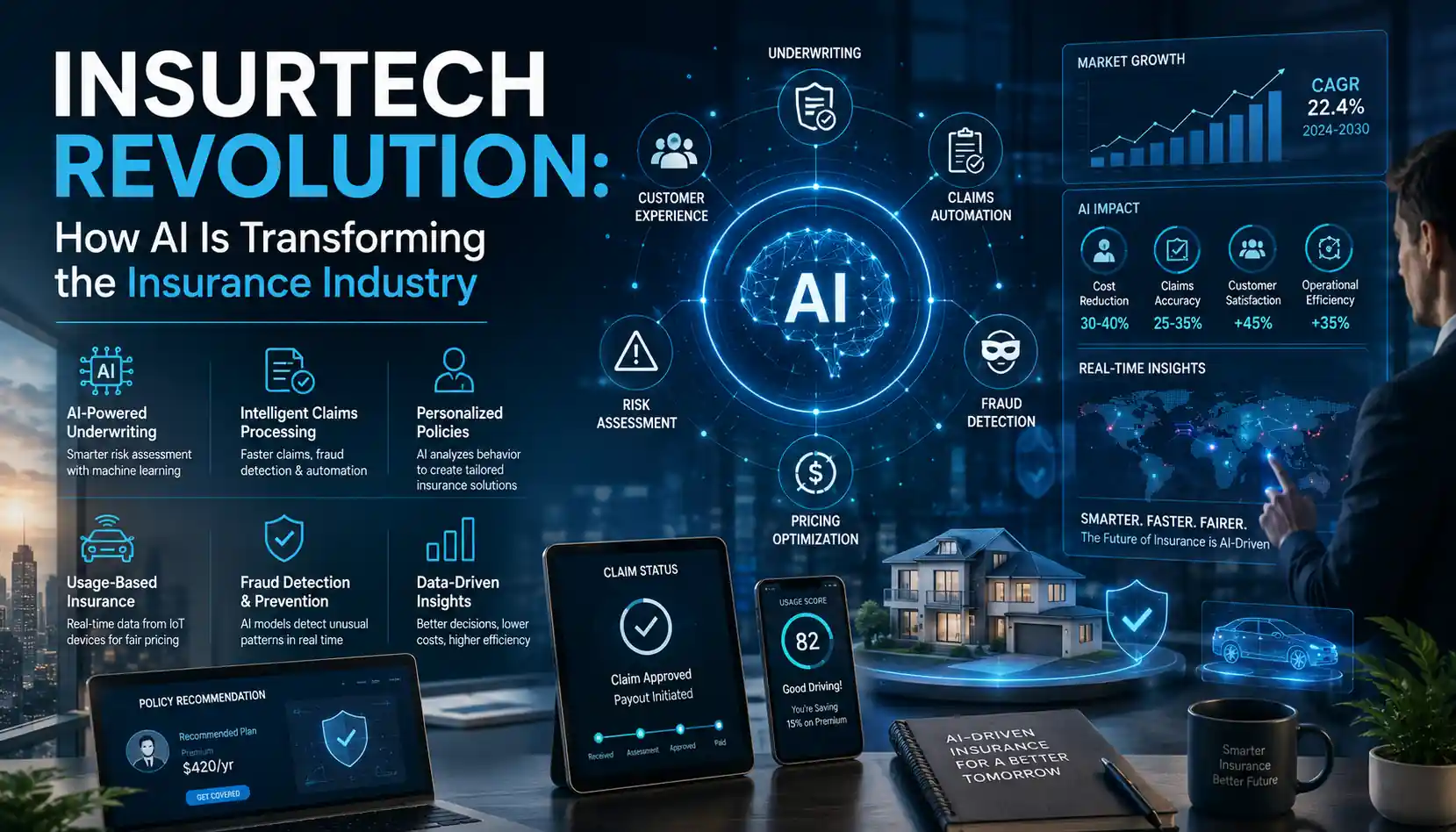
Lemonade processed a renters insurance claim in 3 seconds using AI in 2016. In 2026, AI underwrites policies, detects fraud, prices car insurance by actual driving behaviour, and predicts property damage before it occurs. The $6.7 trillion global insurance industry is being rebuilt from first principles.
Insurance is fundamentally an information problem: estimate risk accurately, price it appropriately, and pay valid claims efficiently. AI is better at all three than the actuarial tables and manual processes that defined insurance for 200 years. The incumbents who are integrating AI are becoming significantly more efficient. The insurtechs built natively on AI are rewriting the product entirely.
Automated Underwriting: Speed and Accuracy
Traditional underwriting for life insurance required a medical exam, weeks of processing, and significant manual actuarial work. AI underwriting analyses thousands of data points including electronic health records, prescription history, wearable device data, driving records, credit data, and public records to produce risk assessments in minutes rather than weeks.
Haven Life, backed by MassLife, underwrites up to $3 million in life insurance without a medical exam for applicants below a certain age and health profile, using AI-driven risk assessment. Policy approval takes minutes. The quality of the risk estimate is validated by claims experience over years.
Property underwriting: Satellite and aerial imagery AI assesses property condition, roof age, proximity to fire risk, and coastal vulnerability without a physical inspection. Hippo Insurance combines satellite imagery analysis with smart home sensor data to assess property risk more dynamically than traditional inspection-based underwriting.
Small business insurance: Next Insurance uses AI to underwrite commercial coverage for small businesses across dozens of trades. Businesses buy coverage, get certificates of insurance, and manage policies entirely through a digital interface without brokers. AI analyses thousands of industry-specific risk factors in the underwriting decision.
Telematics: Pay-How-You-Drive
Usage-based insurance (UBI) prices car insurance based on actual driving behaviour rather than demographic proxies. Telematics devices or smartphone apps track acceleration patterns, braking behaviour, speed, time of day driven, and cornering style. Drivers with genuinely low-risk behaviour pay significantly less than traditional pricing would produce.
Progressive’s Snapshot, State Farm’s Drive Safe and Save, and insurance-native apps like Root Insurance have demonstrated that telematics improves pricing accuracy. The proportion of US auto insurers offering some form of UBI has grown from 30 percent in 2020 to over 60 percent in 2026. For young drivers who are statistically expensive to insure but drive safely, the savings can exceed 30 percent.
AI Claims Processing
Claims processing is expensive, slow, and vulnerable to fraud. AI addresses all three simultaneously. Computer vision assesses vehicle damage from photos submitted through a smartphone app. Natural language processing processes claim descriptions and automatically validates against policy terms. Robotic process automation handles the administrative steps of claim fulfilment.
Lemonade’s AI claims: Lemonade’s AI Jim processes claims 24/7, verifying coverage, analysing photos of damage, checking against fraud indicators, and approving payment instantly for straightforward claims. Complex claims escalate to human adjusters. The system processes certain claim types in seconds rather than days.
Property damage claims: Aerial imagery from drones and satellites after weather events (hailstorms, hurricanes, wildfires) allows AI systems to assess damage across thousands of properties simultaneously. Farmers Insurance deploys drone imagery AI to assess roof damage after hailstorms, reducing the time between event and claim assessment from weeks to days.
Fraud Detection
Insurance fraud costs the US insurance industry over $300 billion annually. AI fraud detection analyses claim patterns, device behaviour, network relationships between claimants, and real-time verification to identify fraudulent claims at rates human investigators cannot match at scale.
Graph AI detects fraud rings by identifying clusters of claimants with suspicious relationship patterns: shared addresses, shared phone numbers, overlapping vehicle repair shops, and temporal clustering around specific events. These patterns are invisible in individual claim review but obvious in network analysis.
Parametric Insurance: Automatic Payout on Conditions
Parametric insurance pays a fixed amount when a specified condition occurs, without requiring loss assessment. AI and real-time data enable: flood insurance that pays automatically when gauge data confirms water levels above a threshold, crop insurance that pays when satellite NDVI data confirms drought damage, and travel insurance that pays automatically when flight data confirms a delay.
The claim is the data, not the assessment. This eliminates the most expensive and contentious part of the claims process for events that are objectively measurable. Parametric products have grown significantly in the climate risk space as insurers withdraw from traditional coverage in high-risk areas.
What is insurtech and how is AI changing insurance?
Insurtech applies technology to transform insurance products and processes. AI changes underwriting (automated risk assessment in minutes), pricing (telematics-based behaviour pricing), claims processing (instant AI assessment for straightforward claims), and fraud detection (graph AI identifying fraud rings). The result is faster, more accurate, and cheaper insurance delivery.
What is telematics insurance and how does it work?
Telematics insurance prices car coverage based on actual driving behaviour: acceleration patterns, braking, speed, cornering, and time of day driven. A telematics device or smartphone app records this data and transmits it to the insurer. Safe drivers pay less than traditional demographics-based pricing would produce. Savings of 20 to 30 percent are achievable for genuinely low-risk drivers.
How fast can AI process insurance claims?
Simple, straightforward claims can be processed in seconds on platforms like Lemonade. AI verifies coverage, analyses submitted photos, checks fraud indicators, and approves payment instantly. Complex claims with ambiguous circumstances or high values escalate to human adjusters. The overall claims cycle time for AI-handled claims is orders of magnitude faster than traditional manual processing.
What is parametric insurance?
Parametric insurance pays a fixed amount when a specified measurable condition occurs, without requiring traditional loss assessment. Flood coverage pays when gauge data confirms water levels above a threshold. Crop insurance pays when satellite data confirms drought. Travel insurance pays when flight data confirms a delay. The condition data is the claim trigger, eliminating the assessment dispute.
How does AI detect insurance fraud?
Graph AI analyses networks of relationships between claimants: shared addresses, phone numbers, vehicle repair shops, and temporal patterns. These fraud rings are invisible in individual claim review but clear in network analysis. Computer vision detects staged accident damage inconsistencies. Behavioural analytics flags device and usage patterns inconsistent with the claimed scenario.
Are insurtech companies replacing traditional insurers?
Not replacing, but forcing significant transformation. Insurtechs with native AI infrastructure operate at lower cost ratios than incumbents. Traditional insurers are responding by acquiring insurtechs, building internal AI capabilities, and partnering with technology providers. The incumbents with scale advantages in reinsurance and regulatory relationships are integrating AI rather than being displaced by it.
Insurance Becomes a Real-Time Product
The traditional insurance model priced risk at a point in time (application) based on historical data, and held that price for a year regardless of how the actual risk changed. AI enables continuous risk monitoring and dynamic pricing that reflects current behaviour and conditions. This is genuinely better risk management. It also raises questions about the social insurance function when individual risk is priced perfectly a discussion the industry and regulators are actively working through.