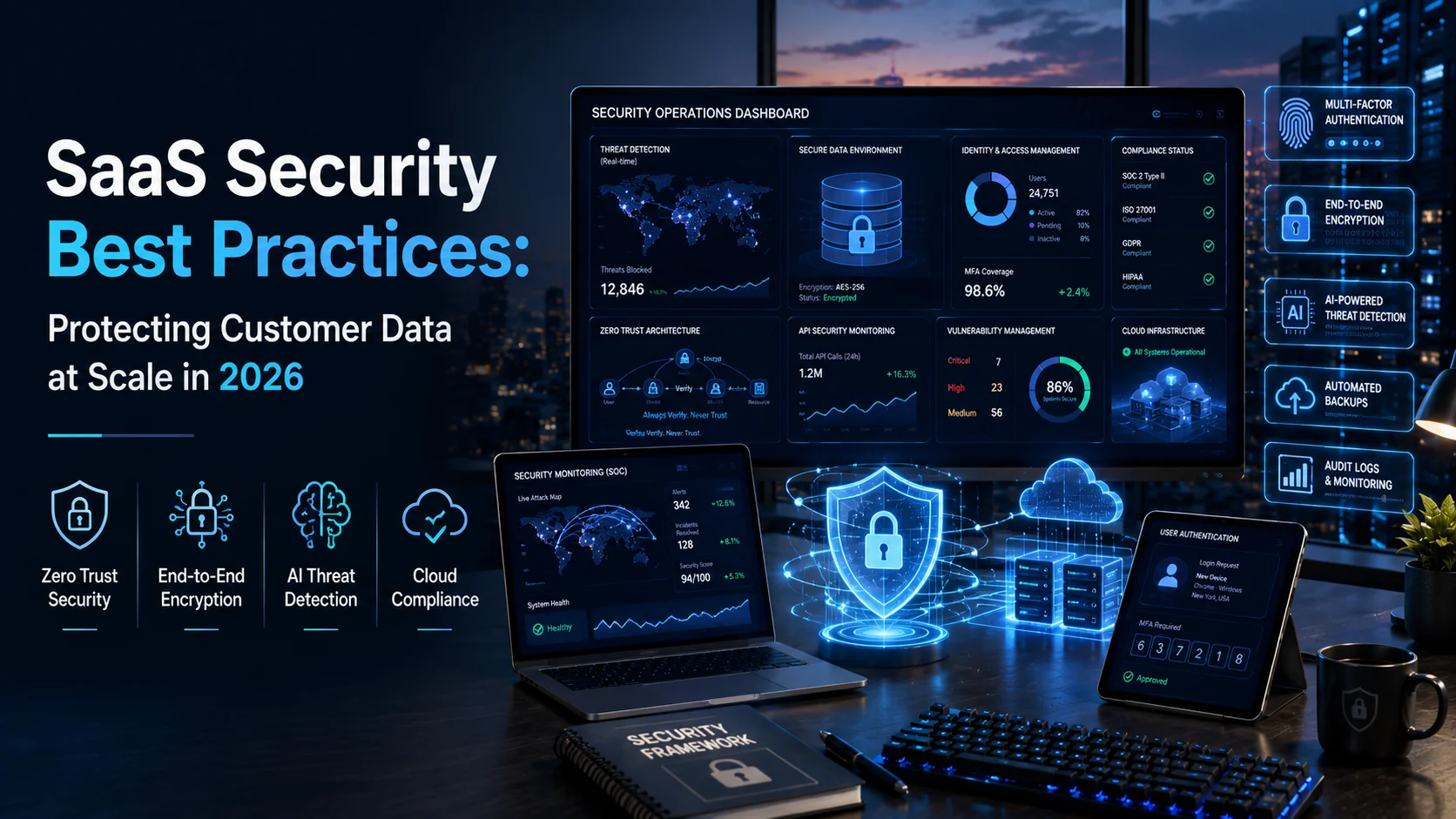
The average SaaS data breach costs $4.88 million, higher than the cross-industry average, because SaaS breaches often involve multi-tenant architecture where one vulnerability exposes multiple customers simultaneously. Security is not a feature SaaS companies add. It is the foundation that customer trust, enterprise contracts, and regulatory compliance are built on.
SaaS security in 2026 encompasses authentication hardening, data architecture decisions, compliance frameworks, vendor risk management, and incident response. For SaaS companies selling to enterprises, security posture is increasingly a primary sales consideration: procurement teams run detailed security questionnaires, SOC 2 reports are standard requirements, and enterprise contracts include security SLAs that breach triggering clauses.
Layer 1: Authentication and Identity
Enforce MFA across all accounts: Every user account should require a second factor. Authenticator apps (TOTP) are minimum standard. Hardware keys (FIDO2/WebAuthn) should be required for administrative access. Authentication SMS codes should be deprecated: SIM swapping attacks have made them unreliable for high-sensitivity access.
Single Sign-On (SSO) for enterprise customers: Enterprise buyers expect SAML 2.0 or OIDC SSO integration. SSO reduces credential sprawl, allows enterprises to manage user access through their existing identity provider (Okta, Azure AD, Google Workspace), and enables them to enforce their own MFA policies. Gating SSO behind expensive plan tiers creates significant friction in enterprise sales.
Role-Based Access Control (RBAC): Users should only access data and features their role requires. Implement RBAC with clearly defined permission levels before you need it — adding it to an existing codebase after enterprise customers require it is significantly harder than building it from the start.
Session management: Implement session expiry, concurrent session limits for sensitive operations, and anomalous login detection. Logins from new devices or unusual geographies should trigger step-up authentication.
Layer 2: Data Architecture and Encryption
Encryption in transit: All API communications and web traffic must use TLS 1.2 or higher. TLS 1.3 is preferred. HTTP endpoints are not acceptable for any production SaaS in 2026. Certificate management should be automated using Let’s Encrypt or equivalent.
Encryption at rest: All customer data stored in databases, file systems, and backups should be encrypted. AES-256 is the current standard. Key management should use a dedicated service (AWS KMS, HashiCorp Vault, Azure Key Vault) rather than application-level key storage.
Tenant data isolation: Multi-tenant SaaS architectures must ensure that one customer’s data cannot be accessed by another customer through application bugs, query injection, or API parameter manipulation. Implement tenant ID validation at every data access layer and use automated testing to verify isolation.
Sensitive data minimisation: Do not store data you do not need. Payment card data should flow through a PCI-compliant processor (Stripe, Braintree) rather than your own systems. Personal health information should be handled under HIPAA-appropriate architecture only when required for the product. Minimising sensitive data storage minimises breach impact.
Layer 3: Compliance Frameworks
SOC 2 Type II
SOC 2 Type II is the standard compliance requirement for US-focused SaaS companies selling to enterprises. It assesses your security controls over a minimum 6-month audit period across the Trust Service Criteria: security, availability, processing integrity, confidentiality, and privacy. Achieving SOC 2 Type II demonstrates sustained security controls rather than a point-in-time snapshot.
The process typically costs $15,000 to $100,000 depending on company size and audit firm, takes 6 to 12 months for a first audit, and requires automation tools (Vanta, Drata, Secureframe) to manage evidence collection efficiently. Enterprise buyers frequently require SOC 2 Type II before approving a new SaaS vendor.
ISO 27001
ISO 27001 is the international equivalent of SOC 2, more commonly required by European enterprise buyers. It covers an Information Security Management System (ISMS) and requires certification by an accredited certification body. More process-intensive than SOC 2 but more widely recognised outside North America.
GDPR and Data Privacy
SaaS products processing EU residents’ data must comply with GDPR. Key SaaS-specific requirements: Data Processing Agreements (DPAs) with customers who are data controllers using your platform, sub-processor disclosure and management, data subject rights mechanisms (deletion, access, portability), and 72-hour breach notification capability.
Layer 4: Vulnerability Management
Penetration testing: Annual penetration tests by qualified third-party security firms are baseline practice for enterprise SaaS. Bug bounty programmes (HackerOne, Bugcrowd) provide continuous testing by security researchers. Both should be in place before significant enterprise customer acquisition.
Dependency management: Software supply chain attacks have increased dramatically. Regularly audit open-source dependencies with tools like Snyk, Dependabot, or OWASP Dependency-Check. Automated alerts for known vulnerable package versions should integrate with your CI/CD pipeline.
SAST and DAST: Static Application Security Testing (SAST) analyses source code for vulnerabilities before deployment. Dynamic Application Security Testing (DAST) tests running applications for vulnerabilities. Both should be integrated into the development pipeline rather than run as periodic standalone audits.
Layer 5: Zero Trust Architecture
Zero trust means no implicit trust based on network location. Every access request is verified regardless of whether it originates from inside or outside the corporate network. For SaaS companies this means: strong identity verification for every API call, least-privilege access for internal services, network segmentation to limit breach blast radius, and continuous verification rather than session-based trust.
Security as a Sales Asset
For enterprise SaaS, security posture is a competitive differentiator. Publishing a trust page with security certifications, maintaining a public security.txt, providing self-service access to security documentation, and having a clear responsible disclosure policy all reduce friction in enterprise security reviews. Security questionnaire automation tools (SafeBase, Whistic) reduce the manual burden of responding to enterprise security assessments.
What are the most important SaaS security practices?
In priority order: enforce MFA for all users, implement SSO for enterprise customers, encrypt data in transit (TLS 1.3) and at rest (AES-256), maintain tenant data isolation in multi-tenant architecture, achieve SOC 2 Type II certification, conduct annual penetration testing, and implement dependency vulnerability scanning in the development pipeline.
What is SOC 2 Type II and why do SaaS companies need it?
SOC 2 Type II is an audit of a company’s security controls over a 6-month-plus period, covering security, availability, confidentiality, processing integrity, and privacy. Enterprise buyers commonly require it before approving new SaaS vendors. Type II demonstrates sustained controls versus a Type I point-in-time snapshot. First audits typically cost $15,000 to $100,000.
How should SaaS companies handle multi-tenant data isolation?
Implement tenant ID validation at every data access layer. Test isolation through automated penetration scenarios in staging environments. Use database-level row security policies in addition to application-level filtering. Never trust client-provided tenant IDs for data access decisions without server-side validation.
What is zero trust architecture for SaaS?
Zero trust eliminates implicit network location trust. Every API call is authenticated regardless of internal or external origin. Services use least-privilege credentials. Network segmentation limits breach blast radius. Continuous verification replaces session-based trust assumptions. This model assumes breach and limits blast radius rather than assuming internal networks are safe.
How does SaaS security affect enterprise sales?
Enterprise procurement includes detailed security questionnaires, SOC 2 Type II report requirements, DPA requirements for GDPR compliance, and security SLA provisions in contracts. A SaaS product without SOC 2 Type II is effectively disqualified from many enterprise procurement processes. Security posture is a primary evaluation criterion, not a secondary one.
What is the difference between SAST and DAST in SaaS security?
SAST (Static Application Security Testing) analyses source code for vulnerabilities before deployment — finding SQL injection patterns, hardcoded credentials, insecure cryptography. DAST (Dynamic Application Security Testing) tests running applications by simulating external attacks — finding authentication bypasses, business logic flaws, and runtime vulnerabilities that static analysis misses.
Security Is Not Slowing You Down. It Is What Enterprise Customers Are Buying.
The SaaS companies that treat security as a cost centre and compliance as a checkbox produce weaker products and smaller enterprise pipelines. The ones that treat security as product quality and SOC 2 as a customer trust investment build the foundation that enterprise revenue requires. The investment in security infrastructure at early stage is lower than the cost of a breach or a lost enterprise deal at growth stage.