
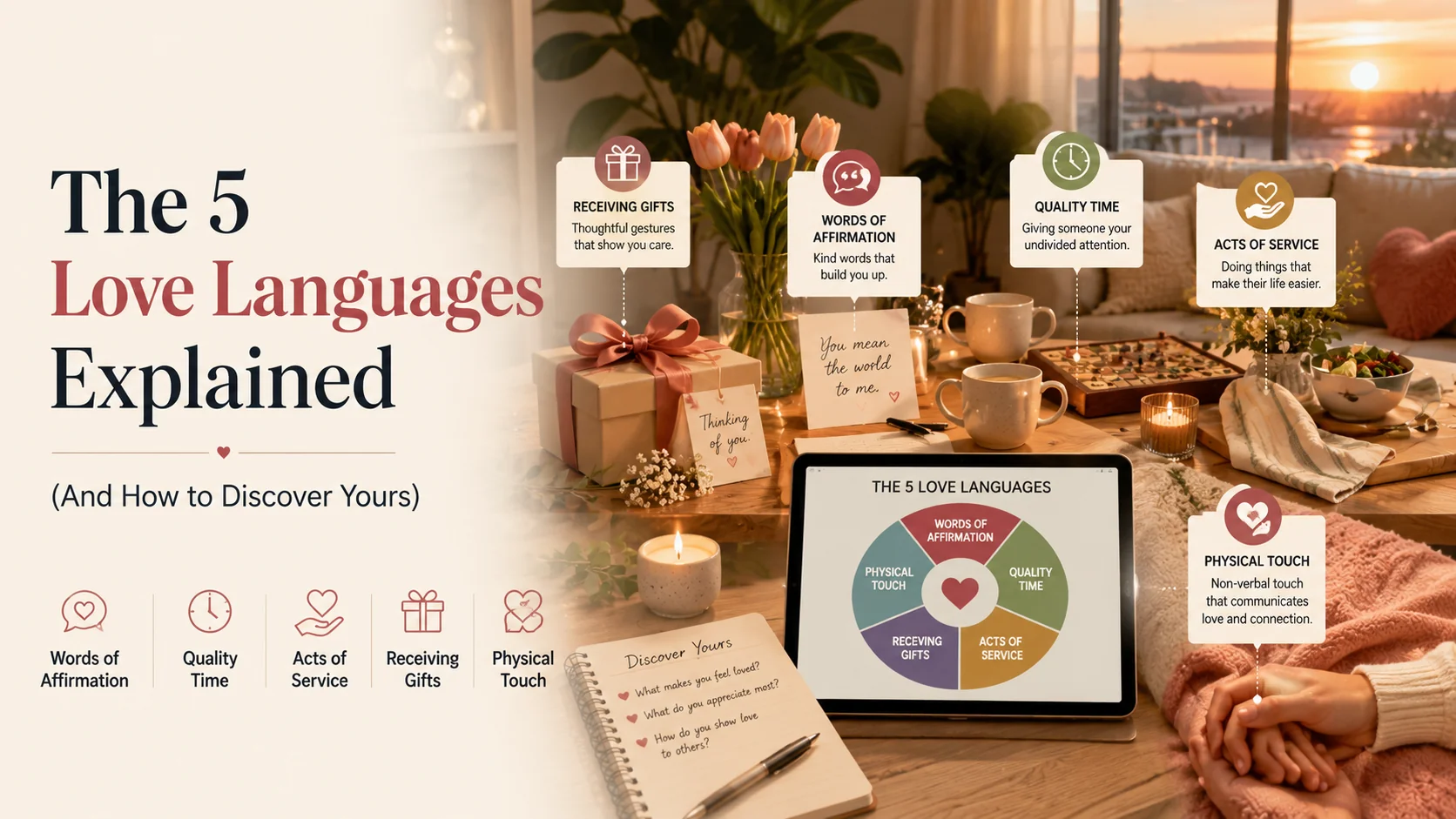
Gary Chapman’s The 5 Love Languages has sold over 20 million copies and remained in the New York Times bestseller list for years. The core idea is simple and genuinely useful: people both give and receive love in different ways, and mismatches between how you express love and how your partner experiences it create the gap between good intentions and actual connection.
The love languages framework is not clinical psychology. It is a practical model for understanding why two people who genuinely love each other can consistently leave each other feeling unloved. Understanding your own primary love language and your partner’s is the beginning of giving love in the form they can actually receive it.
The 5 Love Languages
1. Words of Affirmation
People whose primary love language is Words of Affirmation feel most loved through verbal expressions of appreciation, encouragement, compliments, and direct statements of love and value. This is not about empty flattery. It is about specific, genuine expressions that tell the person they are seen and valued.
What this looks like: Telling your partner specifically what you appreciate about them and why. Verbal encouragement before a challenge. Leaving a note. Complimenting them in front of others. Saying ‘I love you’ and meaning it specifically in that moment, not as a reflexive greeting.
What hurts: Harsh criticism, negative language, sarcasm delivered as humour when the impact is different from the intent, and withholding positive acknowledgment. For someone with this love language, what is not said can hurt as much as what is.
2. Acts of Service
People whose primary love language is Acts of Service feel loved when their partner does things for them: actions that make their life easier, that contribute to shared responsibilities, or that solve problems. The love is in the doing, not the saying.
What this looks like: Handling a task your partner finds difficult or time-consuming without being asked. Noticing what needs doing and doing it. Following through consistently on what you said you would do. Taking something off their plate without announcement or expectation of acknowledgment.
What hurts: Empty promises that are not followed through. Doing things halfway. Making more work for your partner by not completing tasks. Being asked to do things repeatedly because they are not done unprompted. For someone with this language, broken promises are experienced as a statement about how much they matter.
3. Receiving Gifts
People whose primary love language is Receiving Gifts feel most loved through tangible symbols of thoughtfulness. This is consistently the most misunderstood language because it is often dismissed as materialism. It is not. The gift is a symbol of the thought: ‘I was thinking about you when you were not with me, and I translated that thought into something physical.
What this looks like: Gifts that reflect genuine knowledge of the person: their interests, current preoccupations, and expressed needs. Timing matters as much as expense: a small gift at the right moment (the day they had a difficult meeting) can outweigh an expensive one given generically. Remembering significant dates.
What hurts: Forgotten events like birthdays or anniversaries, empty-handed arrivals when a small gesture was appropriate, and not noticing or tracking what the person has expressed wanting. Gifts given without thought (last-minute, clearly generic) can be worse than none.
4. Quality Time
People whose primary love language is Quality Time feel most loved through undivided, focused attention. Not merely being in the same room. Genuinely present time where the other person is the priority. This is one of the most affected love languages in the smartphone era.
What this looks like: Conversations where phones are put away and eye contact is maintained. Activities chosen together where the shared experience is the point. Turning off the television when your partner wants to talk. Planning and following through on one-on-one time that is protected from interruption.
What hurts: Distracted presence (physically present, mentally elsewhere). Cancelled plans without effort to reschedule. Spending time together that is really time in parallel rather than time together. The opposite of quality time is not absence: it is presence without attention.
5. Physical Touch
People whose primary love language is Physical Touch feel most loved through appropriate physical connection: holding hands, hugs, sitting close, a hand on the shoulder, or other forms of non-sexual physical presence. The research on touch in human relationships is extensive: physical touch reduces cortisol, increases oxytocin, and is one of the most direct biochemical pathways to felt safety and connection.
What this looks like: Greeting with a genuine hug, reaching for your partner’s hand during normal activity, a touch on the back while passing in the kitchen, sitting close together, physical comfort during difficult moments.
What hurts: Physical neglect: long periods without affectionate touch. Pulling away from affection. Physical touch that is only initiated in a romantic or sexual context and absent otherwise. For someone with this language, the absence of casual affectionate touch communicates distance even when everything else seems fine.
How to Discover Your Love Language
Chapman offers a formal quiz at 5lovelanguages.com. Two informal methods that often reveal the same information more quickly:
Notice what you most often ask for or request in relationships: The love language you express most loudly as a need is usually your primary one. Do you frequently wish your partner would plan something special just for the two of you (quality time)? Tell you more specifically what they appreciate about you (words of affirmation)? Help with the things on your list without being asked (acts of service)?
Notice what you most often feel is missing: The repeated complaint in previous relationships or the current one typically points directly to the unfilled love language. ‘We’re always in the same house but never really together’ suggests quality time. ‘You never do what you say you’ll do’ suggests acts of service.
Using the Framework With a Partner
The most useful application of the love languages framework is not knowing your own. It is learning your partner’s and deliberately practising their language even when it does not come naturally to you.
If your primary language is words of affirmation and your partner’s is acts of service, the natural tendency is to tell them how much you appreciate them while continuing to leave tasks undone. They hear the words and wait for the evidence. Speaking their love language requires deliberate practice in a form that does not come as intuitively as your own.
What are the 5 love languages?
Gary Chapman’s 5 Love Languages are: Words of Affirmation (feeling loved through verbal appreciation and encouragement), Acts of Service (feeling loved through helpful actions), Receiving Gifts (feeling loved through thoughtful tangible symbols), Quality Time (feeling loved through undivided focused attention), and Physical Touch (feeling loved through appropriate physical connection).
How do you discover your love language?
Notice what you most frequently request from people close to you, and what its absence makes you feel most unloved without. These reveal your primary love language more reliably than thinking abstractly. The official quiz at 5lovelanguages.com provides a structured assessment. Most people have a primary language with a strong secondary one.
Can people have more than one love language?
Yes. Most people have a primary love language with one or two secondary languages that also significantly affect how loved they feel. The framework ranks how strongly each language resonates rather than assigning one exclusive mode. In different relationship contexts (romantic, family, friendship) the primary language may also differ.
What is the most common love language?
Research from Chapman’s surveying suggests Words of Affirmation and Quality Time are the most commonly reported primary love languages, with variation across demographics, cultures, and gender. No single love language is most common across all populations, and the distribution within couples is what matters most for relationship application.
How do you speak your partner’s love language if it is not yours?
Deliberately practice their language rather than defaulting to yours. If your partner’s language is acts of service and yours is words of affirmation, set a specific intention to notice and handle things without being asked rather than expressing appreciation verbally. It requires conscious effort initially because you are not doing what comes naturally.
Are the love languages based on scientific research?
The love languages are a popular framework based on Chapman’s clinical counselling experience rather than controlled research studies. They have not been extensively validated through peer-reviewed psychology research as a formal typology. However, the underlying insight that people have different needs for how they experience feeling loved is consistent with attachment theory and relationship psychology more broadly.
The Framework as a Starting Point
The love languages framework works best as a starting point for conversation rather than a rigid categorization. Understanding that your partner feels most loved differently from how you naturally express love opens a practical conversation about how to close that gap. The value is in the action the framework generates, not in the accuracy of the typology itself.