
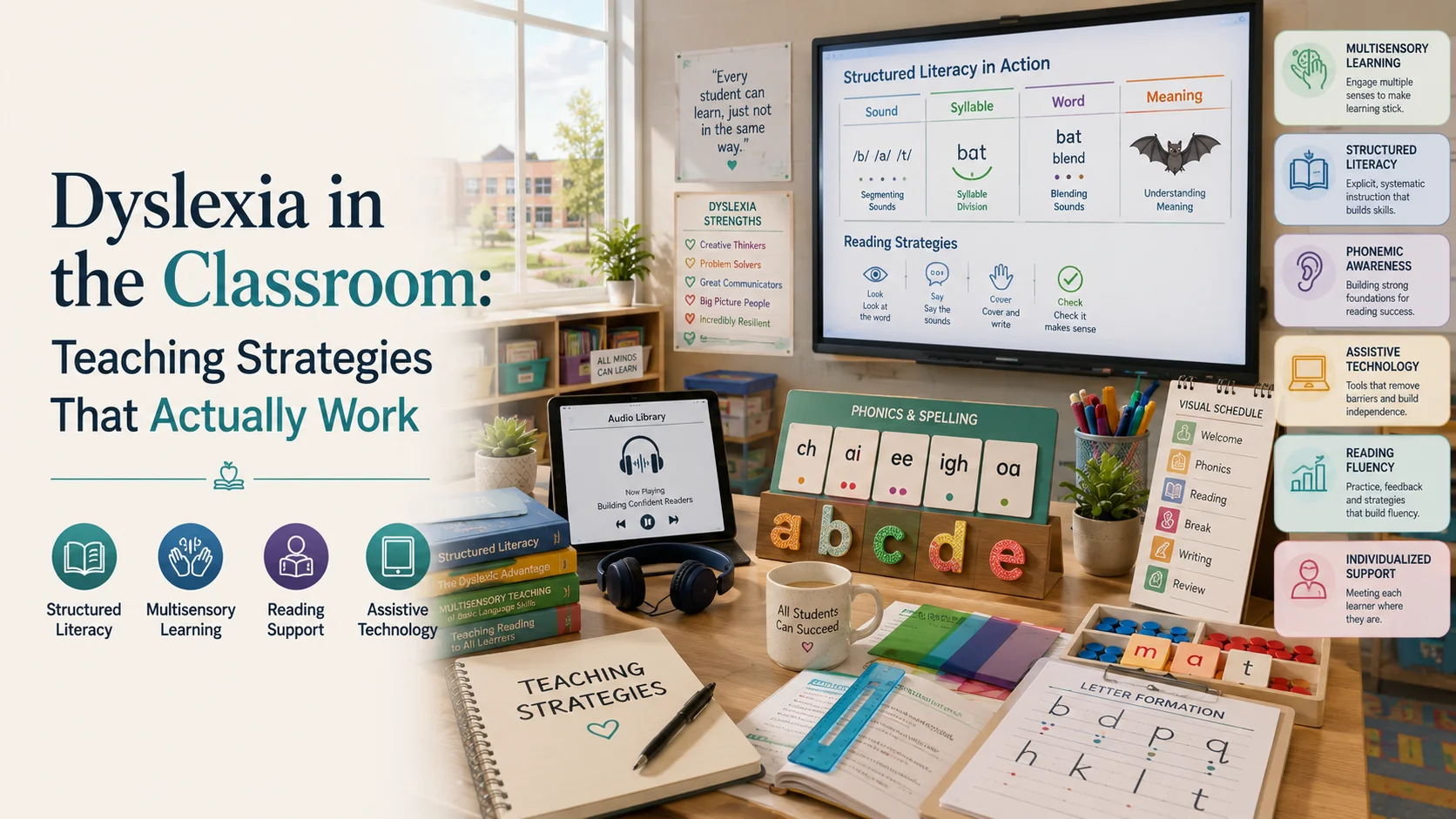
Dyslexia affects 15 to 20 percent of the population, making it the most common learning difference. An estimated 70 to 80 percent of students receiving special education services for reading difficulties have dyslexia. The research on what teaches reading to students with dyslexia is among the most robust in educational science. The gap is not in knowing what works. It is in consistent classroom implementation.
Dyslexia is a neurobiological learning difference characterised by difficulties with accurate and fluent word recognition, poor decoding ability, and poor spelling, despite adequate intelligence and instruction. It is not a vision problem. It is not laziness. It is not a function of intelligence. It is a difference in how the brain processes language, specifically the phonological component of language.
What the Research Says About How Dyslexic Students Learn
The most consistent finding across decades of reading research is that students with dyslexia respond best to explicit, systematic phonics instruction delivered in a structured, multisensory format. This approach is supported by the National Reading Panel, the International Dyslexia Association, and the research reviewed in the 2019 Australian Report on Reading and Dyslexia.
fMRI studies show that explicit phonics instruction produces measurable changes in brain activation patterns for students with dyslexia, moving activation toward the left hemisphere language areas typically associated with skilled reading. This neural plasticity is the evidence base for the effectiveness of structured literacy programmes.
Structured Literacy: The Evidence-Based Framework
Structured literacy is an explicit, systematic, and cumulative approach to teaching reading that directly addresses the phonological processing challenges at the core of dyslexia. It is not a single programme. It is a set of principles implemented through several validated programmes including Orton-Gillingham, Wilson Reading System, SPIRE, and Barton Reading and Spelling System.
Phonological awareness: The ability to hear and manipulate the sounds within words. Before children can connect letters to sounds, they must be able to hear the individual sounds in spoken words. Dyslexic students often have deficits here that require explicit, repeated instruction in rhyming, syllable identification, and phoneme manipulation.
Phonics (alphabetic principle): The systematic connection between letters (graphemes) and sounds (phonemes). Structured literacy introduces these connections in a specific sequence from simple to complex, with mastery at each level before advancing. This differs from incidental phonics embedded in other reading activities.
Fluency: The ability to read connected text accurately, smoothly, and with appropriate expression. Students with dyslexia who have mastered decoding often still read slowly because of processing load. Repeated reading of the same text at instructional level builds fluency.
Vocabulary and comprehension: Explicitly teaching academic vocabulary and comprehension strategies (inference, main idea identification, summarisation) supports dyslexic students whose reading difficulty has limited their exposure to complex text and vocabulary.
Multisensory Instruction
The Orton-Gillingham approach, the foundation of most structured literacy programmes, uses simultaneous visual, auditory, and kinesthetic-tactile pathways when teaching letter-sound relationships. When a student learns the letter ‘b’, they see it, hear the sound, say the sound, trace the letter shape, and tap the phoneme simultaneously. Multiple sensory pathways reinforce the connection and compensate for the phonological processing weakness.
Practical multisensory tools: Letter tiles and magnetic letters for hands-on manipulation. Writing letters in sand, rice, or on textured surfaces. Tapping out phonemes on fingertips when reading or spelling. Air writing (forming letters in the air with large arm movements). Colour-coding vowel and consonant patterns.
Classroom Accommodations That Support Dyslexic Students
Extended time on reading and writing tasks: Processing written text takes longer for dyslexic students. Extended time (typically 1.5 to 2 times standard) allows them to demonstrate knowledge without being disadvantaged by processing speed.
Text-to-speech technology: Tools including Microsoft Immersive Reader, NaturalReader, and Read&Write allow students to hear text read aloud while following along. This separates reading comprehension from decoding, allowing students to access grade-level content while decoding skills are developed.
Speech-to-text: Google Docs voice typing, Dragon NaturallySpeaking, and Apple Dictation allow students to express knowledge through speech rather than writing, separating content knowledge from written expression mechanics.
Reduced copying from the board: Copying from a distance requires holding text in working memory while transferring to paper, a particular challenge for dyslexic students. Provide printed copies where possible.
Alternative formats for assessment: Oral examination, typed rather than handwritten responses, and reduced spelling weighting in subject assessments (where spelling is not the assessed skill) provide accurate measures of content knowledge.
What Does Not Work
‘More time reading’ without instruction: Dyslexic students cannot bootstrap better reading from more reading practice. They need explicit instruction in the missing foundational skills. Assigning more reading without targeted instruction is like prescribing more running to someone with a broken leg.
Whole-language approaches in isolation: Context guessing (using picture clues, sentence context, and initial letter to guess words) is ineffective for students with dyslexia and develops habits that are counterproductive to phonological decoding. Balance with explicit phonics is required.
Waiting and hoping: Early intervention (ideally before age 8) produces significantly better outcomes than later intervention. The Matthew Effect means reading difficulties compound: poor readers read less, fall behind in vocabulary and knowledge, and find catching up progressively harder.
Identifying Dyslexia in the Classroom
Teachers are often the first to notice signs of dyslexia before formal assessment. Key indicators: slow reading relative to apparent intelligence, persistent letter reversals beyond the typical developmental window (age 7 to 8), difficulty with phonological awareness tasks (rhyming, initial sound identification), poor spelling that does not improve with study, fatigue during reading tasks, and avoidance of reading aloud.
What is structured literacy and why does it work for dyslexia?
Structured literacy is an explicit, systematic approach to reading instruction that directly teaches phonological awareness, phonics, fluency, vocabulary, and comprehension in a carefully sequenced, multisensory format. It works for dyslexia because it explicitly teaches the phonological processing skills that dyslexic students do not acquire incidentally, and fMRI research shows it produces measurable changes in brain activation toward typical reading patterns.
What accommodations do dyslexic students need in the classroom?
The most evidence-backed accommodations are: extended time on reading and writing tasks (1.5 to 2x standard), text-to-speech technology for accessing written content, speech-to-text for written expression, printed materials instead of board copying, and alternative assessment formats that measure content knowledge without penalising decoding difficulty.
What is the Orton-Gillingham approach for dyslexia?
Orton-Gillingham is a structured literacy instructional approach using simultaneous visual, auditory, and kinesthetic-tactile pathways to teach phonics. Students see, hear, say, and write letter-sound connections simultaneously. It is the foundational methodology behind most validated dyslexia reading programmes including Wilson, SPIRE, and Barton.
How does dyslexia affect learning in the classroom?
Dyslexia affects accurate and fluent word recognition, decoding, and spelling. In practice this means slower reading, difficulty with tasks requiring written output, exhaustion from tasks other students complete effortlessly, and potential knowledge assessment underestimation if content knowledge is measured through reading and writing rather than alternative formats.
At what age should dyslexia intervention begin?
Early intervention produces significantly better outcomes: ideally before age 8 when neural plasticity is highest and before the Matthew Effect (reading difficulties compounding with each year of missed learning) creates larger gaps. Assessment should be considered when phonological awareness or reading progress is significantly below expectations by kindergarten or first grade.
What assistive technology helps students with dyslexia?
Text-to-speech tools (Microsoft Immersive Reader, Read & Write, Natural Reader) allow students to access written content through audio. Speech-to-text tools (Google Voice Typing, Dragon NaturallySpeaking) allow written expression without handwriting or typing barriers. Audiobooks combined with text following support fluency development. These tools support access to content while structured literacy instruction develops foundational reading skills.
The Gap Is Implementation, Not Knowledge
The evidence base for dyslexia teaching is unusually strong. We know what works. The consistent problem is implementation: teacher training in structured literacy, school-wide screening protocols, and early intervention resource availability. The classroom teacher who understands dyslexia and applies structured literacy principles is one of the most significant assets a dyslexic student can have in their school career.