
McKinsey research consistently finds that 70 percent of large-scale change programmes fail to achieve their stated objectives. A meta-analysis of 300 change initiatives found the primary failure drivers are not technical: they are inadequate senior leadership commitment, insufficient employee engagement, and ineffective communication. The barriers to change are human, not operational.
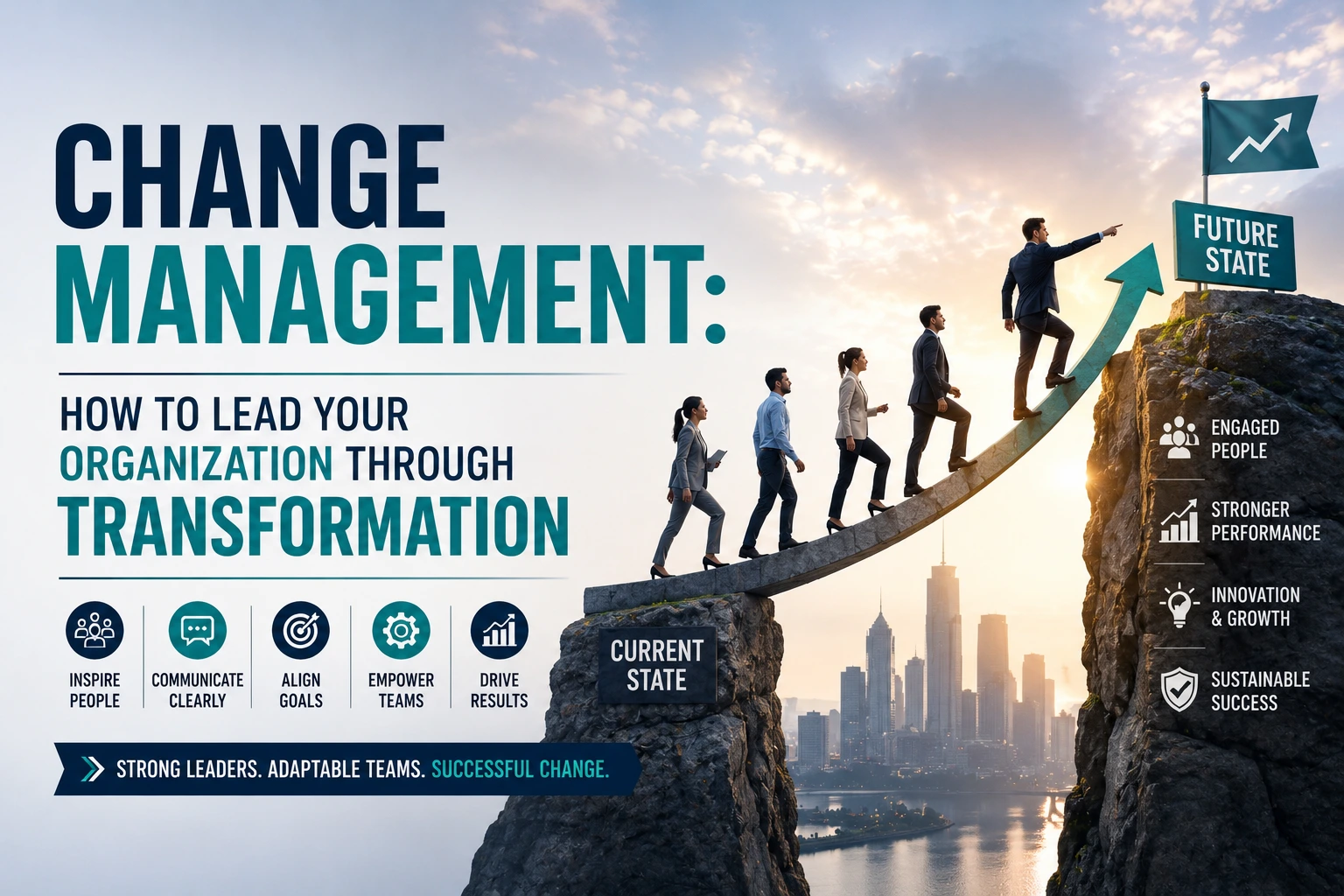
Change management is the structured approach to transitioning organisations, teams, or individuals from a current state to a desired future state. It encompasses the technical design of new processes and the human change journey required to make those processes actually work. Most change initiatives invest heavily in the technical component and underinvest in the human one. The failure statistics reflect this imbalance consistently.
Why Change Initiatives Fail: The Evidence
The McKinsey 70 percent failure statistic is frequently cited without its accompanying analysis. The most consistent failure causes in their research:
Employee resistance (33% of failures): Change that is done to people rather than with people generates resistance proportional to how excluded people feel from the process. Resistance is rarely irrational: it typically reflects legitimate concerns about job security, workload, capability requirements, or the adequacy of the change plan itself.
Inadequate management support (39% of failures): Middle managers are the crucial bridge between executive change vision and frontline implementation. When middle management is uncertain, unconvinced, or actively resistant, they communicate that ambivalence to their teams regardless of what the executive communications say.
Insufficient resources: Change requires additional capacity (for training, communication, transition work, and performance dip management) beyond existing workload. Organisations that expect change to happen on top of full-load operations systematically underestimate the investment required.
Kotter’s 8-Step Change Model
John Kotter’s 8-step model, developed from studying successful and failed major change initiatives, remains the most widely used change management framework:
- Create urgency: make the case for why change is necessary now. Complacency is the enemy of change. Without a compelling reason that people feel, not just understand, change initiatives stall.
- Build a guiding coalition: assemble a group with the authority, credibility, and representation to lead the change. This is not the same as the senior leadership team.
- Form a strategic vision: develop a clear, specific picture of what the future state looks like. Vague change visions (‘we will be more agile’) produce confusion rather than direction.
- Enlist a volunteer army: engage the broader organisation beyond the guiding coalition. Change at scale requires critical mass from middle and frontline levels, not just top-down mandate.
- Enable action by removing barriers: identify and remove structural, technical, and cultural obstacles to the change. Asking people to change while preserving the systems that reinforce old behaviours produces contradictions that undermine the initiative.
- Generate short-term wins: visible, meaningful early wins build momentum and credibility for the longer change journey. Plan for them deliberately rather than hoping they occur.
- Sustain acceleration: do not declare victory too early. Change that is not embedded in systems, culture, and processes tends to revert. Keep pressure on after early wins.
- Institute change: anchor new approaches in culture, systems, and processes so they outlast the change initiative itself.
Prosci ADKAR: Individual Change Alongside Organisational Change
While Kotter’s model addresses organisational change at scale, Prosci’s ADKAR model addresses the individual change journey: Awareness (why change is necessary), Desire (motivation to change), Knowledge (how to change), Ability (skills to implement the change), and Reinforcement (systems and support to sustain the change).
ADKAR is most useful as a diagnostic tool. When a change initiative is stalling, ADKAR helps identify where in the individual change journey the blockage is occurring. An organisation where people lack Awareness needs different interventions than one where Awareness and Desire are high but Ability is low.
Communicating Change: What Research Shows Works
Frequency beats perfection: Effective change communication is not a single well-crafted announcement. It is frequent, consistent messaging that reaches people through multiple channels and reinforces the same message over time. Aim for 7 to 10 exposures to a change message before expecting it to land.
Two-way channels matter as much as broadcast: Announcements address Awareness but not Desire or Ability. Forums for questions, manager conversations, and feedback mechanisms are the channels that build engagement and surface resistance early.
Use managers as primary communicators: Employees trust and act on messages from their direct manager significantly more than messages from senior leaders. Train and equip managers to communicate the change rather than relying on executive broadcasts.
Address the ‘what does this mean for me?’ question first: People process organisational change through a personal lens. Effective change communication answers individual impact questions before explaining strategic rationale.
Managing Resistance
Resistance is information. When employees resist change, they are signalling either that they have concerns worth addressing (about job security, workload, the adequacy of the plan, or unintended consequences) or that they lack the Awareness, Desire, or Ability components of the change journey. Both warrant attention rather than dismissal.
Early resistance (Awareness stage): Invest in education and communication. Resistance from people who do not understand why change is necessary is addressed through information.
Resistance after Awareness (Desire gap): Engage with the underlying concern directly. ‘What specifically worries you about this change?’ and ‘What would need to be true for you to feel good about this?’ produce more useful information than generic reassurance.
Resistance despite Desire (Ability gap): Provide training, resources, and practice opportunities. People who want to change but lack the skills to do so become frustrated, not just resistant. This is a development investment, not a compliance problem.
Why do 70 percent of change initiatives fail?
McKinsey research identifies three primary drivers: employee resistance (33%), inadequate management support at the middle management layer (39%), and insufficient resources for the transition period. The failures are human and cultural rather than technical. Organisations that invest in the technical design of change and underinvest in the human change journey produce the 70 percent failure statistic.
What is Kotter’s 8-step change model?
Kotter’s model describes eight steps for large-scale change: creating urgency, building a guiding coalition, forming a strategic vision, enlisting a volunteer army, enabling action by removing barriers, generating short-term wins, sustaining acceleration, and instituting change in culture and systems. It emphasises that change is a multi-year journey requiring sustained leadership commitment.
What is the ADKAR model in change management?
Prosci’s ADKAR model describes the individual change journey: Awareness (understanding why change is necessary), Desire (motivation to support the change), Knowledge (knowing how to change), Ability (skills to implement the change), and Reinforcement (systems that sustain the new behaviour). It is most useful as a diagnostic tool for identifying where change stalls.
How do you communicate change effectively to employees?
Use frequent, consistent messaging through multiple channels rather than a single announcement. Equip direct managers as primary communicators (employees trust their manager more than senior leaders). Answer ‘what does this mean for me?’ before explaining strategic rationale. Create two-way forums for questions. Plan for 7 to 10 message exposures before expecting the change to land.
How do you handle employee resistance to change?
Treat resistance as information rather than obstruction. Early resistance signals awareness gaps addressed through communication. Resistance after awareness signals desire gaps addressed through engaging the specific concern directly. Resistance despite desire signals ability gaps addressed through training and support. Each type requires different interventions.
What is the role of middle managers in change management?
Middle managers are the most critical and most underinvested bridge in most change initiatives. They translate executive change vision to frontline reality. When middle management is unconvinced or unsupported, their ambivalence communicates to teams regardless of executive messaging. Investing in middle manager conviction and communication skills is one of the highest-ROI activities in any change programme.
Change Is Not Done to People. It Is Done With Them.
The organisations that execute change successfully are those that treat affected employees as participants in the change journey rather than recipients of it. The model is consistent: early engagement, honest communication about impact, genuine channels for concerns, and visible leadership commitment from the middle management layer as much as the executive suite.
Change management is not a soft discipline. It is the practical difference between a $10 million technology implementation that achieves its business case and one that does not.
Leading organizational change requires the right strategy, communication, and leadership. Explore more expert business insights and practical management guides with WritoryBuzz to help your organization navigate transformation with confidence and achieve lasting success.