
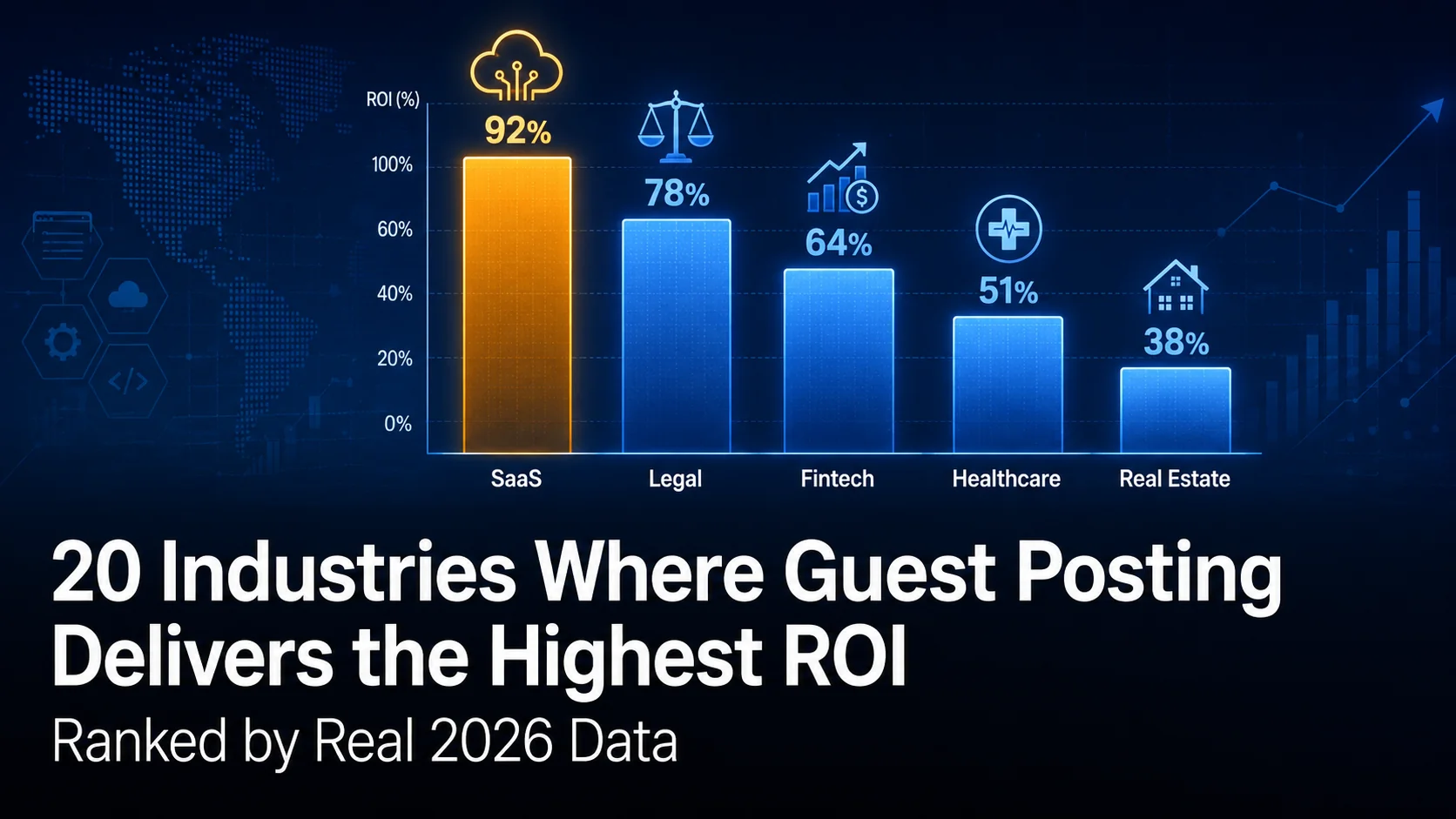
B2B SaaS companies report an average 702 percent ROI from well-executed link-building campaigns, the highest of any vertical measured in RankZ’s 2026 research, with legal services following at 526 percent. Those two figures are the most precisely measured data points available, but the underlying pattern, high customer lifetime value, research-heavy buying journeys, and competitive keyword landscapes, extends across a broader group of industries where guest posting consistently punches above its cost.
The list below combines the two directly measured figures with industries that share the same underlying characteristics driving that ROI: expensive purchase decisions, informed buyers who read before they commit, and search-driven discovery rather than impulse purchasing. Each entry includes the specific buyer behavior driving the ROI pattern and a realistic content angle for that industry, so the list functions as a planning tool rather than just a ranking.
Several of the highest-ROI industries below overlap directly with what WritoryBuzz covers editorially. WritoryBuzz accepts contributor pitches across business, AI, fintech, and cybersecurity, several of the exact verticals this list identifies as strongest for guest posting return.
Industries With Directly Measured High ROI
- B2B SaaS. 702 percent average ROI, the highest directly measured figure in RankZ’s 2026 research, driven by high contract values and buyers who research extensively before purchasing, often comparing five or more vendors before a demo call. A strong guest post angle here is a specific implementation story: how a named team solved a defined operational problem using a category of software, backed by a real before-and-after metric rather than generic feature commentary.
- Legal services. 526 percent average ROI, the second-highest directly measured figure, reflecting extremely high customer lifetime value, a single client matter can be worth tens of thousands of dollars, and intensely competitive local and national search terms where organic visibility is difficult and valuable to earn. Strong guest post angles focus on a specific, narrow area of law with a real case pattern or regulatory change, rather than broad practice-area overviews that compete against thousands of similar law firm blogs.
Industries Sharing the Same High-ROI Characteristics
- Fintech and financial technology. High-value transactions and a research-driven buyer base similar to SaaS, with the added trust premium that editorial coverage provides in a regulated space where buyers are specifically screening for legitimacy signals. A strong angle is a data-backed piece on a specific regulatory shift or payment infrastructure trend, since fintech buyers actively seek analysis that helps them stay ahead of compliance changes.
- Cybersecurity. Enterprise buying committees that research extensively and place unusual weight on third-party credibility before a purchase decision, often requiring sign-off from multiple stakeholders who each independently vet vendor claims. A named incident response lesson or a specific vulnerability pattern, written without disclosing anything client-confidential, tends to outperform generic threat-landscape commentary in this space.
- Healthcare technology and health tech SaaS. Long sales cycles and high per-customer value mirror core B2B SaaS dynamics, with additional trust requirements around data privacy and clinical accuracy that guest posting on relevant, credible sites can help establish ahead of a sales conversation. Angles grounded in a specific clinical workflow improvement or a documented compliance milestone perform best.
- Insurance. Extremely high customer lifetime value, particularly in commercial lines, and a historically expensive paid search landscape that makes organic and earned visibility comparatively efficient by comparison. A guest post explaining a specific coverage gap or claims trend, backed by real claims data where available, resonates more than generic insurance-buying advice.
- Commercial real estate. High transaction values, often seven figures per deal, and a buyer base that actively researches market data, cap rates, and expert commentary before major decisions. Market-specific data analysis, a named metro area’s absorption trends or vacancy rates, consistently outperforms generic real estate investment advice.
- HR technology and recruiting software. A competitive, SaaS-adjacent space where buying committees, typically including HR leadership and finance, read comparison and thought leadership content extensively before shortlisting vendors. Angles built around a specific hiring metric improvement, time-to-fill reduction or retention gain, perform better than generic workplace culture commentary.
- Marketing technology and martech. A crowded, well-informed buyer audience that actively consumes industry content as part of their own professional development, making genuinely useful, specific guest posts unusually effective at building both authority and direct traffic. Tool comparison and workflow-specific content tends to outperform broad marketing trend pieces in this space.
- Legal technology, legaltech. Combines legal services’ high customer value with SaaS’s research-driven buying pattern, reaching a buyer, typically a law firm partner or operations lead, who is simultaneously evaluating cost savings and professional liability risk. Angles addressing a specific compliance or efficiency pain point in legal practice management perform strongly.
- Property technology, proptech. High-value B2B and B2C transactions with an audience that actively researches before large purchases, whether that audience is a property manager evaluating software or a buyer evaluating a platform. Data-driven content on a specific market inefficiency or operational cost saving tends to perform best.
- Wealth management and financial advisory services. Extremely high customer lifetime value and a trust-driven decision process where editorial credibility on a respected third-party site carries real weight, often more than the advisory firm’s own marketing content would in isolation. Angles grounded in a specific planning strategy or market condition analysis, clearly framed as educational rather than individualized advice, perform well.
- Enterprise software and IT infrastructure. Long, research-heavy sales cycles similar to SaaS with typically even higher per-contract value, often involving procurement committees that review dozens of vendor-submitted and third-party sources before a shortlist decision. Architecture decision write-ups and named migration case studies are the strongest-performing content type in this space.
- Higher education and online degree programs. High-value, infrequent purchase decisions where prospective students and their families research extensively across multiple sources before committing, often over a period of months rather than days. Outcome-focused content, career trajectory data or program-specific return on investment analysis, consistently outperforms generic program description content.
- Business consulting and professional services. High per-engagement value and a buyer base that evaluates expertise primarily through published thought leadership before ever taking a sales call, making guest posting one of the most direct pipelines to credibility in this category. A specific framework or methodology, demonstrated through a real anonymized client scenario, performs better than generic consulting advice.
- Logistics and supply chain technology. A growing, increasingly digital B2B space with high contract values and research-driven procurement processes, often involving operations leaders who actively follow trade and technology publications as part of their role. Angles addressing a specific supply chain disruption pattern or efficiency metric tend to perform well.
- Renewable energy and clean technology. High-value B2B and B2C purchase decisions combined with strong media and public interest in the sector, creating unusually broad potential distribution for genuinely well-sourced content beyond the immediate buyer audience. Project-specific data, a named installation’s cost and output figures, performs better than general sustainability commentary.
- Biotech and life sciences. Extremely high per-transaction value in B2B contexts, often involving research partnerships or equipment purchases worth six or seven figures, with a scientifically literate audience that values credible, well-sourced content over promotional framing. Angles grounded in published research findings or a specific methodological advance perform best.
- Manufacturing technology and industrial automation. High contract values and a technically sophisticated buyer base that researches extensively before major capital decisions, often involving engineering stakeholders who scrutinize technical accuracy closely. Specific efficiency or downtime-reduction case data outperforms generic Industry 4.0 trend commentary.
- Commercial insurance and risk management. Shares insurance’s high customer lifetime value with an added layer of complex, research-intensive B2B decision-making, often involving risk managers who read industry analysis as part of their professional responsibility rather than only when actively buying. Angles addressing an emerging risk category, a specific liability trend or regulatory change, perform strongly.
Why These Industries Share a Pattern
Every industry on this list shares three characteristics: a high per-customer or per-transaction value that justifies real investment in earning a single qualified lead, a buyer who genuinely researches before committing rather than purchasing impulsively, and a competitive search landscape where organic and earned visibility meaningfully outperforms paid alternatives on cost efficiency. Guest posting’s ROI advantage compounds fastest in exactly these conditions, and the content angle recommendations above are specifically chosen because they match what a research-driven buyer in each space is actually looking for, rather than generic industry commentary that competes against thousands of similar pieces.
FAQs: Guest Posting ROI by Industry Questions
Which industry gets the highest ROI from guest posting?
B2B SaaS companies report the highest directly measured ROI from guest posting and link building at 702 percent on average, according to RankZ’s 2026 research, followed by legal services at 526 percent. Both figures reflect well-executed campaigns on genuinely relevant, high-authority sites rather than bulk marketplace placements.
Why does guest posting work well for high-value industries?
Guest posting works well for high-value industries because those buyers typically research extensively before committing to an expensive purchase, and editorial content on trusted sites influences that research process directly. High customer lifetime value also means each converted lead justifies more investment in earning organic visibility through content.
Does guest posting work for low-value or impulse-purchase industries?
Guest posting can still work for lower-value or impulse-purchase industries, but the ROI is typically less dramatic than in research-driven, high-value verticals, since impulse buyers rely less on extended research before purchasing. Industries with longer, research-intensive buying journeys consistently show the strongest measured returns.
Is fintech a good industry for guest posting ROI?
Yes, fintech shares the high-value, research-driven characteristics that drive strong guest posting ROI in B2B SaaS, with an added trust premium since editorial coverage on relevant sites helps establish credibility in a regulated, scrutiny-heavy space where buyers are actively screening for legitimacy.
How is guest posting ROI measured?
Guest posting ROI is typically measured by comparing the cost of a link building campaign against the value of resulting organic traffic, lead generation, and conversions attributable to improved search rankings over a defined period. RankZ’s 2026 research measured this at the campaign level across surveyed B2B SaaS and legal services companies.
What industries should avoid heavy investment in guest posting?
Industries with very low customer lifetime value, minimal research-driven buying behavior, or highly localized, low-competition search landscapes generally see less dramatic ROI from guest posting compared with high-value, research-intensive B2B verticals. This does not mean guest posting fails in these industries, only that the return is typically more modest.
ROI Follows the Buyer’s Research Habits
The common thread across every industry on this list is not the product itself, it is how thoroughly that industry’s buyers research before committing. Guest posting earns its strongest return wherever a genuinely informed reader is actively looking for the kind of expertise a well-placed article can provide, and the specific content angles suggested above are designed to meet that reader at the exact stage of research where a well-sourced guest post carries the most influence.