
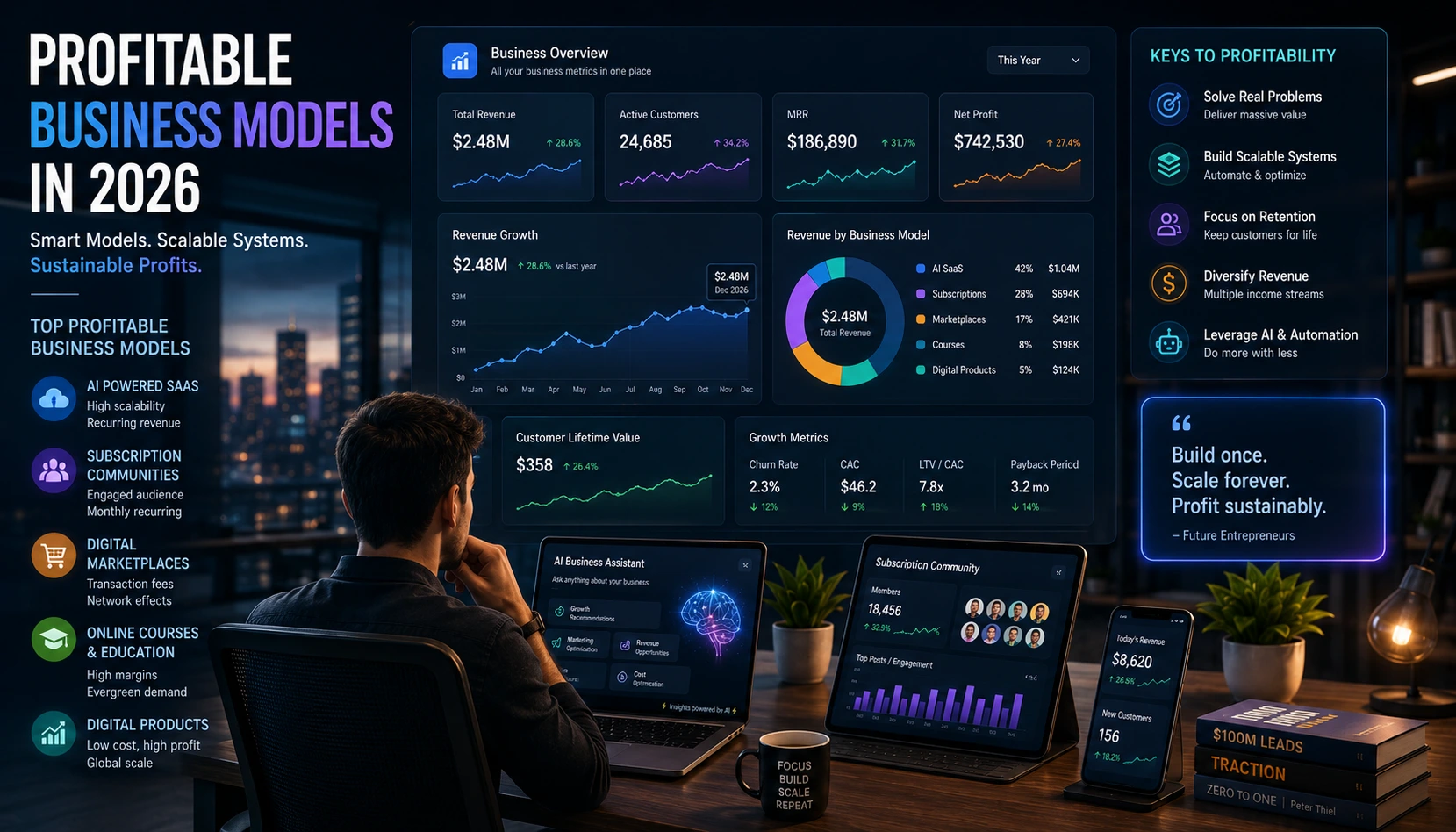
Not all business models are equal right now. Some are benefiting from AI, regulatory tailwinds, and shifting buyer behavior. Others are getting squeezed.
Here is an honest breakdown of which models are working in 2026, why they work, and what each one actually requires to succeed.
What Makes a Business Model Work in 2026
Three forces are reshaping which models win: AI is driving down production and customer service costs dramatically, buyers are more cautious about long-term commitments, and the bar for differentiation in crowded markets has risen sharply.
The models that perform well share a few characteristics: predictable recurring revenue, clear unit economics, and some degree of defensibility (switching costs, network effects, or deep vertical specialization).
The Top 6 Business Models Right Now
1. Vertical SaaS
The biggest opportunity in software is not building another horizontal tool. It is building the only CRM for landscaping companies, or the only compliance tool for dental practices.
Vertical SaaS wins because it faces less competition, commands higher pricing, and has lower churn than horizontal alternatives. Buyers do not switch because the product is built specifically around their workflow and terminology.
The SaaS market is expected to reach $465 billion in 2026, with vertical AI tools leading profitability. The entry cost for building niche software has dropped significantly with no-code tools and AI-assisted development.
2. AI-Powered Services (Productized)
Service businesses that productize their delivery using AI are generating margins that pure service businesses cannot match. A marketing agency charging $3,000 per month for SEO reports that previously required a team of five is now running equivalent outputs with two people.
The model: standardized service, fixed price, AI handles delivery, humans handle strategy and quality control. Retention is high because the output is consistent. Margins improve every time AI capabilities advance.
3. Outcome-Based Pricing
Customers are increasingly resistant to paying for access to a tool. They want to pay for a result. Performance marketing (pay per lead), outcome-based SaaS (pay per result), and usage-based models are all growing as buyers demand alignment between cost and value.
This is harder to run operationally, but the sales cycle is shorter because the risk sits with the vendor.
4. Two-Sided Marketplaces
Platforms connecting supply and demand in underserved niches continue to generate strong returns once they solve the chicken-and-egg problem. The barrier is high, but so is the defensibility once network effects kick in.
Niche marketplaces for freelancers in specific industries, used equipment in specialized sectors, and B2B services with complex buyer-seller matching are all seeing strong activity in 2026.
5. Subscription Content and Community
The creator economy is maturing past ad revenue. Paid newsletters, membership communities, and subscription-based expert access are growing categories with high audience LTV when the community trust is genuine.
The model breaks when content is commoditized. It works when the creator has a distinct perspective that cannot be replicated elsewhere.
6. Website and Digital Asset Flipping
Buying undervalued digital assets, improving their SEO, content, and monetization, then selling at a multiple of monthly revenue. Content websites in 2026 sell at 30 to 45 times monthly average profit.
A site making $1,000 per month sells for $30,000 to $45,000. The skills required (SEO, content strategy, monetization) are learnable, and platforms like Flippa and Investors.Club make deal flow accessible.
Models That Are Struggling
| Model | Why It Is Under Pressure |
| Generic horizontal SaaS | Too much competition, AI commoditizing features fast |
| Pure ad-revenue publishing | CPMs declining, AI-generated content flooding search |
| Traditional dropshipping | Thin margins, supply chain complexity, rising ad costs |
| Undifferentiated consulting | AI doing routine analysis, buyers expect unique insight not reports |
How to Choose
There is no universally best model. The right choice depends on your skills, capital, and risk tolerance.
- If you have technical skills: Vertical SaaS or Micro-SaaS with a specific niche problem
- If you have operational expertise: Productized services using AI for delivery
- If you have content or community skills: Subscription model with genuine audience loyalty
- If you have capital and analytical skills: Digital asset acquisition and flipping
Clear, strategic, and insight-driven content helps brands stand out in competitive markets. WritoryBuzz creates SEO-focused business content that builds authority, attracts audiences, and supports long-term digital growth.
FAQ
What is the most profitable business model in 2026?
Vertical SaaS consistently produces the highest margins among software companies because of low competition, high retention, and pricing power. For non-technical founders, productized AI-powered services offer strong margins with lower build complexity.
How has AI changed business models?
AI has compressed delivery costs in service businesses, commoditized generic SaaS features, and created a new category of outcome-based tools. It has made some models less viable (undifferentiated services) and others more accessible (productized delivery at scale).
What is Vertical SaaS and why is it outperforming?
Vertical SaaS is software built for one specific industry rather than the general market. It outperforms because it has less competition, commands higher pricing, and has lower churn since users cannot easily find a comparable replacement.