
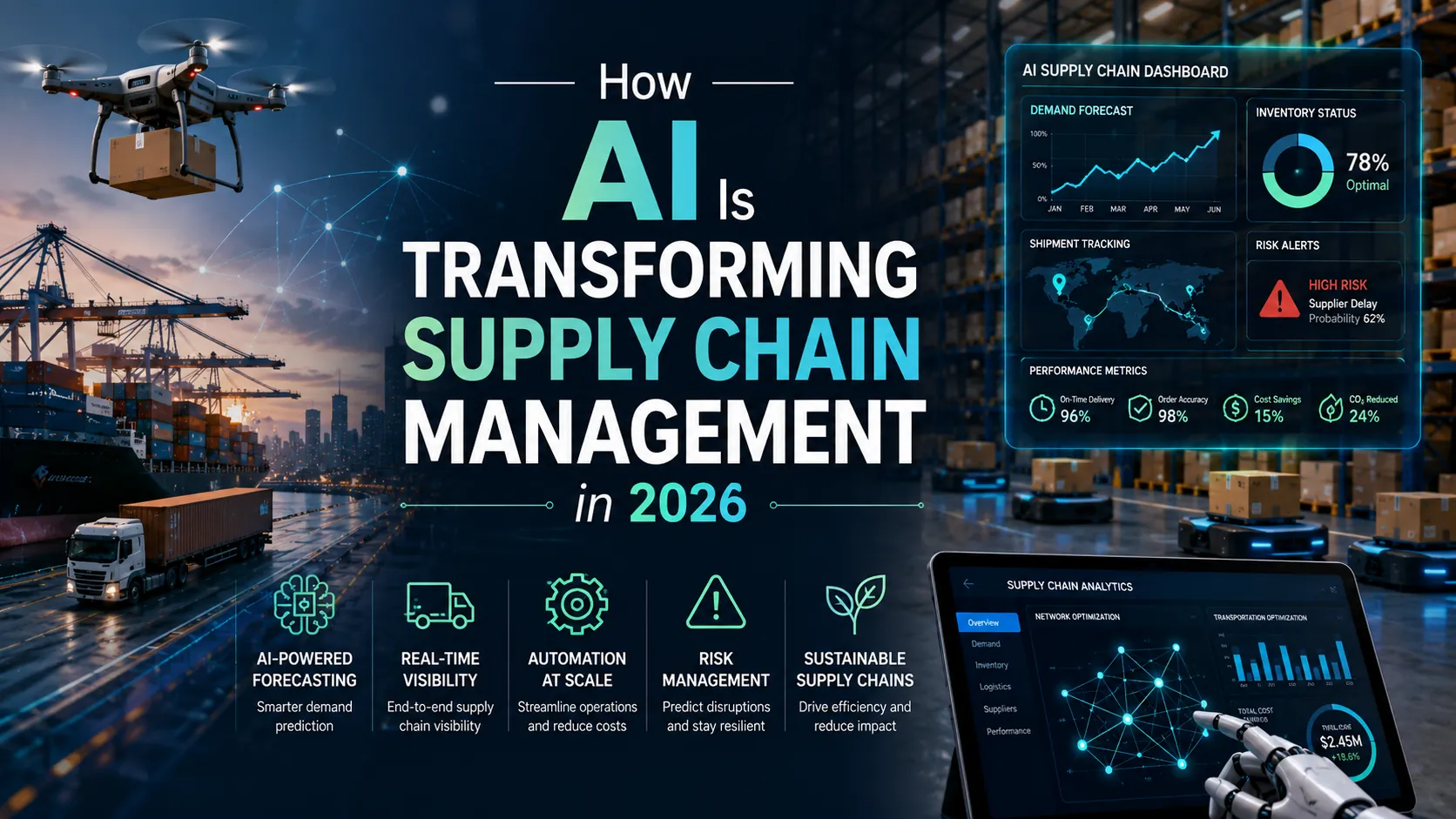
Supply chains failed spectacularly during 2020 to 2022. The lesson learned: reactive management cannot survive modern disruption. AI-powered supply chains act before problems arrive.
From semiconductor shortages to port congestion, the last five years exposed how fragile linear supply chains are when built on historical data and human reaction time. The organisations navigating disruption best in 2026 share a common characteristic: they replaced reactive decision-making with predictive systems that anticipate problems days or weeks before they materialise.
AI in supply chain is not one technology. It is a set of machine learning, computer vision, natural language processing, and optimisation capabilities applied across the entire value chain from supplier selection to last-mile delivery.
The Core Applications Delivering Real Results
Demand Forecasting
Traditional demand forecasting relied on historical sales data and seasonal adjustments. AI-powered forecasting ingests dozens of data sources simultaneously: point-of-sale data, social media sentiment, weather forecasts, competitor pricing, local events, and macroeconomic indicators. The result is a forecast that updates in real time rather than weekly or monthly.
Retail leaders using AI-driven demand forecasting have reduced inventory write-offs by tens of millions of dollars annually while cutting forecast error rates by more than 30 percent compared with previous statistical approaches, according to supply chain analytics research from 2026. Amazon’s ML models process order history, search trends, and location data to pre-position inventory closer to customers before orders are placed — reducing last-mile delivery distance and cost.
Route Optimisation and Logistics
AI route optimisation processes real-time traffic, weather, fuel costs, driver hours, vehicle capacity, and customer time windows simultaneously to find the most efficient delivery sequences. This is computationally impossible for humans managing thousands of daily routes. Major carriers deploying AI route optimisation consistently report fuel savings of 10 to 15 percent and measurable carbon emission reductions.
George Maksimenko, CEO of Adexin, notes that in 2026, AI’s real value in logistics comes from targeted applications — route optimisation, ETA prediction, and resource planning — where the more specific the use case, the more powerful the result.
Warehouse Automation
Gartner predicts more than 75 percent of large enterprises will use industrial robots in their warehouses by 2026. Ocado, the British online grocery retailer, operates AI-powered robotic arms that can handle and pack a vast range of food items with accuracy and speed — completing a 50-item order in minutes. Amazon’s Kiva robots move shelving units to pick stations, reducing the distance human workers travel by 60 to 70 percent.
Computer vision enables real-time quality inspection, inventory counting without manual stock-takes, and damage detection in receiving. AI-powered sorting systems process parcels at speeds that human-sorted operations cannot approach.
Supply Chain Visibility and Risk Management
Most supply chain decisions are made on data that is hours or days old. AI platforms process IoT sensor data, shipping status feeds, port congestion data, and supplier production data to provide end-to-end visibility in real time. When a container ship encounters delay, AI systems automatically identify which purchase orders are affected, calculate the downstream impact, and propose mitigation actions alerting procurement teams before customers feel the impact.
The resilience application is particularly valuable. AI systems can model disruption scenarios before they happen: simulating supplier failures, port closures, and demand spikes, then recommending contingency actions. The World Economic Forum has highlighted AI-driven resilience as a top supply chain priority for global businesses through 2030.
Supplier Management and Procurement
AI is automating routine procurement communication, price negotiation for commodity categories, and supplier risk scoring. Systems monitor supplier financial health, geopolitical risk in their operating regions, and quality performance metrics to provide early warning of supplier instability before it disrupts production.
| Application | What AI Does | Business Impact |
| Demand forecasting | Ingests 20+ data sources, updates in real time | 30%+ reduction in forecast error, lower inventory write-offs |
| Route optimisation | Processes real-time traffic, capacity, time windows | 10–15% fuel savings, reduced emissions |
| Warehouse automation | Computer vision, robotic picking, sorting | 60–70% reduction in picker travel distance |
| Risk management | Models disruption scenarios, monitors supplier health | Early warning, proactive mitigation vs reactive scramble |
| Procurement | Automates routine purchasing, monitors supplier risk | Staff redeployed to strategic decision-making |
The Honest Challenges
Data quality is the limiting factor in most AI supply chain initiatives. AI models are only as good as the data fed into them. Organisations with siloed, inconsistent, or poorly maintained supply chain data find that AI implementations underperform until the data infrastructure is addressed.
Integration complexity is significant. Most enterprises operate legacy ERP, WMS, and TMS systems built at different times by different vendors. Connecting AI layers to these systems requires substantial technical investment.
Human oversight remains essential. AI supply chain systems recommend and automate within defined parameters, but the escalation protocols for edge cases, ethical supplier decisions, and strategic network design still require human judgment.
Where to Start
The organisations seeing the best AI supply chain ROI in 2026 started with one high-impact application rather than a comprehensive transformation. Demand forecasting is the most common starting point because the data usually exists, the ROI is measurable in 6 to 12 months, and it does not require changes to physical operations.
- Start with the application where your current process produces the most expensive mistakes.
- Fix data quality before deploying AI models. Garbage in, garbage out applies more severely to ML models than to spreadsheets.
- Use vendor solutions rather than building from scratch for standard applications like route optimisation and demand forecasting. The infrastructure cost of building these internally rarely justifies itself.
How is AI used in supply chain management in 2026?
AI is applied across demand forecasting, route optimisation, warehouse automation, real-time visibility, risk management, and procurement automation. The highest-impact applications process real-time data from multiple sources simultaneously — something that was computationally impractical before modern ML infrastructure.
How does AI reduce supply chain disruptions?
By predicting disruptions before they occur rather than reacting after they happen. AI systems monitor supplier financial health, geopolitical risk indicators, port congestion, and weather data, modeling disruption scenarios and recommending contingency actions in advance. This proactive posture is the fundamental change from traditional reactive supply chain management.
The Direction Is Clear
Supply chain AI is not in the pilot phase for most large organisations in 2026. It is in production. The question has moved from ‘should we explore AI for our supply chain?’ to ‘which applications do we prioritise, and how do we scale what is already working?’ For organisations still at the exploration stage, the cost of delayed adoption is already measurable in competitive disadvantage.