
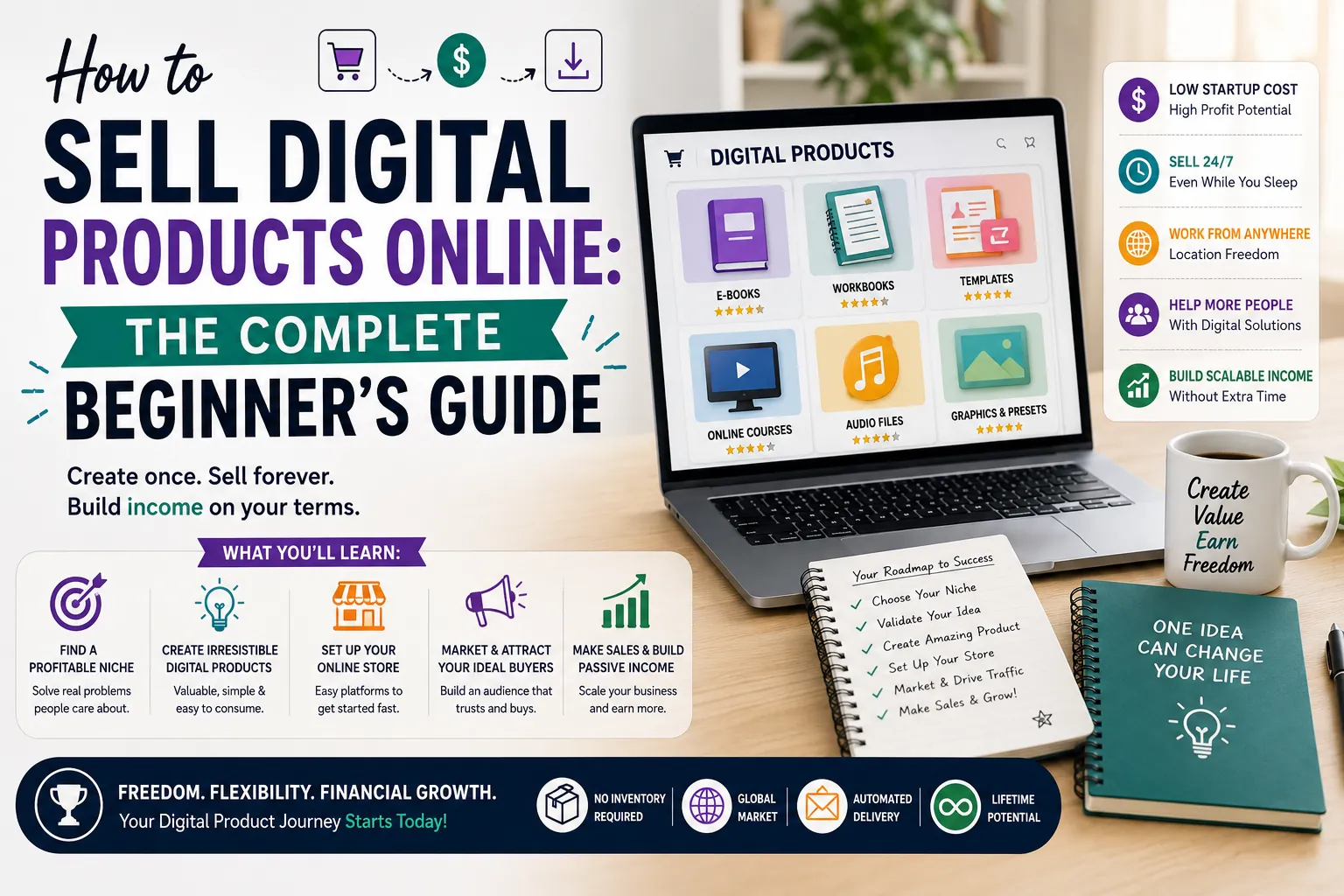
Digital products have the best unit economics of any online business model. You create it once. It sells indefinitely. The variable cost of each sale is zero. Here is how to actually build this.
Selling digital products is the most accessible online business model available in 2026. No inventory, no shipping, no manufacturing. A well-positioned digital product in a niche with real demand can generate income while you sleep — the phrase that sounds like marketing copy but accurately describes what happens after the system is built.
The honest caveat: ‘build it once, sell forever’ requires building something people actually want, positioning it where the right buyers can find it, and setting up the sales infrastructure correctly. This guide covers all three.
What Counts as a Digital Product
Ebooks and guides. Long-form written content solving a specific problem or teaching a specific skill. The term ebook suggests formality; in practice these range from 20-page PDF guides to comprehensive 200-page books. They sell best when the topic is specific and the buyer has high intent.
Templates and tools. Notion templates, Excel spreadsheets, Canva design templates, website themes, landing page frameworks. These often have the highest perceived value-to-creation-effort ratio. A well-designed Notion dashboard template sells for $15 to $50 and can be created in a day by someone who already has the system.
Online courses and workshops. Video, audio, or text-based courses teaching a skill or process. Higher price points ($50 to $2,000+) and higher creation effort. The most scalable when hosted on evergreen platforms.
Printables and worksheets. Downloadable PDFs for planning, journaling, education, or creative activities. Popular on Etsy, lower price points ($2 to $15), and lower creation effort than courses. Volume-dependent income model.
Software, presets, and plugins. Lightroom presets, Photoshop actions, WordPress plugins, code libraries. Requires relevant technical skill but commands premium pricing and strong passive income potential.
Where to Sell: Platform Comparison
| Platform | Best For | Traffic | Fee Model | Ease |
| Gumroad | Creators, indie products | You bring traffic | 10% + payment fees (free plan) | Very easy |
| Etsy | Printables, templates, digital art | Built-in marketplace | Listing + transaction fees | Easy |
| Teachable | Online courses | You bring traffic | 5% + payment fees (free plan) | Easy |
| Podia | Courses + community + email | You bring traffic | 0% transaction (paid plans) | Easy |
| Shopify + SendOwl | Brand control, scaling | You bring traffic | Shopify monthly + app fee | Medium |
| Kajabi | All-in-one: course + email + site | You bring traffic | Monthly subscription | Medium |
The Most Common Starting Mistakes
Creating a product before validating demand. The most expensive mistake. Before spending weeks creating a course or ebook, validate that people are actively searching for it and willing to pay. Use keyword research, check Amazon book categories, and look at Etsy bestsellers in your niche. If no one is searching for similar products, there may not be demand.
Setting the price too low. Digital product creators consistently underprice. A Notion template priced at $5 will not be taken seriously by buyers expecting professional quality. Research what comparable products sell for and price competitively, not cheaply. Higher prices often signal higher quality.
Relying entirely on the platform’s marketplace. Etsy and platform marketplace traffic is valuable but not yours. Your product’s success should not depend entirely on marketplace algorithm changes. Build an email list and direct traffic channel alongside any marketplace presence.
Validating Your Digital Product Idea
Before creating anything, answer three questions:
- Is there demonstrated demand? Search Google, Etsy, and Amazon for similar products. Are people buying them? How many reviews do similar products have? High review counts on existing products indicate real buyer activity.
- Can you reach the buyers? Where does your target customer spend time online? Do you have or can you build access to that audience through SEO, social media, marketplace listings, or partnerships?
- What will make yours better? Every successful digital product category has competition. The new entrant needs a specific angle: more comprehensive, better designed, more specific to a niche, or priced at an accessible tier the market currently lacks.
Creating Your First Product
The fastest digital product to create and validate is a PDF guide or template. You can create it in Canva or Google Docs, export as PDF, and list it on Gumroad in an afternoon. The creation barrier is low enough that validation can happen quickly.
For the first product, choose a topic where:
- You have genuine knowledge or experience — not necessarily expert-level but real and specific
- The buyer’s problem is clear and the solution is teachable or deliverable
- The format matches the complexity: simple templates for simple problems, comprehensive courses for complex skill development
The Sales System
A product page that converts. The product listing page needs: a specific title that clearly describes what the buyer gets, social proof (reviews, buyer count), a clear preview of the content, and explicit statement of who it is for. ‘Social media marketing templates’ is worse than ’30 Canva social media templates for coaches and consultants.’
An email capture for non-buyers. Visitors who arrive at your product page but don’t buy are not lost — they are prospects. A lead magnet offering a free sample or related resource captures their email for follow-up.
A post-purchase upsell. Customers who just bought trust you. The moment after purchase is the highest-conversion point for related products. An automatic post-purchase offer for a complementary product at a discount converts at 15 to 25 percent without additional marketing effort.
What digital products sell best online?
Templates and tools (Notion templates, Canva designs, Excel models) have the best effort-to-revenue ratio for most creators. Online courses command the highest price points. Printables on Etsy have the most marketplace traffic. The best-selling category depends entirely on your skills and audience.
How much money can you make selling digital products?
The range is enormous — from a few hundred dollars monthly from a single Etsy product to seven-figure revenues from established course businesses. A realistic expectation for a focused beginner with an existing small audience is $500 to $3,000 monthly within the first year. Without an existing audience, the first year is typically focused on product creation, marketing infrastructure, and initial traction.
Start With One Product, One Platform, One Audience Channel
The most common digital product failure mode is too many products across too many platforms without enough focus on any of them. One good product, sold through one well-chosen platform, marketed through one traffic channel you will consistently execute, produces better results than four products across five platforms with scattered effort.
Create the simplest version of your first product. List it on the platform where your target buyer already shops. Build the traffic channel that connects you to them. Everything else comes after that foundation is proven.