
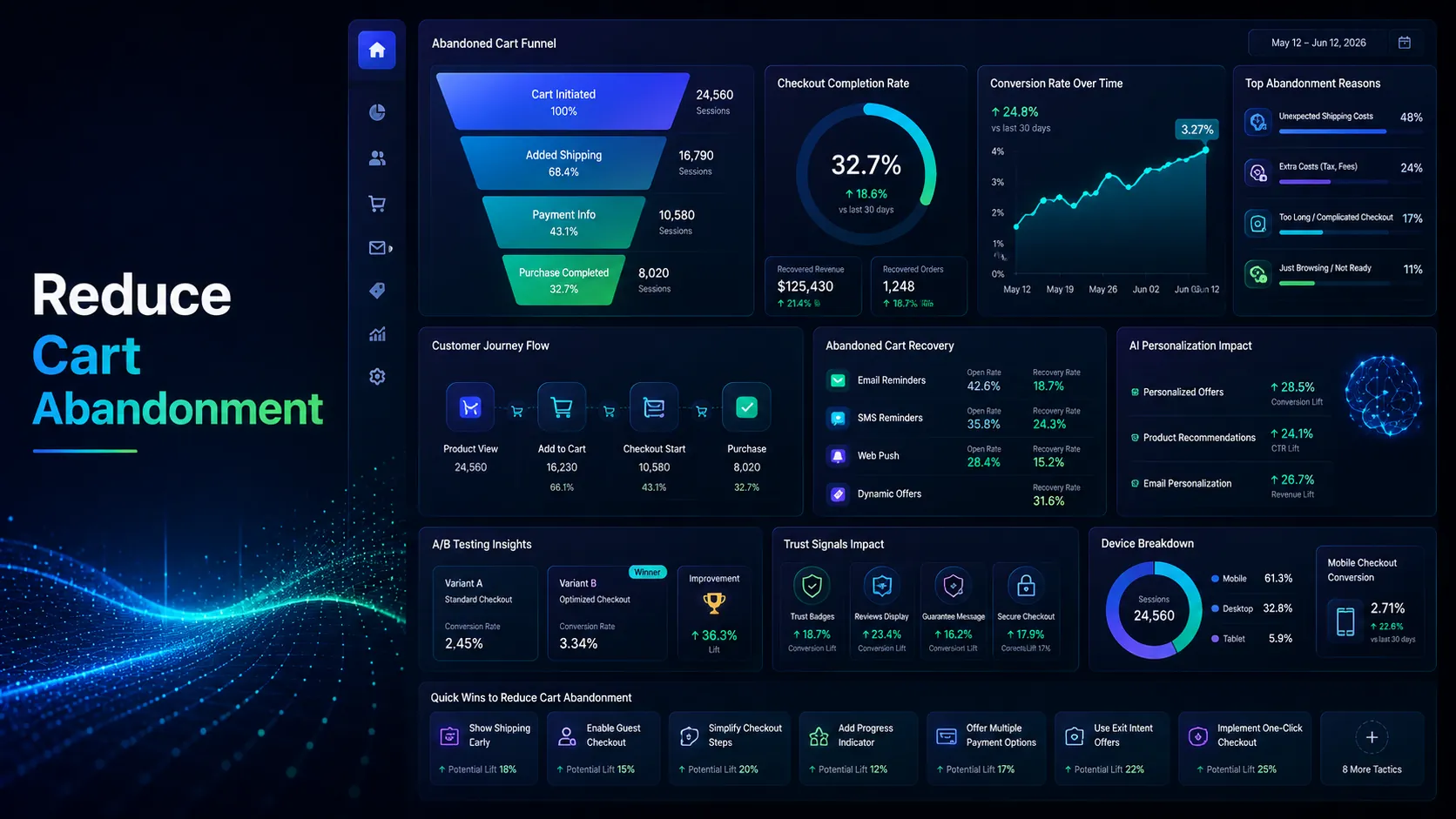
70 percent of shoppers who add items to cart leave without buying. Most of that lost revenue is recoverable. These 15 tactics have the strongest evidence behind them.
The global cart abandonment rate in 2026 is 70.22 percent according to Baymard Institute’s meta-analysis of 50 studies. Mobile abandonment reaches 76.98 percent. Baymard estimates $260 billion in abandoned revenue is recoverable in the US and EU through better checkout design and recovery tactics.
Why Shoppers Leave (The Data)
- Unexpected extra costs at checkout (shipping, taxes) — cited by 48% of abandoners
- Required to create an account — 24% of abandoners
- Too long or complicated checkout — 22% of abandoners
- Not trusting the site with card information — 18% of abandoners
- No suitable payment methods — 13% of abandoners
All five causes are fixable with checkout design changes that require no additional marketing spend.
Checkout Experience Tactics (Highest Leverage)
- Show all costs upfront. The highest-impact single change. Display estimated shipping on the product page or early in checkout. Surprise costs at the final step are the leading abandonment cause. Show free shipping thresholds prominently and indicate how close customers are to reaching them.
- Offer guest checkout. Requiring account creation before purchase loses 24 percent of potential buyers. Guest checkout with optional post-purchase account creation captures the sale first.
- Reduce form fields. The average checkout form has 14.88 fields according to Baymard — more than twice the 8-field optimal. Combine first and last name. Remove fields for data you can infer.
- Add address autocomplete. Google Places API reduces form completion time and errors by 20 to 30 percent. Minimal implementation cost, measurable abandonment reduction.
- Show checkout progress. Users who know how many steps remain abandon less. A simple 3-step indicator (Cart > Details > Payment) reduces perceived friction significantly.
- Keep carts persistent. Shoppers returning three days later should find their cart intact. Requiring re-adding items is unnecessary friction that costs sales.
- Offer multiple payment methods. Apple Pay, Google Pay, and PayPal reduce checkout time dramatically for mobile users. BNPL options reduce abandonment by 20 percent for orders over $100 and 29 percent for 18 to 34-year-olds.
- Display trust signals on payment page. Security badges, SSL indicators, visible return policies, and reviews near the checkout button address the 18 percent who do not trust the site.
Recovery Tactics
- Three-part abandoned cart email sequence. Above 40 percent open rates. Email 1 (1 hour): soft reminder with cart contents. Email 2 (24 hours): address an objection. Email 3 (72 hours): urgency or incentive. Together a well-designed sequence recovers 5 to 15 percent of abandoned carts.
- SMS recovery for opted-in subscribers. 98 percent open rates. Sent 30 minutes after abandonment, typically recovers 2 to 4 times more revenue per send than email. Ensure explicit opt-in — non-opt-in SMS violates TCPA and GDPR.
- Dynamic retargeting ads. Ads showing the specific product abandoned outperform generic retargeting 3 to 4 times. Apply frequency caps to avoid damaging brand perception.
- Exit-intent popups with genuine value. Triggered when cursor moves toward the browser close button. Needs to offer real value — a first-time discount, free shipping threshold, or cart save option — not generic interruption.
Trust and Friction Reduction
- Reviews near checkout. Product reviews visible on or near the checkout page reduce late-stage doubt.
- Visible specific return policy. ‘Free 30-day returns, no questions asked’ near the buy button addresses purchase risk anxiety.
- Test mobile checkout separately. Mobile abandonment is 12 percentage points higher than desktop. One-tap payment methods reduce this gap by 35 percent.
| The Biggest Available Win
Baymard’s research shows fixing checkout usability issues alone can increase conversion by 35.26 percent for average large e-commerce sites. No more traffic, no more advertising. Just fixing the checkout that existing traffic is already abandoning. |
What is the average cart abandonment rate in 2026?
70.22 percent across all industries per Baymard’s meta-analysis. Mobile is 76.98 percent. Finance sector is highest at 83.7 percent. Pet care and consumer goods are lowest at 54 to 57 percent.
What is the most effective cart recovery method?
A three-part abandoned cart email sequence with the first email sent within 1 hour. The first email alone recovers more than later emails. SMS recovery has higher open and conversion rates for opted-in subscribers.
Fix the Checkout First
Transparent shipping costs, guest checkout, and reduced form fields these three changes alone typically increase checkout completion by 10 to 20 percent in A/B tests. Fix the checkout before building the recovery sequence.