
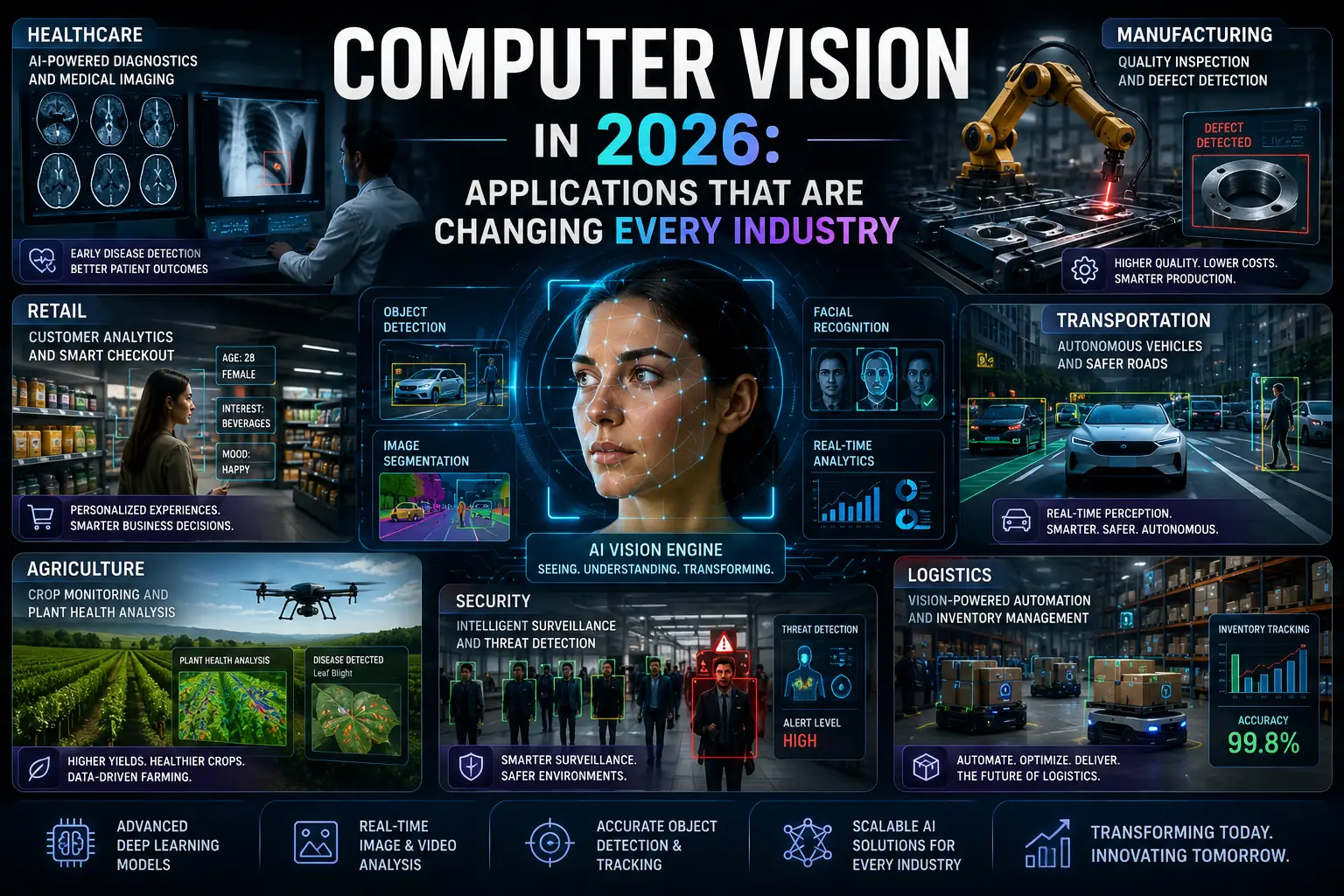
Computer vision crossed $32 billion in market value in 2026. It detects cancer in MRI scans, navigates autonomous vehicles, monitors factory defects in real time, and powers cashierless checkout. The technology is no longer a research prototype. It is operational infrastructure.
Computer vision enables machines to interpret and act on visual data the way human eyes and brains do. Powered by deep learning and convolutional neural networks, modern vision systems process thousands of images per second with accuracy that matches or exceeds human performance on specific tasks. By 2026, multimodal AI combining vision with language and audio has expanded what these systems can do further still.
Healthcare: The Highest-Stakes Application
Medical imaging diagnosis: AI vision systems analyse X-rays, MRI scans, and CT images to detect anomalies that may be too subtle for human eyes. Voxel-level analysis on MRI scans can identify early-stage tumours at sizes that challenge human radiologists. FDA-cleared medical imaging AI tools are now deployed in clinical workflows at major health systems globally.
Remote patient monitoring: Smart cameras with IoT connectivity observe patients in hospital and care home settings, detecting falls, sudden movements, and changes in posture in real time. Systems alert care staff immediately rather than waiting for scheduled check-ins.
Surgical assistance: AR-powered visual overlays guide surgeons during complex procedures by highlighting anatomical structures and key areas in real time. Computer vision systems track instrument position and can flag deviations from planned surgical paths.
Manufacturing: The Largest Current Deployment
Manufacturing is the strongest real-world use case for computer vision in 2026 because small accuracy improvements compound massively at production scale. A vision system detecting 99.7 percent of defects on a line producing 100,000 units daily prevents 300 defective products from reaching customers. Human inspection at comparable speed and accuracy is not feasible.
Automated quality inspection: High-speed cameras connected to vision AI inspect products for defects, dimensional accuracy, surface finish, and labelling errors at production line speed. In automotive and electronics manufacturing, vision AI detects issues nearly invisible to the human eye.
Predictive maintenance: Computer vision monitors equipment condition visually, detecting heat signatures, unusual motion patterns, and surface degradation that precede equipment failure. Thermal cameras combined with vision AI identify components running hot before they fail.
Retail: From Checkout to Customer Behaviour
Cashierless checkout: Amazon’s Just Walk Out technology and similar systems use camera arrays with deep learning to track items customers pick up and charge accounts automatically. Simpler implementations using cameras to identify items placed on a scale are more widely deployed than full cashierless environments.
Real-time shelf monitoring: Vision AI alerts staff immediately when shelves are empty or incorrectly stocked. Retailers lose significant revenue from out-of-stock events. Real-time shelf monitoring reduces the gap between stock depletion and replenishment.
Visual search: Customers increasingly search for products using images rather than text. Platforms built on visual search and image recognition allow shoppers to photograph a product they want and find matching items immediately, improving discovery and conversion.
Autonomous Vehicles and Smart Infrastructure
Autonomous driving: BYD’s God’s Eye 5.0 system rolled out across 2.3 million vehicles in China in 2026. Wayve demonstrated a mapless, camera-based autonomy stack operating in novel cities. Computer vision is the primary sensory system for object detection, pedestrian identification, lane recognition, and traffic sign reading in autonomous vehicles.
Traffic management: Smart city computer vision monitors traffic flow, detects incidents, and adjusts signal timing in real time. Vision systems at intersections reduce average congestion by identifying bottlenecks and directing rerouting before gridlock develops.
Port and logistics: Drone-based vision systems scan shipping containers for structural damage, rust, and labelling at ports. Warehouse robots use computer vision for navigation, item identification, and collision avoidance with human coworkers.
Agriculture and Field Applications
Precision agriculture uses drone-mounted and field-mounted cameras to monitor crop health, detect disease and pest damage, and assess irrigation needs across large areas. Vision systems identify specific plant diseases from aerial imagery with accuracy that would require hours of manual field inspection per hectare.
Livestock management applications include computer vision systems that monitor individual animal health, detect injuries or illness, and in some documented deployments, keep piglets safe from crushing by monitoring the position of the mother sow continuously.
| Industry | Primary Application | Key Metric |
| Healthcare | Medical imaging diagnosis | FDA-cleared AI in clinical workflows |
| Manufacturing | Quality inspection at speed | 99.7%+ defect detection accuracy |
| Retail | Cashierless checkout and shelf monitoring | Real-time stock alerts |
| Automotive | Autonomous driving systems | 2.3M vehicles (BYD God’s Eye 5.0) |
| Agriculture | Crop health monitoring via drone | Hours of inspection reduced to minutes |
| Logistics | Container damage and parcel sorting | Automated routing at scale |
What is computer vision and how does it work in 2026?
Computer vision enables machines to interpret images and videos using neural networks trained on large datasets. In 2026, deep learning models and Vision Transformers process visual data with accuracy that matches human performance on specific tasks, operating in real time across industries from healthcare to autonomous vehicles.
Which industry uses computer vision the most?
Manufacturing has the largest current deployment of computer vision for quality inspection, defect detection, and predictive maintenance. Healthcare is the fastest-growing segment driven by FDA-cleared medical imaging AI. Retail and automotive are both scaling rapidly in 2026.
How is computer vision used in healthcare?
Computer vision analyses X-rays, MRI scans, and CT images to detect abnormalities, often at sizes below human detection thresholds. It also powers remote patient monitoring for fall detection, surgical assistance with AR overlays, and pathology image analysis for disease diagnosis.
What is the computer vision market size in 2026?
The computer vision market passed $32 billion in value in 2026 according to industry analysis. Growth is driven by manufacturing adoption, healthcare deployment of FDA-cleared AI imaging tools, and the scaling of autonomous vehicle programs globally.
Can computer vision replace human inspection?
For repetitive, high-speed visual inspection tasks with defined defect criteria, computer vision outperforms humans on speed and consistency. It does not replace human judgment for novel situations, complex contextual decisions, or tasks requiring physical interaction. The most effective deployments combine computer vision for volume tasks with human oversight for edge cases.
What is a Vision Transformer and why does it matter?
Vision Transformers (ViTs) apply the attention mechanism from large language models to image analysis, enabling models to understand spatial relationships across entire images rather than local patches. In 2026, ViTs have become a leading architecture for medical imaging, autonomous driving, and any computer vision task requiring global context understanding.
The Infrastructure Behind Modern AI
Computer vision is transitioning from a technology that demonstrates capability to one that delivers operational ROI at scale. The industries deploying it most successfully are those with high-volume repetitive visual tasks, where accuracy and speed requirements exceed what human operators can sustainably provide.
The frontier for 2026 and beyond is multimodal: systems that combine vision with language understanding to not just see but reason about what they see in context.
As computer vision becomes a core driver of innovation across industries, businesses that adopt it effectively will gain a significant competitive edge. At WritoryBuzz, we help organizations develop intelligent computer vision solutions that streamline operations, enhance decision-making, and unlock new growth opportunities. Whether you’re exploring automation, visual analytics, or AI-powered inspection systems, our team can help you turn vision technology into real business results.