
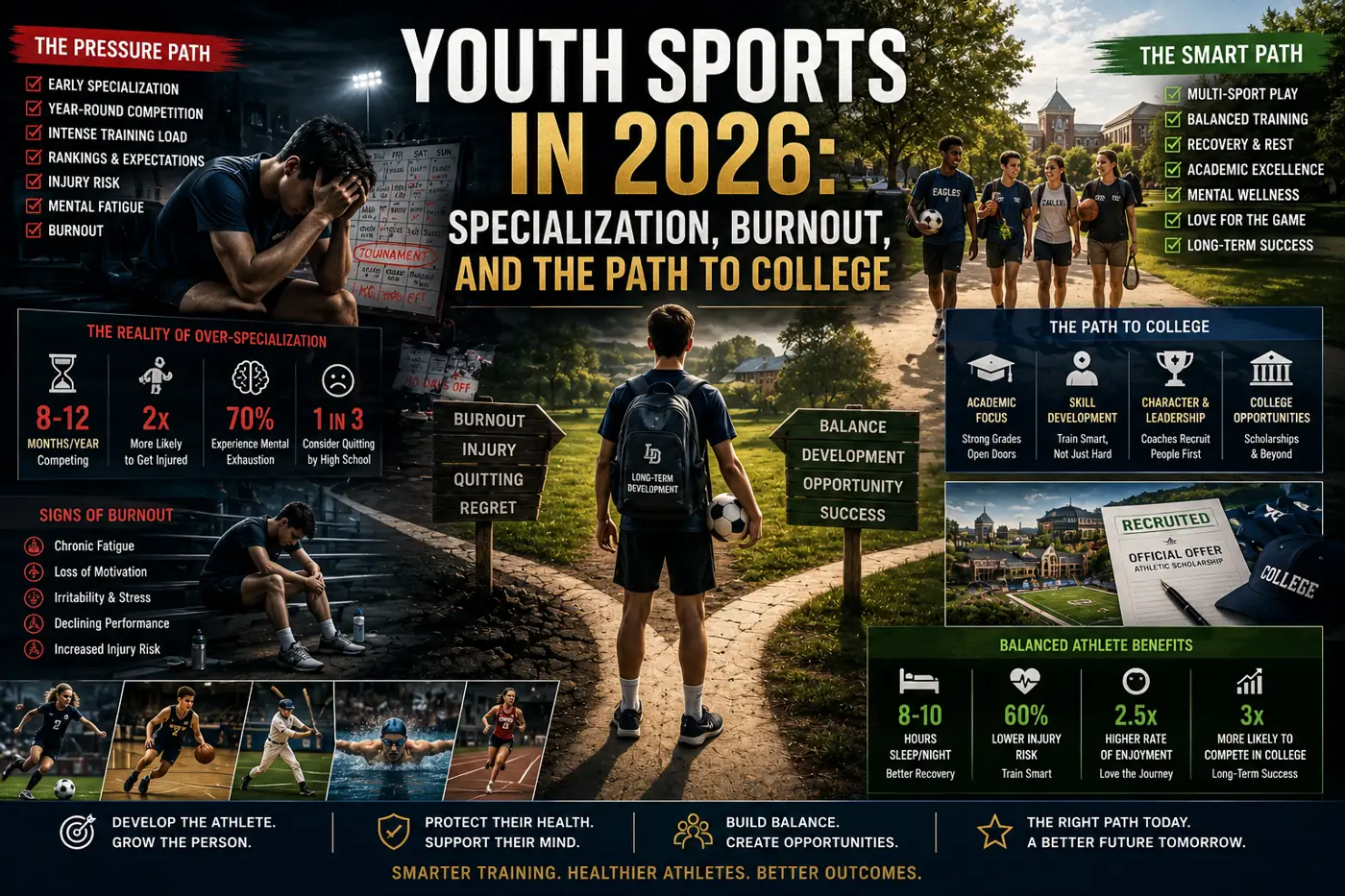
The pressure in youth sports has intensified over the past decade. Year-round training in a single sport, private coaching, travel team commitments that span multiple states, and the implicit or explicit promise that early specialisation is the path to college scholarships and professional careers have become normalised in many athletic communities.
The research on whether this approach achieves its stated goals is considerably less supportive than the industry built around it. What sports medicine researchers, university coaches, and athletic development specialists consistently find diverges significantly from what is often presented to parents of talented young athletes.
What Early Specialisation Actually Does to Young Athletes
Early sports specialisation is defined by researchers as year-round training in a single sport before puberty, with the exclusion of other sports. The benefits are real: earlier technical skill acquisition, deeper tactical understanding of a specific sport, and a competitive edge in age-group competition.
The documented costs are also real. A 2019 meta-analysis in the British Journal of Sports Medicine found that early sport specialisation is associated with a 70 to 93% higher rate of overuse injuries compared to multi-sport athletes. Repetitive stress on developing bodies, before bone density and connective tissue have matured, produces injury patterns that affect long-term athletic careers.
The psychological toll is documented separately. Studies of athlete dropout rates consistently show that early specialisers are more likely to leave their sport before age 18 than late specialisers, primarily due to burnout, loss of enjoyment, and sport-identity collapse when performance does not meet expectations.
The Burnout Profile: What It Looks Like and When to Act
| Burnout Indicator | Early Signs | Late Signs (Intervention Needed) |
|---|---|---|
| Emotional | Less enthusiasm pre-practice | Dread, anxiety, crying before events |
| Physical | Persistent fatigue despite rest | Frequent illness, injury recurrence |
| Motivational | Declining effort in practice | Refusal to attend, no desire to improve |
| Identity | Less talk about the sport at home | Complete withdrawal from sport-related identity |
| Social | Isolation from non-sport peers | Total social world defined by sport only |
Early-stage burnout is reversible. A reduced training load, unstructured play, deliberate off-season time away from the sport, and conversations with the athlete about their actual enjoyment level are effective interventions. Late-stage burnout frequently results in permanent sport dropout and, more concerning, broader motivational and identity issues that extend beyond athletics.
What University Coaches Actually Recruit
The gap between what parents believe increases college recruitment prospects and what university coaches report looking for is significant. A survey of NCAA Division I coaches across multiple sports consistently finds that coaches recruit athletes who demonstrate coachability, character, and physical development potential over those who specialised earliest.
Several prominent D1 programmes have publicly noted that multi-sport athletes often adapt better to the demands of college athletics because they bring better general athleticism, spatial awareness, and psychological resilience than athletes who have done only one thing since age eight. The narrow technical skill of a young specialist sometimes comes at the cost of broader athletic development that becomes limiting at higher levels.
The athletic development research supports this: the sampling years, typically ages 10 to 14 for most sports, where children play multiple sports and develop a broad base of fundamental movement skills, produce athletes who reach senior elite performance more often than those who specialised in the same period.
How to Evaluate Travel Teams and Club Programmes
The club sports industry in the US is a multi-billion dollar sector largely unregulated for athlete welfare. Travel teams and club programmes vary enormously in coaching quality, athlete development philosophy, and the honesty of their recruitment promises.
Questions worth asking before committing a young athlete to a programme: what is the coach’s athlete development philosophy regarding specialisation and playing multiple sports? What is the programme’s policy on injured athletes (do they pressure athletes to play through injury)? What percentage of the programme’s graduates have gone on to college programmes and at what level? How many hours per week, year-round, does the programme expect?
A programme that discourages multi-sport participation, pressures injured athletes, and uses selective data to claim college placement rates is operating against the long-term interests of the athletes in it. These programmes exist and are widespread; identifying them requires specific questions rather than relying on reputation alone.
The Case for Late Specialisation
Late specialisation, where athletes continue sampling multiple sports through early adolescence and specialise closer to late secondary school age, is associated with better long-term outcomes in most research. Tennis, gymnastics, and figure skating are the notable exceptions where early technical grounding is strongly associated with elite outcomes. For most team sports and individual athletics, the data favours later specialisation.
Roger Federer played multiple sports competitively through early adolescence. Wayne Gretzky played multiple sports. The mythology of the early specialist who turned to their sport full-time at age five and dominated is real but uncommon and survivor-biased; for every early specialist who succeeded, there are many who burned out or were injured before reaching the level that would make their story tellable.
FAQs
At what age should a young athlete specialise?
Sports medicine organisations including the American Academy of Pediatrics recommend avoiding specialisation before age 12 to 14 for most sports. After early adolescence, higher levels of specialisation are appropriate as the child’s physical development matures and their own preferences become more defined. For early technical sports like gymnastics, swimming, and figure skating, earlier specialisation is more accepted but should still be balanced with deliberate recovery periods.
How many hours per week is appropriate for youth sport?
A widely cited guideline is that sport-related activity hours per week should not exceed the child’s age in years. A 12-year-old should not regularly exceed 12 hours of sport per week. This includes practice, competition, and training. Above this threshold, injury rates and burnout rates increase measurably. Many elite youth programmes significantly exceed this guideline.
Is a college sports scholarship realistic?
The data is sobering. The NCAA reports that approximately 7% of high school athletes go on to play college sports at any level. Of those, fewer than 2% receive full scholarships. The probability of a full athletic scholarship for any given youth athlete is extremely low. Academic scholarships are both more numerous and more attainable for most young athletes, and the academic work that college athletics requires means academic performance matters as much as athletic performance in most recruitment conversations.
What Parents Can Do Differently
The most protective thing a parent can do for a young athlete’s long-term development is to ensure that sport remains primarily the child’s activity, not the family’s project. When the parent’s emotional investment in the child’s sport performance exceeds the child’s own investment, the motivational dynamic that fuels burnout is already established.
Conversations about sport that focus on effort, enjoyment, and learning rather than results, rankings, and recruitment keep the athlete’s intrinsic motivation alive. That intrinsic motivation is both the best predictor of long-term athletic development and the best protection against burnout.
For sports science coverage, youth athlete development research, and honest sports culture analysis throughout 2026, WritoryBuzz covers athletics beyond the results tables.