
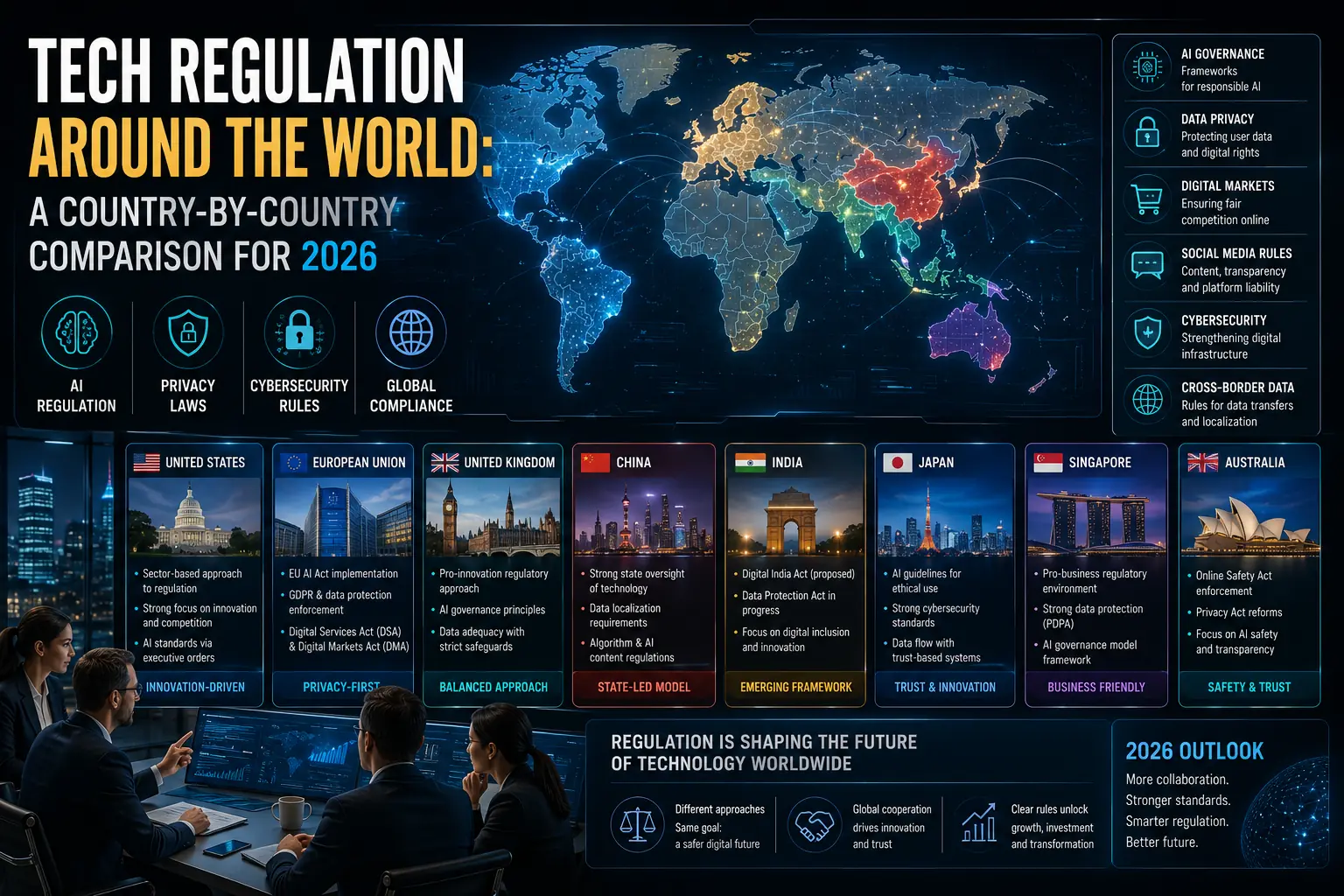
The European Union fined Meta 1.2 billion euros under GDPR in 2023, the largest privacy fine in history. China mandated algorithm transparency for domestic platforms. The US passed the first federal AI-specific legislation in 2026. India’s Digital Personal Data Protection Act took effect in 2025. The global regulatory picture has never been more fragmented, or more consequential for tech companies operating across borders.
Tech regulation in 2026 varies so dramatically across jurisdictions that a product compliant in one region may require fundamental redesign in another. Understanding the major regulatory approaches, their different philosophical foundations, and their practical implications is essential for any technology business with international operations or ambitions.
The European Union: The Most Aggressive Regulator
The EU has established itself as the world’s most aggressive technology regulator through a combination of GDPR (privacy), the Digital Markets Act or DMA (competition), the Digital Services Act or DSA (content moderation), and the EU AI Act (AI governance). Together, these four frameworks represent the most comprehensive technology regulatory architecture in existence.
GDPR (2018, ongoing): Governs the collection, processing, and storage of personal data. The extraterritorial scope means it applies to any organisation processing EU residents’ data regardless of where the organisation is based. Maximum fines of 4 percent of global annual turnover. Actively enforced with significant fines: Meta 1.2 billion euros in 2023, Amazon 746 million euros, WhatsApp 225 million euros.
Digital Markets Act (2023): Designates large online platforms as ‘gatekeepers’ and imposes obligations on them including interoperability requirements, data portability, and prohibitions on self-preferencing. Apple has faced significant DMA scrutiny in 2025 and 2026 over App Store practices and browser choice requirements.
EU AI Act (2024-2026 phased implementation): The world’s first comprehensive AI regulation, classifying AI systems by risk level. High-risk applications (healthcare, recruitment, law enforcement) face strict requirements. General purpose AI models above certain capability thresholds face transparency and safety obligations. Full implementation continues through 2027.
United States: Fragmented but Accelerating
US technology regulation has historically been less prescriptive than the EU, with sector-specific regulations and significant reliance on market competition. In 2026, this is changing. Congress passed the first federal AI-specific legislation in early 2026, primarily focused on national security applications and high-risk AI systems. State-level privacy laws now exist in more than 20 states with California’s CCPA/CPRA remaining the strongest.
Antitrust enforcement: The Department of Justice successfully established that Google maintains illegal monopolies in search and search advertising in its landmark 2024 ruling. Remedies are being determined through 2026. The FTC’s scrutiny of AI market consolidation has increased significantly, examining the relationships between major tech companies and AI startups.
AI Executive Orders and legislation: President Biden’s 2023 AI Executive Order established reporting requirements and safety standards for AI systems above certain capability thresholds. Congress’s 2026 AI legislation focuses on high-risk applications in critical infrastructure and requires pre-market evaluation for certain AI systems.
Data privacy: No federal comprehensive privacy law as of mid-2026, despite years of Congressional discussion. State laws remain the primary privacy regulatory framework, creating a patchwork of requirements that businesses with national operations must navigate.
China: State Control and Domestic Innovation Priority
China’s approach to technology regulation is distinct from both the EU and US frameworks. Regulation primarily serves two objectives: maintaining state control over information flows and data, and protecting and promoting domestic technology companies from foreign competition.
Algorithm regulation: China’s Algorithm Recommendation Regulations (2022) require platforms to disclose recommendation algorithm operations to users, allow users to opt out of personalised recommendations, and prohibit algorithms that induce addictive behaviour. This represented the most sophisticated algorithmic transparency regulation globally when introduced.
Data sovereignty: China’s Data Security Law and Personal Information Protection Law restrict cross-border data transfers and require security assessments for data exports. International tech companies operating in China face requirements to store Chinese user data locally.
AI regulation: China has published guidelines for generative AI services requiring security assessments and mandatory registration. The regulation prioritises social stability and political content control alongside the more universal concerns of accuracy and safety.
India: The Emerging Regulatory Market to Watch
India’s Digital Personal Data Protection Act came into effect in 2025, establishing a national privacy framework for the world’s most populous country. The Act establishes user rights over personal data, data principal consent requirements, and an enforcement mechanism through a Data Protection Board.
India represents one of the most important emerging regulatory markets for technology companies. Its 1.4 billion person internet-accessible population combined with rapidly maturing domestic tech sector and growing regulatory framework makes it a jurisdiction no global tech company can ignore.
Content moderation: India’s IT Rules require significant social media platforms to appoint local grievance officers, respond to government removal requests within defined timelines, and provide user traceability for encrypted content under court order.
The Regulatory Fragmentation Challenge for Tech Companies
The practical challenge for technology companies operating globally in 2026 is that these frameworks are not just different in emphasis. They are sometimes directly contradictory. EU GDPR data minimisation principles conflict with some US national security data retention requirements. China’s cross-border data transfer restrictions conflict with how global platforms manage data infrastructure.
Companies responding to this fragmentation are increasingly building regional data architectures, region-specific product features, and localised compliance teams. Smaller companies either focus on specific regulatory environments or build for the most stringent applicable regime (typically GDPR) as a global standard.
| Region | Primary Focus | Key Framework | Enforcement Style |
| EU | Privacy, competition, AI safety | GDPR, DMA, EU AI Act | Aggressive, large fines |
| US | Antitrust, AI security, sector-specific | DOJ/FTC enforcement, state laws | Enforcement-led, fragmented |
| China | State control, domestic AI | Algorithm regs, PIPL | State-directed compliance |
| India | Data protection, content moderation | DPDPA, IT Rules | Emerging, developing capacity |
| UK | Post-Brexit alignment | UK GDPR, Online Safety Act | Moderate, sector-focused |
Which country has the strictest technology regulation?
The EU has the most comprehensive and actively enforced technology regulatory framework, combining GDPR (privacy), the Digital Markets Act (competition), the Digital Services Act (content), and the EU AI Act (AI governance). Fines reach 4 percent of global annual turnover under GDPR.
What is the EU AI Act and who does it affect?
The EU AI Act classifies AI systems by risk level and imposes requirements proportional to risk. High-risk AI systems in healthcare, recruitment, and law enforcement face pre-market conformity assessment, transparency obligations, and ongoing monitoring. General purpose AI models above certain capability thresholds face transparency and safety evaluation requirements. It applies to any AI system deployed in the EU regardless of where the developer is based.
Does GDPR apply to companies outside the EU?
Yes. GDPR’s extraterritorial scope applies to any organisation that processes data of EU residents, regardless of where the organisation is headquartered. A US-based company with EU customers is subject to GDPR. Enforcement has been directed at major non-EU companies including Meta, Amazon, and WhatsApp.
How does China’s approach to tech regulation differ from the EU?
The EU prioritises user rights, market competition, and AI safety. China’s regulation primarily serves state control of information flows and data sovereignty, with domestic platform promotion as a secondary objective. Both require algorithm transparency but for different reasons and with different mechanisms. China’s cross-border data transfer restrictions are among the most stringent globally.
What is the Digital Markets Act and which companies does it affect?
The EU’s Digital Markets Act designates large online platforms as ‘gatekeepers’ and imposes obligations including interoperability, data portability, and self-preferencing prohibitions. Gatekeepers include Alphabet (Google), Apple, Meta, Amazon, Microsoft, and ByteDance. The Act aims to contest the structural market power these platforms hold in key digital markets.
Is there a federal data privacy law in the United States?
No federal comprehensive data privacy law exists as of mid-2026 despite years of Congressional discussion. More than 20 US states have enacted their own privacy laws with varying requirements. California’s CCPA/CPRA is the strongest and most widely influential. Companies operating nationally must navigate this patchwork framework.
Regulatory Geography Is Now Product Strategy
Technology regulation in 2026 is no longer a compliance function that operates after product decisions are made. The regulatory environment of target markets is a primary product and infrastructure design consideration for any technology company operating internationally.
The divergence between the EU’s rights-based framework, the US enforcement-led approach, and China’s sovereignty-first model is structural and likely to persist. Building for the most stringent applicable regime, typically GDPR, as a global baseline remains the most practical default for companies that do not have the scale to maintain fully regional product architectures.