
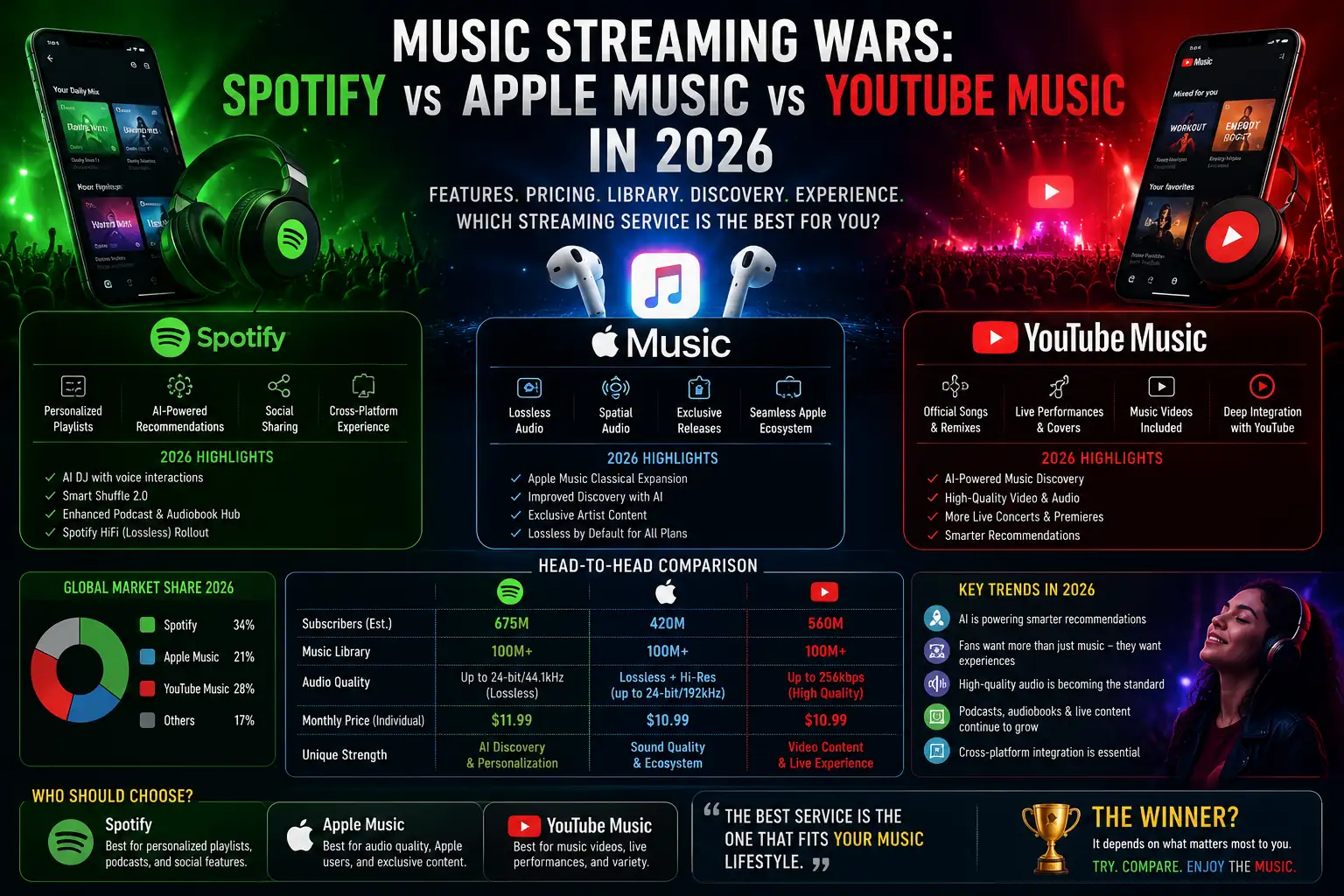
Spotify has 713 million monthly active users including 276 million paying subscribers. Apple Music has 94 million subscribers. YouTube Music benefits from 2.2 billion YouTube users as its discovery engine. Music streaming apps generated $63.6 billion in revenue in 2025. Yet the competition between the three has never been more about features than it is about catalogue, which all three now essentially share.
The music streaming comparison in 2026 is not primarily about which service has more songs. All three services carry 100 million-plus tracks and the overlap is nearly total for mainstream content. The competition is about sound quality, ecosystem integration, algorithmic discovery, video integration, podcast and audio expansion, and the increasingly important question of how much artists get paid.
Subscriber and Revenue Picture
| Platform | Active Users | Paying Subscribers | Annual Revenue | Market Share |
| Spotify | 713 million MAU | 276 million | ~$15 billion | 36% subscriber share |
| Apple Music | N/A (Apple ecosystem) | 94 million | $9.2 billion | US market leader |
| YouTube Music | Bundled with YouTube Premium | ~80 million (estimated) | Part of $60B+ YouTube revenue | Growing rapidly |
| Amazon Music | N/A | ~68 million (estimated) | Bundled with Prime | Stable |
Sound Quality Comparison
Sound quality has become a genuine differentiator in 2026 as lossless audio has moved from niche audiophile feature to standard offering across platforms.
Apple Music: Lossless audio up to 24-bit/192kHz and Dolby Atmos Spatial Audio are included in all Apple Music subscriptions at no extra cost. No premium tier required. The highest quality ceiling of the mainstream services, but requires compatible hardware for the full benefit.
Spotify: Spotify HiFi lossless was announced in 2021 and has been repeatedly delayed. As of mid-2026, Spotify still does not offer lossless audio, which is the most-cited competitive disadvantage against Apple Music. Spotify’s standard quality is 320kbps Ogg Vorbis, which is high quality for compressed audio but not lossless.
YouTube Music: Up to 256kbps AAC quality. No lossless offering. Strong for music video integrated listening. The weakest audio quality ceiling of the three.
Discovery and Algorithm Quality
Spotify’s algorithmic discovery is widely considered the best in the streaming industry. Discover Weekly, Daily Mixes, and Release Radar use listening history, collaborative filtering, and audio analysis to surface relevant new music with a consistency that competitors have not matched. Multiple independent comparisons of discovery quality consistently rank Spotify first.
Spotify: The gold standard for new music discovery. The combination of listening history analysis, playlist context, and explicit audio feature analysis produces recommendations that feel genuinely personalised. Artists’ entire careers can be affected by Spotify algorithm placement.
Apple Music: Stronger editorial curation (human-curated playlists by genre specialists) and slightly weaker algorithmic discovery. Apple Music Radio provides live broadcasting that Spotify does not. Better for listeners who prefer editorial recommendations over algorithmic ones.
YouTube Music: Discovery benefits directly from YouTube’s video recommendation engine. If you have YouTube viewing history, YouTube Music connects music and video discovery. Strong for discovering music through videos rather than audio-first browsing. Less effective for audio-only playlist listening.
Ecosystem Integration
Apple Music: The natural choice for users deep in Apple’s ecosystem. Siri integration, CarPlay, HomePod, Apple Watch, and cross-device syncing through iCloud all work seamlessly. No Android app limitations. Apple Music is the only service Siri natively controls on Apple devices.
Spotify: Cross-platform native app quality is Spotify’s strongest competitive advantage over Apple Music. The experience on Android, Smart TVs, gaming consoles, and non-Apple hardware is consistently better. Spotify Connect (controlling playback across devices from the app) is uniquely functional. Works everywhere that Apple Music does not prioritise.
YouTube Music: Tight integration with YouTube means music and music video content are unified. Google Assistant integration and Android Auto are strong. If you use Google’s ecosystem (Android, Nest speakers, Chromecast), YouTube Music is the native choice.
Pricing in 2026
| Plan | Spotify | Apple Music | YouTube Music |
| Individual | $11.99/mo | $11.99/mo | $10.99/mo |
| Student | $5.99/mo | $5.99/mo | $5.49/mo |
| Family (up to 6) | $19.99/mo | $21.99/mo | $16.99/mo |
| Free tier | Yes (ad-supported) | No | Yes (via YouTube, ads) |
| Lossless audio | No (still pending) | Yes (included) | No |
What Artists Actually Earn Per Stream
Artist pay rates are the most contested and most frequently discussed aspect of music streaming economics. The rates represent per-stream payments averaged across all streaming activity.
Apple Music: Approximately $0.01 per stream. The highest pay rate of the major platforms, which is why Apple Music is preferred by many artists and labels.
Spotify: $0.003 to $0.005 per stream. The most widely cited rate and the lowest of the mainstream paid platforms. Spotify disputes these figures and calculates total artist payments (over $9 billion to rights holders in 2024) rather than per-stream rates.
YouTube Music: Lower effective per-stream rates than both, but YouTube’s enormous user base and ad-supported viewing means total royalty payments are substantial. The combination of YouTube ad revenue and YouTube Music subscription revenue creates a complex per-stream calculation.
Which Platform Is Right for You?
Choose Spotify if: You are on a mix of platforms (Android phone, Windows PC, smart TV). You prioritise algorithmic discovery of new music. You want podcast integration in the same app. You value working everywhere.
Choose Apple Music if: You are primarily in Apple’s ecosystem. Audio quality matters and you want lossless included. You want human-curated editorial playlists alongside algorithmic recommendations.
Choose YouTube Music if: You spend significant time on YouTube already and want music and video discovery unified. You use Google ecosystem devices (Android, Nest, Chromecast). You use YouTube Premium which bundles YouTube Music at no additional cost.
Which is better, Spotify or Apple Music in 2026?
For most users, Spotify wins on discovery algorithm quality, cross-platform availability, and user interface consistency. Apple Music wins on audio quality (lossless included), Siri integration, and artist pay rate. The choice is primarily determined by your device ecosystem and whether audio quality versus discovery quality is more important to you.
Does Apple Music have better sound quality than Spotify?
Yes, significantly. Apple Music includes lossless audio up to 24-bit/192kHz and Dolby Atmos Spatial Audio at no extra cost. Spotify still does not offer lossless audio as of mid-2026, though it has been announced multiple times. Spotify’s standard quality is 320kbps which is high quality compressed audio but not lossless.
How many subscribers does Spotify have in 2026?
Spotify has 713 million monthly active users total, with 276 million paying Premium subscribers as of end-2025 figures. It holds approximately 36 percent of global music streaming subscriber market share, maintaining its position as the largest streaming service.
Is YouTube Music free?
YouTube Music has a free ad-supported tier via YouTube. YouTube Music Premium is $10.99 per month for ad-free listening, background playback, and offline downloads. YouTube Premium ($13.99/month) includes YouTube Music Premium plus ad-free YouTube video, making it the better value for regular YouTube users.
How much do artists earn per stream on Spotify?
Spotify pays approximately $0.003 to $0.005 per stream, making it the lowest-paying major streaming platform per stream. Apple Music pays approximately $0.01 per stream. Spotify disputes these figures on the basis of total payments ($9 billion-plus to rights holders in 2024) but the per-stream rate comparison consistently favours Apple Music for artists.
What is the best music streaming app for discovering new music?
Spotify is consistently ranked the best for algorithmic discovery through Discover Weekly, Daily Mixes, and Release Radar. Apple Music has stronger editorial curation with human-selected playlists. YouTube Music excels at connecting music discovery to music video discovery. For pure audio algorithmic personalisation, Spotify leads.
The Streaming Market Has Room for All Three
The music streaming wars of 2026 are less about one service defeating the others and more about differentiation in a mature market. Spotify dominates through ecosystem ubiquity and discovery. Apple Music leads on quality and ecosystem integration for Apple users. YouTube Music leverages the largest video platform as its distribution engine.
For most listeners, the best service is the one that best fits how you already consume media and which devices you already own.