
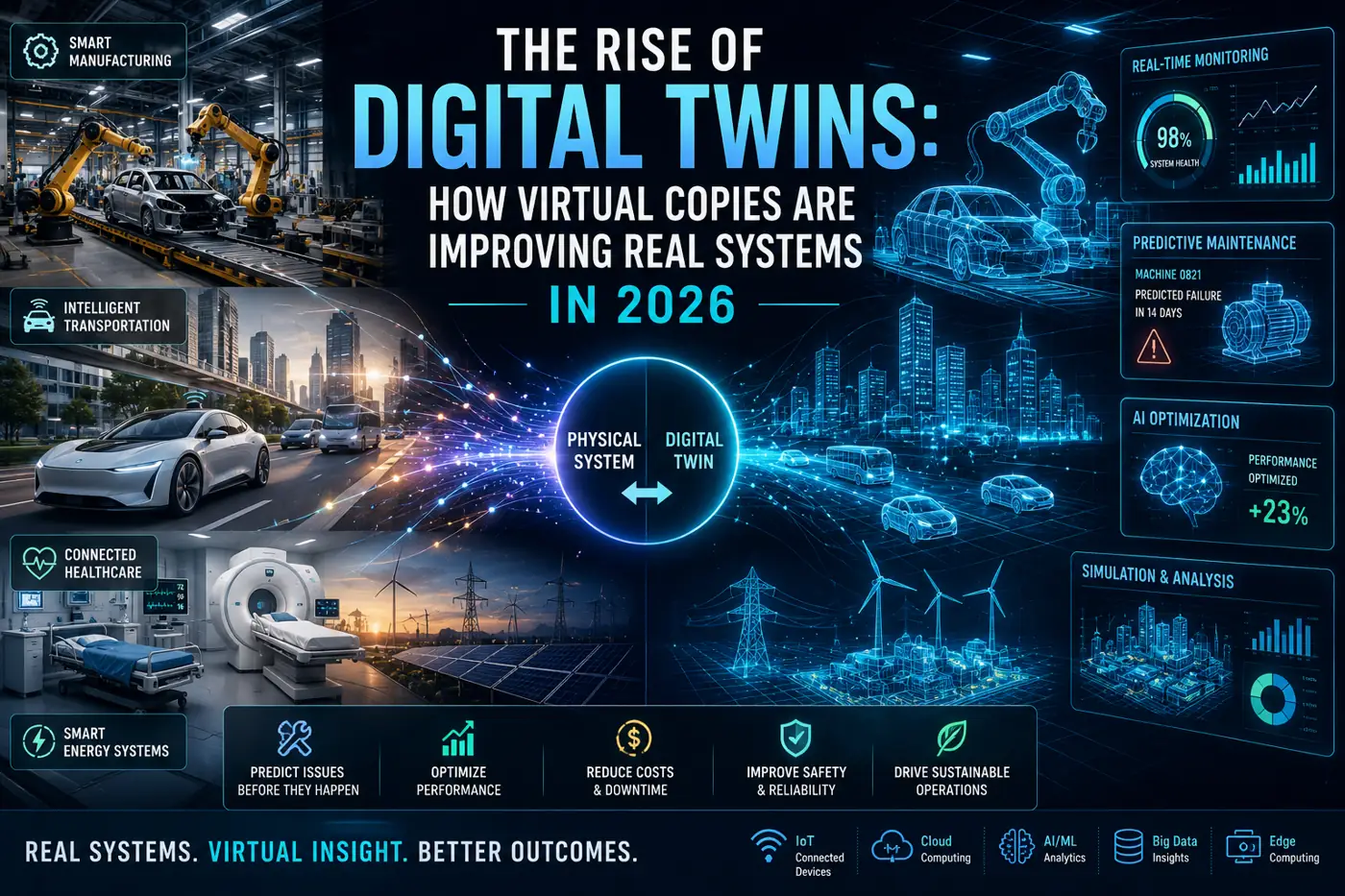
A digital twin is a virtual model of a physical object, process, or system that updates in real time from sensor data and can be used to simulate, test, and optimise the real thing without touching it. The concept has been around in engineering since NASA used early versions to monitor Apollo spacecraft. What has changed in recent years is the cost and scale at which the technology can be deployed.
When a sensor attached to a wind turbine sends operational data to a cloud platform every second, and that platform maintains a living model of the turbine’s internal state, stress points, and predicted failure timeline, that is a digital twin. The same principle applies to a city’s traffic network, a patient’s cardiovascular system, or a factory’s entire production line.
The reason digital twins are attracting significant investment in 2026 is not novelty. It is the convergence of cheap sensors, fast cloud computing, and machine learning that makes the models genuinely accurate and genuinely useful in ways that earlier simulations were not.
How a Digital Twin Actually Works
| Layer | What It Does | Technology Used |
|---|---|---|
| Physical asset | The real-world object being modelled | Sensors, IoT devices, SCADA systems |
| Data ingestion | Collects and transmits sensor data | MQTT, OPC-UA, REST APIs, 5G |
| Digital model | Maintains current state and history of the asset | Cloud platforms, graph databases |
| Analytics and simulation | Runs predictions, what-if scenarios, anomaly detection | Machine learning, physics-based simulation |
| Visualisation and interface | Presents insights to operators and engineers | 3D rendering, dashboards, AR overlays |
The quality of a digital twin depends primarily on the fidelity of the model and the freshness of the data. A twin updated every hour is less useful for real-time operations than one updated every second. A model built on simplified physics is less accurate than one incorporating material properties and environmental conditions.
Industries Where Digital Twins Are Delivering Real Results
Manufacturing
Manufacturing digital twins operate at multiple levels simultaneously: individual machine twins that track wear and predict maintenance needs, production line twins that optimise throughput and identify bottlenecks, and factory-wide twins that model energy consumption, staffing, and material flow.
Siemens, ABB, and GE Digital have deployed factory digital twin platforms at scale. Siemens’ Xcelerator platform maintains digital twins for manufacturing facilities across the automotive, aerospace, and electronics sectors. The documented results include 20 to 30% reductions in unplanned downtime and measurable improvements in first-pass quality rates.
The design iteration benefit is separate from the operational benefit. Engineers who can test manufacturing process changes on a digital twin before implementing them physically can run dozens of iterations in a week that would take months of physical trials. This compresses product development timelines significantly.
Urban Planning and Smart Cities
Singapore’s Virtual Singapore programme, one of the most ambitious city-scale digital twin deployments globally, maintains a detailed 3D model of the entire city updated from satellite imagery, IoT sensors, and planning data. Urban planners use it to model how new buildings affect wind patterns, shadow, and pedestrian flow before a single foundation is dug.
Helsinki, Amsterdam, and several Chinese cities have deployed similar city digital twin platforms for infrastructure planning, disaster response simulation, and energy grid management. The return on investment comes from reduced physical trials, better infrastructure decisions, and faster emergency response modelling.
Healthcare
Patient-specific digital twins, virtual models of an individual’s anatomy built from medical imaging and physiological data, are changing surgical planning and treatment selection. Surgeons using digital twins of a patient’s heart can simulate a procedure multiple times before entering the operating theatre, identifying complications that standard planning might miss.
Dassault Systèmes’ Living Heart Project has produced a validated digital twin of the human heart used by medical device manufacturers to test devices virtually before clinical trials. The FDA has formally recognised computational modelling as a valid component of medical device submissions, legitimising the approach for regulatory purposes.
Energy and Utilities
Wind farm operators use digital twins of individual turbines and full farm arrays to optimise yaw angle, pitch settings, and maintenance scheduling simultaneously. The ability to model how one turbine’s wake affects downstream turbines and adjust settings accordingly produces measurable output improvements at no additional capital cost.
Power grid digital twins model transmission and distribution networks to identify stability risks, optimise reactive power flow, and simulate the integration of intermittent renewable generation. National Grid in the UK and several US regional transmission organisations use digital twin platforms for grid operations.
The Technology Stack Behind Modern Digital Twins
Platform providers including Microsoft Azure Digital Twins, AWS IoT TwinMaker, Siemens Teamcenter, PTC ThingWorx, and NVIDIA Omniverse (for physically accurate simulation) have created enterprise-grade infrastructure for digital twin deployment. These platforms handle data ingestion, model maintenance, and simulation at scales that would require large engineering teams to build from scratch.
NVIDIA Omniverse deserves specific mention because it adds photorealistic, physically accurate simulation to digital twin workflows. Its deployment in BMW’s manufacturing planning, where factory layouts and production sequences are fully simulated before implementation, demonstrated that digital twins can carry the full design and validation workload for new facilities.
Where Digital Twins Are Still Developing
Model accuracy degrades when systems are modified and the digital model is not updated to match. A manufacturing facility that installs new equipment without updating the digital twin loses the value of the twin for that part of the operation. Keeping models synchronised with physical reality is an ongoing operational discipline, not a one-time setup.
Interoperability between digital twin platforms from different vendors remains a challenge. A factory with Siemens automation, ABB robotics, and GE energy systems may run three separate digital twins that do not share data or coordinate decisions. Industry standardisation efforts, including the Digital Twin Consortium and the Industrial Internet Consortium, are working on interoperability frameworks but full integration is still years away.
Data governance for digital twins that model people, patients, building occupants, or citizens raises privacy questions that vary by jurisdiction. A city digital twin that tracks individual movement to optimise traffic flow sits in complex territory under GDPR and similar privacy frameworks.
FAQs
What is the difference between a digital twin and a simulation?
A simulation runs a model once or repeatedly to explore scenarios. A digital twin maintains a continuously updated model that reflects the current state of the real-world counterpart. A simulation is a tool for analysis. A digital twin is a persistent operational asset that evolves with the physical system it represents.
How expensive is it to deploy a digital twin?
Costs vary enormously by scope. A single machine twin using an existing IoT platform can be deployed for tens of thousands of pounds. A factory-wide digital twin programme with custom modelling runs to millions. City-scale twins are government infrastructure investments of comparable scale to physical infrastructure projects. Cloud platform improvements are reducing entry costs each year.
Which industries will adopt digital twins fastest in the next three years?
Healthcare device testing, energy grid management, and construction project planning are the three areas with the strongest near-term deployment trajectories. Automotive digital twins for vehicle development are already mature. Defence and aerospace have used high-fidelity simulation for decades and are integrating real-time twin elements progressively.
The Direction of the Technology
The convergence of digital twins with generative AI is the most significant development in the field for 2026. Rather than running predefined simulation scenarios, AI-augmented digital twins can generate novel test scenarios, identify unexpected failure modes, and autonomously optimise system parameters without human-specified rules.
Autonomous systems, both industrial robots and vehicles, increasingly use onboard digital twins of themselves to monitor health, predict component failures, and adapt behaviour to current operating conditions. The digital twin becomes part of the system’s real-time decision-making rather than a separate analytical tool.
For technology infrastructure analysis, industrial IoT coverage, and digital transformation case studies throughout 2026, WritoryBuzz tracks how enterprise technology is actually deployed across sectors.