
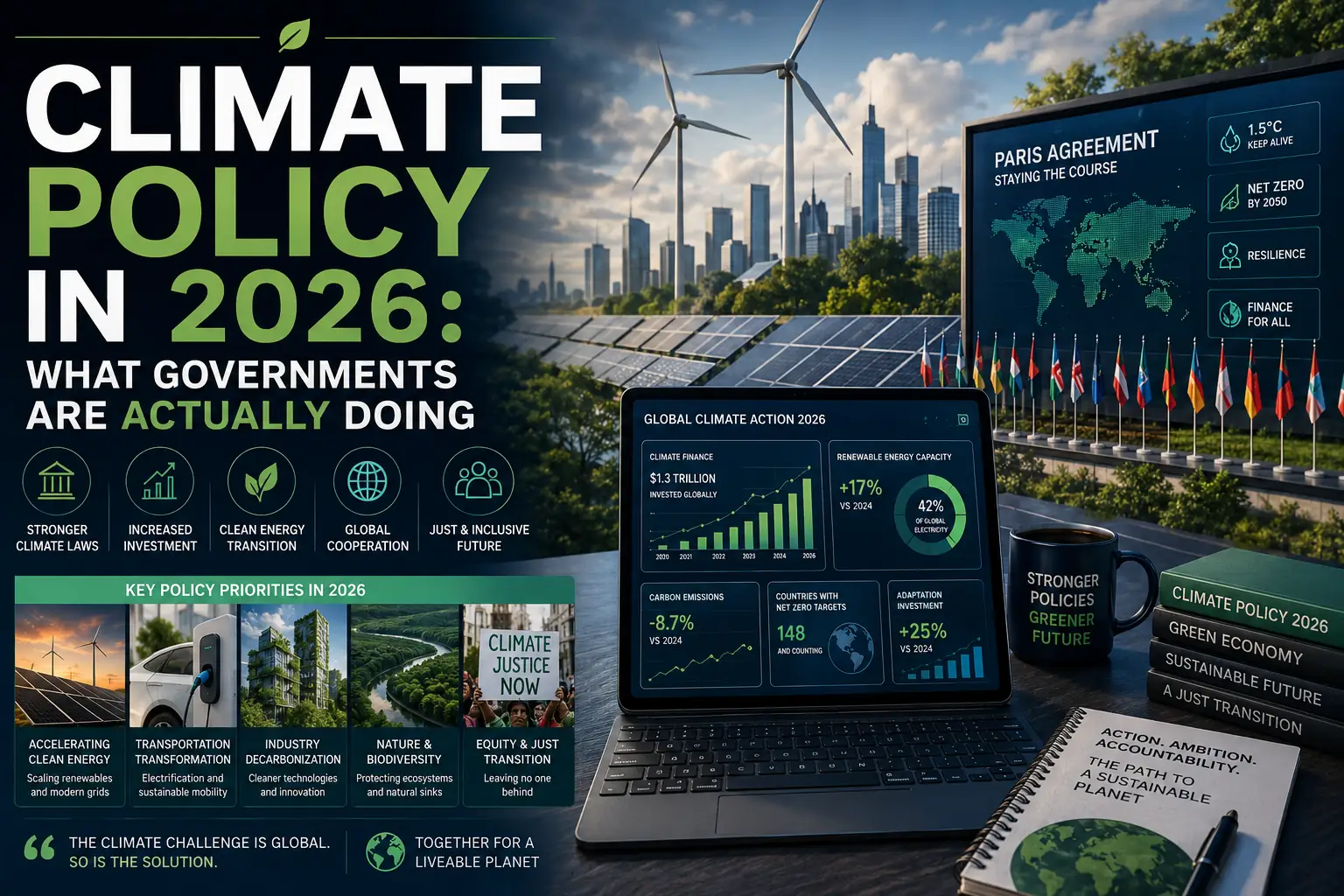
Climate policy discussions are frequently dominated by targets and pledges. 2030 targets, net zero by 2050 commitments, and nationally determined contributions fill the news at every COP conference. What matters more for near-term outcomes is the gap between those pledges and the policies governments have actually enacted, funded, and begun enforcing.
This article focuses on what is actually happening in 2026, not what has been promised. The picture is more mixed than either climate optimists or climate pessimists tend to acknowledge.
Carbon Pricing: The Policy With the Strongest Evidence Base
Carbon pricing, through either a carbon tax or a cap-and-trade emissions trading system (ETS), is the most widely endorsed climate policy among economists. By putting a price on emissions, it creates incentives for every economic actor to reduce them without government having to specify how.
The EU Emissions Trading System, now in its fourth phase, is the world’s largest and most developed carbon market. The carbon price reached over €80 per tonne in 2023 before moderating. The scheme now covers aviation, shipping, and construction alongside its original industrial base. The EU Carbon Border Adjustment Mechanism (CBAM), fully operational from 2026, imposes carbon costs on imports from countries without equivalent carbon pricing, preventing carbon leakage.
The UK has its own ETS following Brexit, with prices generally tracking the EU system. Canada has a national carbon price with a rebate system that returns revenue to households. Several US states, including California and the northeastern RGGI states, run cap-and-trade schemes, though there is still no federal US carbon price.
Energy Transition Legislation: Who Has Actually Passed Laws
| Jurisdiction | Key Legislation | Key Target |
|---|---|---|
| European Union | European Green Deal, Fit for 55 package | 55% emissions reduction by 2030 vs 1990 |
| United States | Inflation Reduction Act (2022) | $369B in clean energy incentives through 2030 |
| United Kingdom | Energy Act 2023 | Clean power system by 2035 |
| India | National Solar Mission, Green Hydrogen Mission | 500GW renewable capacity by 2030 |
| China | 14th Five Year Plan energy chapter | Carbon neutrality by 2060, peak emissions by 2030 |
| Australia | Safeguard Mechanism reform 2023 | 43% reduction by 2030 vs 2005 |
The US Inflation Reduction Act deserves particular attention because of its scale and mechanism. Rather than a carbon tax or regulation, it operates primarily through tax credits and subsidies that make clean energy economically attractive. The investment it has catalysed in domestic clean energy manufacturing has been significantly larger than initial estimates.
The Implementation Gap: Between Law and Reality
Many countries have passed climate legislation without the implementation infrastructure to deliver it. Grid upgrade requirements for rapid renewable deployment are consistently underestimated. Permitting processes for wind, solar, and transmission infrastructure remain slow in most democracies, often adding years to project timelines.
The IEA’s 2025 World Energy Outlook found that current policy implementation, as opposed to announced targets, puts the world on track for approximately 2.4 degrees Celsius of warming above pre-industrial levels, not the 1.5 or 2 degrees that international agreements target. This gap between pledges and implemented policy is the central challenge of climate governance.
Fossil fuel subsidy reform illustrates the implementation gap acutely. The IMF estimated global fossil fuel subsidies at $7 trillion in 2022 when implicit subsidies (failure to price environmental and health costs) are included. Explicit government subsidies to fossil fuels, far from declining, have increased in many countries following the 2022 energy price crisis.
Climate Adaptation: The Under-Funded Half of Climate Policy
Most climate policy attention goes to mitigation, reducing emissions. Adaptation, adjusting infrastructure, agriculture, water management, and coastal development to a changing climate, receives a fraction of the funding despite being necessary regardless of how quickly emissions decline.
The UNEP Adaptation Finance Gap Report estimates that developing countries need $215 to $387 billion annually for adaptation, against actual adaptation finance flows of around $63 billion in 2021 to 2022. This gap is largest in the countries most exposed to climate impacts.
Developed countries’ climate finance pledge of $100 billion per year to developing nations was consistently missed from 2009 to 2022. A revised pledge framework under the Paris Agreement’s New Collective Quantified Goal (NCQG), being negotiated through 2024 and 2025, has not yet produced a binding commitment.
Where Individual Countries Have Moved Furthest
Denmark generates over 50% of its electricity from wind power and has legislated a 70% reduction in emissions by 2030 from 1990 levels, the most ambitious near-term target of any large economy. Its combination of carbon pricing, direct investment, and grid integration of renewables is the most cited example of coherent national climate policy.
Chile has deployed solar at a remarkable scale relative to its economic size, with solar representing a substantial and growing share of its electricity mix. Its combination of exceptional solar irradiance, deregulated energy market, and policy support has made it a case study in rapid renewable deployment.
Morocco’s solar and wind programmes have positioned it as a clean energy exporter to Europe, with interconnector agreements under development. For a middle-income country with significant fossil fuel development options available, its clean energy commitment is notable.
Areas Where Policy Has Moved Least
Aviation and shipping together account for roughly 5% of global greenhouse gas emissions. Both are genuinely difficult to decarbonise quickly because the energy density requirements of long-haul aircraft and container ships cannot be met by current battery technology. Sustainable aviation fuels and green hydrogen shipping fuels are developing but at a fraction of the pace needed.
Methane from agriculture, particularly livestock, is a large emissions source with very limited effective policy response in most countries. Agricultural methane is politically sensitive, land-use changes are contested, and there is no clean technological substitution available at scale.
Building retrofit, reducing the energy consumption of existing residential and commercial buildings, moves very slowly in most countries. Costs are high, ownership structures are fragmented (particularly in rental markets), and public subsidy schemes have insufficient coverage.
FAQs
Is the world actually on track for the Paris Agreement goals?
Based on current implemented policy (as opposed to pledges), no. Multiple analyses including those from the IEA and Climate Action Tracker show current policies leading to warming of 2.4 to 2.9 degrees Celsius by 2100. Conditional pledges (those that depend on international finance or other conditions) bring this to approximately 1.8 to 2.1 degrees. The 1.5 degree target requires a pace of emissions reduction not currently reflected in national policies.
What is the difference between a carbon tax and cap-and-trade?
A carbon tax sets a price per tonne of emissions and lets the market determine the quantity of emissions that results. Cap-and-trade sets a maximum quantity of permitted emissions (the cap) and lets the market determine the price through permit trading. Both create a carbon price; they differ in which variable (price or quantity) is fixed by policy.
Which countries are not meeting their climate commitments?
Most major economies are not on track to meet their most ambitious commitments based on current implemented policy. The Climate Action Tracker rates most G20 countries’ targets and policies. As of 2025, no major economy had policies fully consistent with its stated 1.5-degree-compatible pathway, though several Nordic countries and the EU are rated as having ‘Almost Sufficient’ policies.
What to Watch in the Rest of 2026
The COP31 negotiations in 2026 will focus on the New Collective Quantified Goal for climate finance, the first Global Stocktake follow-up actions, and implementation review of the Loss and Damage fund established at COP27 and COP28.
In the US, the IRA’s clean energy provisions face ongoing legislative scrutiny. The economic impact of the clean energy manufacturing boom it has catalysed, over 300 major clean energy manufacturing announcements since 2022, creates a constituency for its continuation even across political transitions.
For fact-based climate policy analysis, energy transition coverage, and science-policy interface reporting, WritoryBuzz tracks climate developments without advocacy framing throughout 2026.
Want to increase your climate, sustainability, or clean technology brand’s online authority? Publish high-quality guest posts with WritoryBuzz to earn powerful backlinks, strengthen your SEO, and reach decision-makers through trusted business, technology, and environmental publications.