
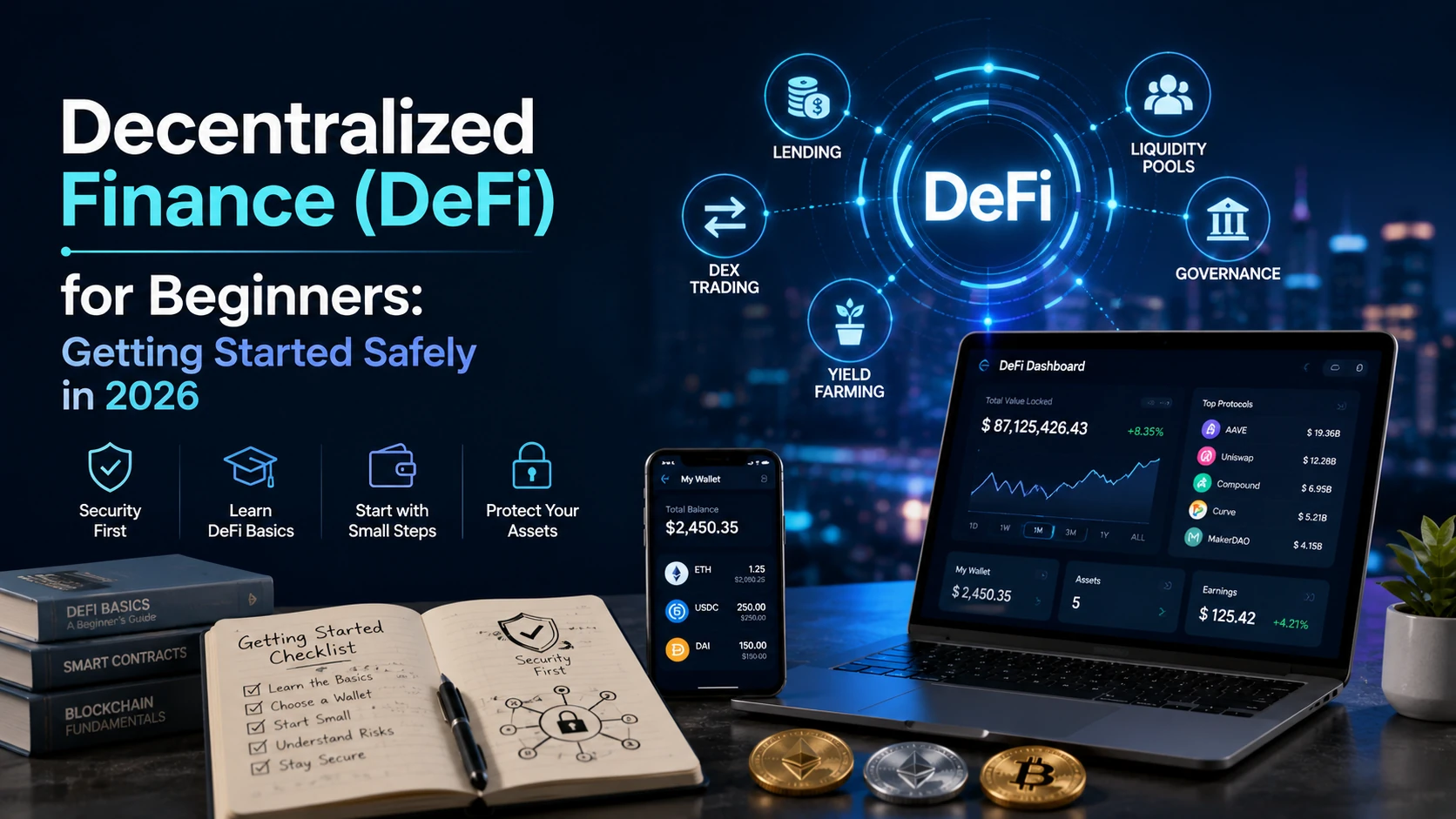
Decentralized finance strips out the institutions that traditionally sit between you and financial services. No bank approves your loan. No broker executes your trade. No exchange holds your funds overnight. Smart contracts running on public blockchains handle the mechanics automatically, open to anyone with an internet connection and a crypto wallet.
The promise is genuine: financial services without gatekeepers, operating 24 hours a day, accessible from anywhere. The risks are equally genuine: smart contract exploits, liquidation cascades, regulatory grey zones, and the permanent irreversibility of transactions mean that mistakes cost real money with no recourse.
This guide explains how the major DeFi categories work, where the specific risks lie, and what a careful approach to getting started looks like in 2026.
The Core Categories of DeFi
| Category | What It Does | Main Platforms in 2026 |
|---|---|---|
| Decentralized Exchange (DEX) | Trade crypto without a centralised intermediary | Uniswap, Curve, dYdX |
| Lending Protocol | Lend assets to earn interest or borrow against collateral | Aave, Compound, MakerDAO |
| Liquid Staking | Stake proof-of-stake assets while retaining liquidity | Lido, Rocket Pool, EigenLayer |
| Yield Aggregator | Automatically optimise returns across protocols | Yearn Finance, Convex |
| Stablecoin Protocol | Issue or hold USD-pegged assets without a bank | MakerDAO DAI, Frax, USDC on-chain |
| Derivatives | Trade options, perpetuals, synthetic assets | GMX, Synthetix, Lyra |
How Decentralized Exchanges Work
A traditional exchange matches buyers and sellers: someone wants to buy ETH at $3,200, someone wants to sell ETH at $3,200, the exchange connects them. A decentralized exchange using an Automated Market Maker (AMM) model does not match orders. It uses liquidity pools.
Liquidity providers deposit pairs of tokens into a pool (say, ETH and USDC). When a trader wants to swap ETH for USDC, the AMM algorithm adjusts the price based on the ratio of tokens in the pool, using a constant product formula. The trader pays a small fee. That fee goes to the liquidity providers.
The price you receive on a DEX depends on the depth of the liquidity pool relative to the size of your trade. For large trades in shallow pools, slippage, the difference between the expected price and the execution price, can be significant. For common trading pairs with deep liquidity, slippage is minimal.
Lending and Borrowing in DeFi
DeFi lending protocols work through over-collateralisation. To borrow $1,000 of USDC, you typically need to deposit $1,500 to $2,000 worth of ETH as collateral. This protects the protocol against default because if your collateral value falls below a defined threshold, the protocol automatically liquidates it to repay the loan.
This model enables lending without credit checks, identity verification, or bank approval. It also means that the system does not serve the most common reason people borrow money, that they need more than they already have. DeFi lending primarily serves traders who want to leverage existing positions or access liquidity without selling assets.
Interest rates in DeFi lending are set algorithmically based on supply and demand. High utilisation of a lending pool drives rates up; low utilisation drives them down. Rates can change significantly between when you open a position and when you close it.
The Risks That New DeFi Users Most Often Underestimate
Smart Contract Risk
A smart contract is code. Code has bugs. When a DeFi protocol’s smart contract has a critical bug, attackers find it and exploit it. Over $3 billion was lost to DeFi protocol exploits in 2022 alone. In 2026 the figure is lower, partly because many major protocols have extensive audit histories and bug bounty programmes, and partly because the most reckless new protocols launch with less fanfare than in the 2021 peak.
The practical mitigation is to use protocols that have been audited by multiple reputable firms, have been running without major exploit for at least 12 to 18 months, and have significant total value locked (TVL). This does not eliminate smart contract risk, but it substantially reduces the probability of catastrophic loss relative to using new, unaudited protocols.
Liquidation Risk
If you borrow against collateral and the value of that collateral drops, you face liquidation. Liquidation is automatic and irreversible: the protocol sells your collateral at a discount to repay the debt, and you may receive nothing or very little if the price drop is severe enough.
Liquidation cascades, where falling prices trigger liquidations that push prices further down, triggering more liquidations, have produced catastrophic outcomes for borrowers in multiple market events. Maintaining a conservative loan-to-value ratio, significantly below the protocol’s liquidation threshold, is essential for anyone using DeFi lending.
Impermanent Loss for Liquidity Providers
Providing liquidity to an AMM pool sounds like easy passive income. The risk that is often not explained clearly is impermanent loss: when the price ratio between the two tokens in your pool changes, you end up with less total value than if you had simply held the tokens.
If ETH triples in price while you are providing ETH/USDC liquidity, you end up with more USDC and less ETH than you deposited, because the AMM rebalanced your position as the price moved. The fees you earned may or may not offset this. For volatile asset pairs, impermanent loss can significantly outweigh fee income.
Scams and Rug Pulls
DeFi’s permissionless nature means anyone can launch a protocol, list a token, and market it aggressively. Rug pulls, where project founders drain liquidity and disappear after attracting deposits, remain common for new and unverified protocols. If a new DeFi project promises yields that seem dramatically higher than established protocols, that is the risk premium for a much higher probability of total loss.
Getting Started Safely: A Practical Sequence
Step 1: Set up a non-custodial wallet. MetaMask for Ethereum-compatible chains, Phantom for Solana, or a hardware wallet like Ledger for larger holdings. Never share your seed phrase. Ever. There is no support team that needs it.
Step 2: Start with established stablecoin positions. Lending USDC or USDT on Aave or Compound exposes you to DeFi mechanics without price volatility risk. The yield will be modest (3 to 7% APY typically) but the experience teaches you how lending protocols work before you take on more complex positions.
Step 3: Use only money you can afford to lose entirely. This is not a cliche. Smart contract bugs, regulatory actions, and market events can destroy DeFi positions without warning. DeFi should represent a small fraction of anyone’s financial exposure.
Step 4: Read the protocol documentation before depositing. Understand what the liquidation threshold is, how fees work, and what happens in a market disruption. If you cannot find clear answers to these questions, do not deposit.
The Regulatory Picture in 2026
DeFi regulation has moved significantly from the ambiguity of 2021 and 2022. The EU’s MiCA (Markets in Crypto-Assets) regulation, fully in effect in 2026, applies to crypto-asset issuers and service providers but has significant gaps in coverage for fully decentralized protocols where there is no identifiable issuer or service provider.
In the US, the SEC has pursued enforcement actions against protocols it considers to be operating as unregistered securities exchanges or offering unregistered securities. The legal status of specific DeFi activities remains contested, and the regulatory risk for US-based participants in particular is real.
Tax treatment of DeFi activities, lending income, liquidity provision fees, and governance token rewards, is now clearer in most major jurisdictions than it was in 2021. In most countries, these are taxable events. Using DeFi without tracking your transactions for tax purposes is a growing compliance risk as on-chain analytics improve.
FAQs
Is DeFi safer than centralised crypto exchanges?
Different risk profiles rather than one being safer. Centralised exchanges carry custodial risk: if the exchange fails or is hacked, you may lose assets held there (as FTX customers discovered). DeFi carries smart contract risk and liquidation risk, but assets held in self-custody wallets remain yours regardless of what happens to any specific protocol. The safest approach combines self-custody with careful protocol selection.
What is gas and why does it matter for DeFi?
Gas is the fee paid to validators on proof-of-work or proof-of-stake blockchains for processing transactions. On Ethereum mainnet, gas fees can make small DeFi transactions uneconomical during periods of high network congestion. Layer 2 networks like Arbitrum, Optimism, and Base process transactions off the main Ethereum chain at a fraction of the cost, making DeFi practical for smaller amounts.
Can I lose more than I deposit in DeFi?
If you are only providing liquidity or lending, you cannot lose more than you deposit (though you can lose most of it to smart contract exploits). If you use DeFi borrowing to take leveraged positions, losses can exceed your initial collateral if markets move sharply and liquidation does not execute quickly enough.
A Grounded Assessment for 2026
DeFi has survived multiple market cycles, regulatory scrutiny, and billions in exploit losses. The protocols that have lasted five or more years with clean security records represent genuinely useful financial infrastructure. The fringe of DeFi, new protocols with unaudited code and astronomical yield promises, remains as dangerous as ever.
The best approach is to treat DeFi as a small, experimental allocation within a broader financial plan rather than as a primary savings or investment vehicle. The technology is interesting. The risk is real. Both things are true simultaneously.
For cryptocurrency and DeFi analysis, protocol tracking, and regulatory updates throughout 2026, WritoryBuzz covers the digital asset space with technical accuracy and honest risk framing.
Ready to explore the future of decentralized finance? Follow WritoryBuzz for practical crypto guides, blockchain insights, and the latest DeFi trends to help you navigate the digital asset ecosystem with confidence and make informed decisions.