
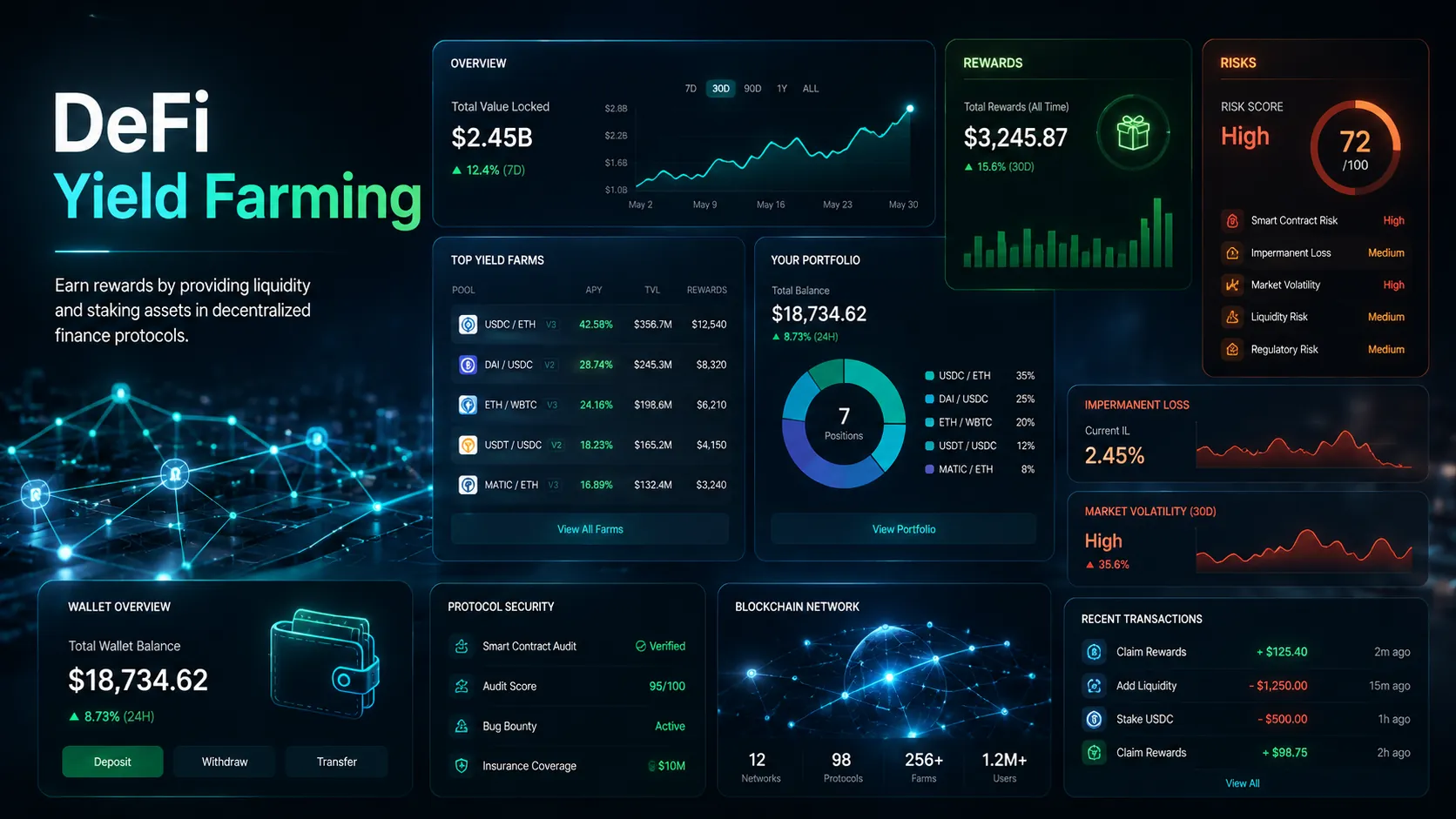
DeFi yield farming lets your crypto earn returns while sitting idle. The rewards are real. So are the risks. Most explanations skip the ones that matter most.
DeFi’s total value locked exceeded $130 billion in early 2026. A significant portion of that capital is there because of yield farming. Understanding why requires understanding what generates the returns — and what can destroy them.
What Yield Farming Actually Is
Yield farming is depositing cryptocurrency assets into decentralised finance protocols to earn returns from three sources: trading fees when you provide liquidity to a DEX, lending interest when borrowers use your deposited assets, and governance token incentives distributed by protocols to attract liquidity.
Returns are expressed as APY. The triple-digit APYs from DeFi Summer 2020 are largely gone. Base yields on major stablecoin pools now run 3 to 8 percent annually on established platforms. Higher yields exist but carry proportionally higher risks.
How Liquidity Pools Work
An automated market maker (AMM) pool uses a mathematical formula to set prices based on the ratio of assets held. You deposit two assets in equal value (for example, USDC and ETH in a 50/50 ratio). In return you receive LP tokens representing your pool share. These LP tokens can often be staked for additional rewards — hence the farming metaphor.
The Risk You Must Understand: Impermanent Loss
Impermanent loss is the most important concept in yield farming and the most often skipped.
When you provide a token pair and one token’s price changes significantly relative to the other, the pool automatically rebalances. By the time you withdraw, you have less of the outperforming token than if you had simply held the assets.
Example: You deposit 1 ETH plus $3,000 USDC when ETH costs $3,000. ETH doubles to $6,000. The pool rebalances to approximately 0.707 ETH plus $4,243 USDC (total $8,486). Simply holding would have given you $9,000. The $514 difference is impermanent loss.
| Why Called ‘Impermanent’?
If ETH returns to $3,000 the loss disappears. It only becomes permanent when you withdraw while price divergence exists. In practice, waiting for prices to return can take months or never happen. Treat impermanent loss as a real risk, not a theoretical one. |
2026 Yield Landscape
| Strategy | Typical APY | Risk Level | Best For |
| Stablecoin lending (Aave, Compound) | 3–8% | Low | Conservative yield seekers |
| Stablecoin LP (Curve Finance) | 4–12% | Low-Medium | Stable passive income |
| ETH/USDC LP (Uniswap v3) | 6–20% variable | Medium | Active position managers |
| New protocol incentive farming | 20–100%+ | High | Experienced DeFi users only |
| Restaking (EigenLayer) | 4–8% additional | Medium-High | ETH stakers wanting layered yield |
Key Risks
Smart contract risk: The governing code can contain bugs. There is no DeFi deposit insurance. Q1 2026 saw $482 million in protocol hack losses. Use audited, battle-tested protocols.
Token inflation risk: If your yield is paid in a governance token, that token’s value determines your real return. Many governance tokens have declined 90 percent, turning apparent 50 percent APY into a real loss.
Regulatory risk: DeFi regulation is actively developing in the US, EU, and Asia. Protocols may restrict access or face asset freezes, particularly relevant for US users.
The Safest Starting Point
For beginners: stablecoin lending on Aave or Compound (use Arbitrum for lower gas costs). Near-zero impermanent loss risk since both deposited assets are dollar-pegged. Yields of 3 to 8 percent with a risk profile closer to a high-yield savings account than speculative DeFi.
Is yield farming still profitable in 2026?
Yes, selectively. Stablecoin lending on established protocols produces 3 to 8 percent annually with minimal risk. Higher yields require understanding and accepting proportionally higher risks.
Which DeFi protocols are safest for yield farming?
Aave, Compound, Curve Finance, and Uniswap v3 have multi-year track records, multiple independent audits, and the most capital which means the most security scrutiny.
Start Simple, Learn the Mechanics
Begin with a small stablecoin position on Aave. Understand how deposits, withdrawals, and gas fees work. Learn the interface. Then evaluate whether higher-yield strategies are appropriate for your risk tolerance and knowledge level.