
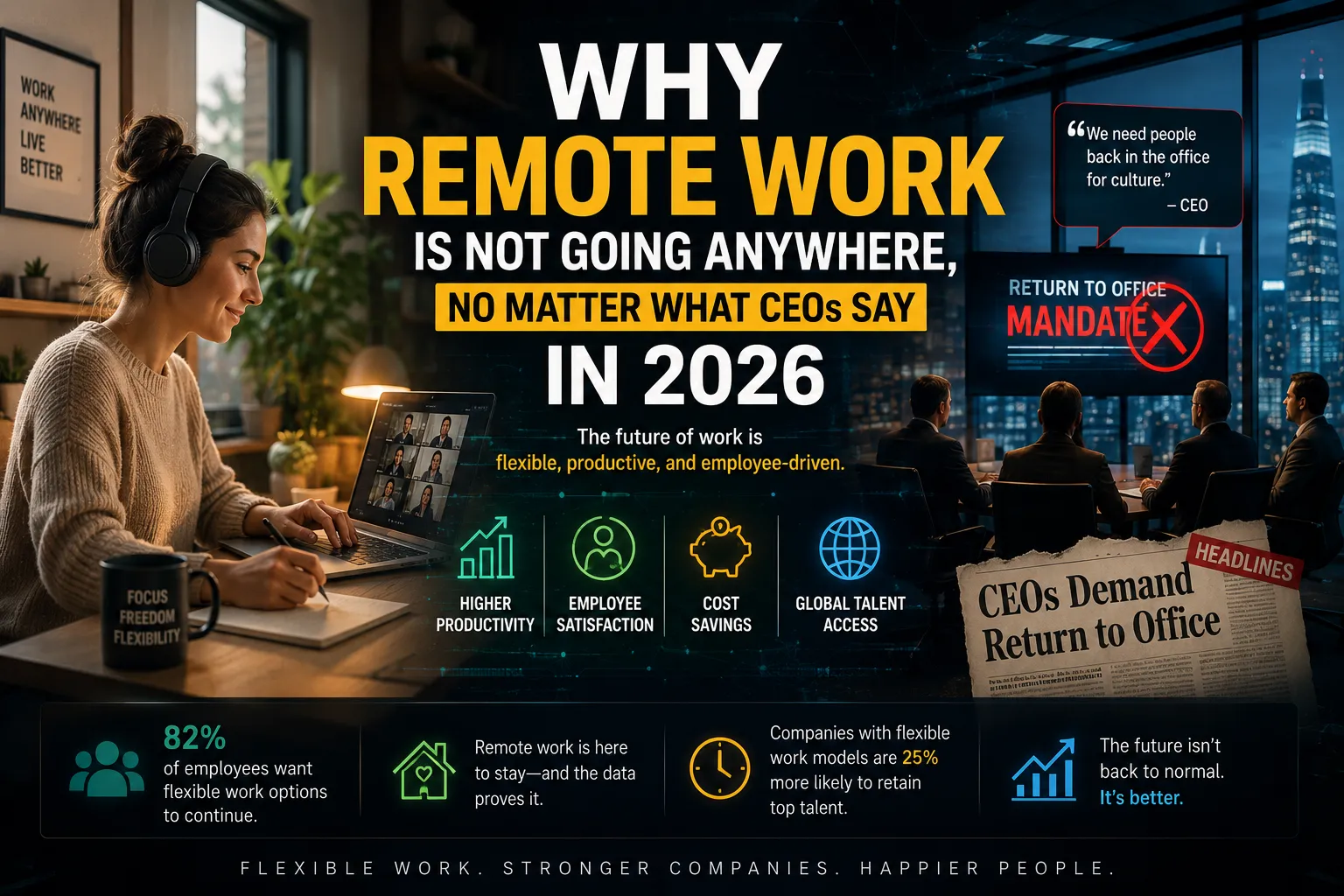
Over the past three years, a pattern has repeated itself with striking regularity. A CEO announces a mandatory return to office. Employees push back. The timeline slips. A hybrid compromise emerges. The CEO declares victory. Most employees work from home slightly more often than before.
Amazon, Apple, Goldman Sachs, Google, and JP Morgan have all issued return-to-office mandates of varying strictness. Most have experienced measurable attrition in specific roles, quiet resistance in others, and considerable management overhead enforcing compliance.
The evidence that remote work is a permanent feature of the knowledge economy, not a pandemic hangover, has been building for years. Here is why the data points in one direction even when the executive announcements point in another.
What the Research Actually Shows
Stanford economist Nicholas Bloom has tracked remote work data more systematically than almost anyone else. His findings, updated through 2025, show that remote-capable workers in the US, UK, and Australia now work from home an average of 1.5 to 2 days per week, and that this level has been stable for two years.
Fully remote work has declined from its pandemic peak. Fully office-based work has not returned to pre-pandemic levels. The equilibrium that has emerged is hybrid, and the specific hybrid arrangements vary by industry, role, and employer.
On productivity, the research is genuinely mixed, which is a more honest answer than either side in the remote work debate typically offers. Complex, collaborative work that involves real-time problem-solving often benefits from in-person co-location. Individual focused work, writing, coding, analysis, consistently shows equal or higher productivity when done remotely.
Why Return-to-Office Mandates Keep Failing
The most consistent finding in the research on return-to-office mandates is that they trigger attrition in the employees companies most want to keep. Senior individual contributors and specialists with transferable skills are the most likely to leave or start looking when faced with a hard mandate. Entry-level and less experienced workers, who benefit more from in-person mentorship and have fewer outside options, comply more readily.
This produces the opposite of what most executives intend. The institutional knowledge and expertise walks out the door while the organisation is left with a full office of people who had no better option.
A study by researchers at the University of Chicago tracked the three-year post-mandate attrition at S&P 500 companies that issued strict return-to-office requirements between 2022 and 2024. The average departure rate for senior-level employees in the 18 months following a strict mandate was 23% higher than at comparable companies without mandates.
The Economic Structure That Keeps Remote Work Alive
| Factor | Effect on Remote Work Permanence |
|---|---|
| Labour market tightness in tech and finance | High-value workers have leverage over location requirements |
| Geographic arbitrage for workers | Remote work enables relocation to lower-cost areas without salary cuts |
| Office real estate costs | Companies with excess space have financial incentives not to mandate returns |
| Global talent access | Remote hiring lets companies reach skill pools outside commuter distance |
| Demonstrated productivity data | Two years of hybrid data reduces the fear-based argument against remote |
What ‘Remote Work Is Over’ Announcements Miss
When Amazon mandated five days in office in September 2023, it made significant headlines. Less covered was the fact that Amazon subsequently lost a measurable number of engineers in Seattle to competitors in other cities who offered flexible arrangements. Amazon’s own internal survey data, reported in the tech press, showed employee satisfaction with the mandate running at under 30% among affected workers.
The announcements that claim remote work is finished are typically made by executives in industries and roles where the benefits of in-person coordination are most visible and the costs of mandate-driven attrition are most bearable. They do not describe the full picture of the knowledge economy.
Which Workers Have Real Remote Flexibility and Which Do Not
Remote work flexibility correlates strongly with income, education, and industry. The Stanford data consistently shows that workers earning above $75,000 annually have dramatically more remote flexibility than workers below that threshold. Knowledge workers in technology, finance, law, consulting, and media have the most flexibility. Workers in retail, healthcare, hospitality, manufacturing, and logistics have essentially none.
The conversation about remote work as a universal phenomenon obscures this structural inequality. When executives announce the end of remote work, they are almost always talking about their own industry and role type, not about the half of the workforce that was never working remotely.
The Hybrid Equilibrium That Is Actually Forming
The workplace structure that the data suggests is settling into is a hybrid model where knowledge workers average two to three days per week in office, with flexibility varying by team, project phase, and individual role. Anchor days, where entire teams are in the office simultaneously, are the mechanism most companies use to capture the benefits of in-person collaboration without mandating full attendance.
This model is less photogenic for executive announcements. It does not produce a clear narrative about culture, collaboration, or return to previous norms. But it reflects what workers have negotiated in practice, and it is more stable than either fully remote or fully in-office arrangements.
What Smart Companies Are Doing Differently
Rather than issuing mandates and then managing the attrition, the companies getting the most from their workforce are designing explicit flexibility agreements. These agreements specify which roles require more in-person time and why, which days teams are expected to be together, and what flexibility individual contributors have for the rest.
The companies getting this right have also invested in making the office worth the commute. An office that is quieter and less functional than a well-set-up home desk is a hard sell. Offices that provide better collaboration tools, social engagement, and spontaneous connection than home produce genuine reasons to be there.
Common Myths About Remote Work That Persist in 2026
That productivity is definitively higher in person. The evidence does not support this as a universal claim. It depends entirely on the type of work.
That company culture only forms in person. Culture is built through shared norms, communication quality, and how people are treated, none of which are exclusively in-person phenomena. Fully remote companies like GitLab and Automattic have built strong documented cultures over more than a decade.
That younger workers prefer the office. Survey data consistently shows that workers in their twenties express high preference for flexibility. The narrative that young workers need or want full-time in-person work does not match what young workers report when asked directly.
FAQs
Does working from home hurt career progression?
The research is mixed. A Stanford study found some evidence of slower promotion rates for fully remote workers in certain corporate structures. However, workers who choose remote work for salary-negotiation leverage or geographic flexibility often outperform office-based peers on total compensation over time. The career progression question depends heavily on company culture and manager quality.
Which industries are most likely to return to full-time office?
Finance and banking have been the most consistent in pushing return-to-office, with Goldman Sachs, JP Morgan, and Morgan Stanley maintaining strong office attendance requirements. Government and public sector roles are trending more in-person than private sector. Technology and media remain the most flexible.
Can employers legally mandate a return to office?
In most jurisdictions, yes, unless a remote work arrangement is contractually specified. Employment contracts that specify remote work give employees legal standing to resist location changes. Contracts that specify a place of work as the office give employers broad authority to require attendance.
The Honest Conclusion
Remote work is not going anywhere, and neither are the executives who dislike it. The outcome is a negotiated hybrid that satisfies neither side completely but works well enough that both sides can live with it.
The companies that will attract and retain the best talent over the next decade are those that build flexible, intentional workplace structures rather than those that use attendance as a proxy for commitment.
For ongoing analysis of workplace trends, management research, and the evolving economics of work in 2026, follow WritoryBuzz’s business and culture coverage.