
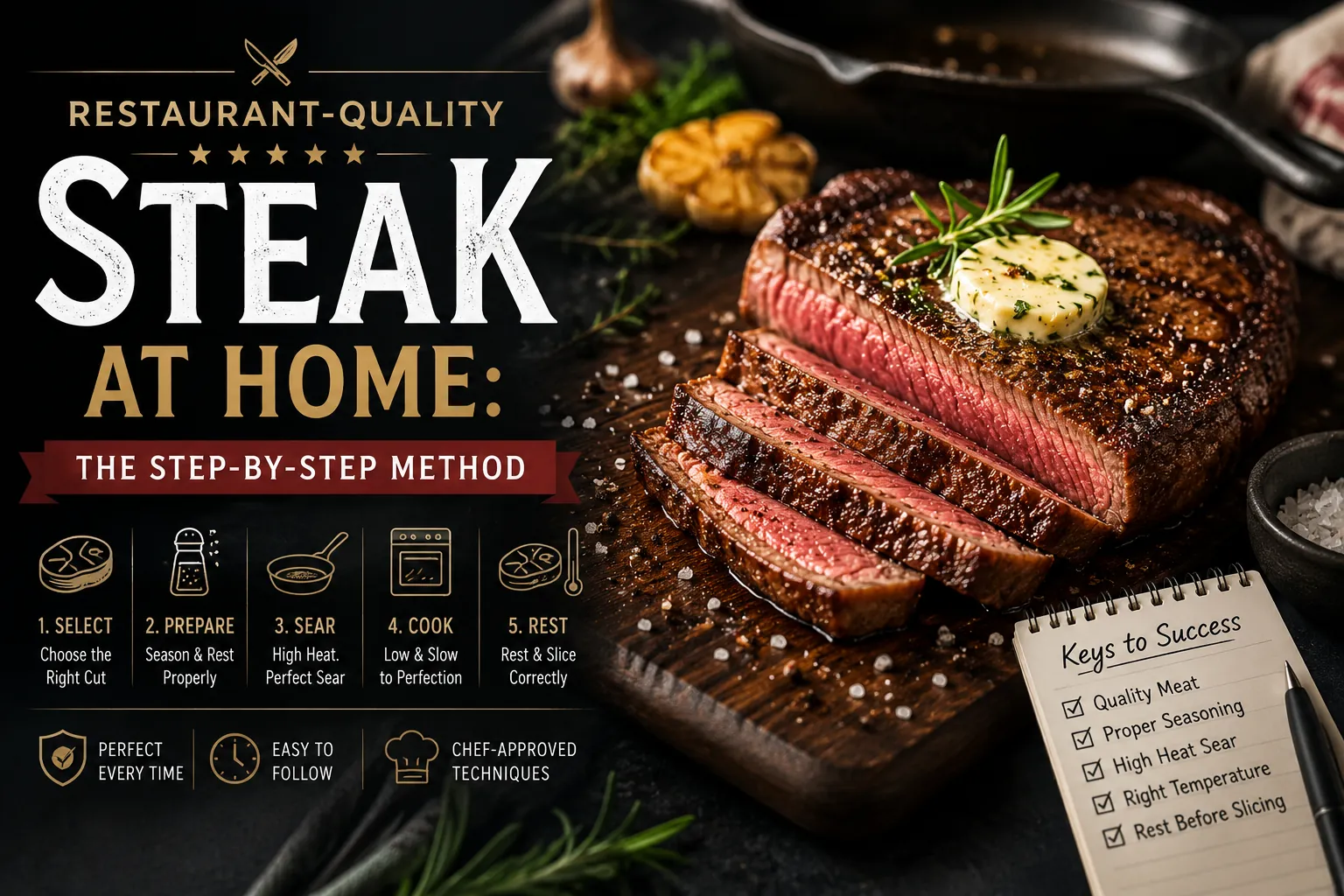
Restaurant steak tastes better than most home-cooked steak for three reasons: the cut is dried properly before cooking, the heat is high enough to form a real crust, and the steak rests long enough for juices to redistribute. None of these require a restaurant kitchen.
The techniques that produce restaurant-quality steak at home are not complicated. They are specific. Most home-cooked steak falls short not because of inferior equipment or skill, but because of three consistent errors: cooking cold meat straight from the refrigerator, using insufficient heat for crust formation, and cutting into the steak too soon after cooking.
This guide covers the complete method from choosing the right cut through resting and serving, including the reverse sear technique that produces the most consistent results for thick steaks.
Step 1: Choosing and Preparing the Cut
The Best Cuts for Home Cooking
Ribeye is the gold standard for home cooking. The high fat marbling self-bastes during cooking, producing flavour and moisture that compensates for minor temperature inconsistencies. It is the most forgiving cut. Sirloin delivers excellent flavour at a lower price point with less fat. Striploin (New York Strip) sits between the two: strong marbling, good crust formation, versatile. T-bone and Porterhouse are impressive but difficult to cook evenly due to the bone.
For the reverse sear method described below, aim for steaks at least 3 centimetres thick. Thin steaks overcook during searing before the interior reaches temperature.
Dry the Surface Before Cooking
Pat the steak completely dry with kitchen paper and then leave it uncovered on a rack in the refrigerator for at least one hour, ideally overnight. This drying step is what restaurants do and most home cooks skip. Moisture on the surface of meat steams rather than sears when it hits a hot pan, preventing crust formation. A dry surface produces the Maillard reaction crust that makes a great steak. A wet surface produces a grey steam-cooked exterior.
Salt timing: Salt the steak either immediately before cooking (less than 5 minutes) or at least 45 minutes before cooking. In between these windows, salt draws moisture to the surface by osmosis before it has time to be reabsorbed, which leaves a wet surface. If salting overnight, place the steak uncovered on a rack in the refrigerator. The surface dries beautifully.
Step 2: The Reverse Sear Method for Thick Steaks
The reverse sear produces the most evenly cooked interior with the best crust of any home method. It is particularly effective for steaks over 2.5 centimetres thick.
- Preheat your oven to 120 degrees Celsius (250 degrees Fahrenheit). Place the salted, dried steak on a rack over a baking tray.
- Cook in the oven until the internal temperature is 10 degrees Celsius below your target temperature. For medium-rare (target 57 degrees Celsius), pull the steak from the oven at 47 degrees. Use an instant-read thermometer. This takes 30 to 45 minutes depending on thickness.
- Rest the steak for 5 to 10 minutes while you get the pan screaming hot.
- Sear in a cast iron pan over the highest heat your stove produces, with a thin layer of a high smoke-point oil (avocado oil or refined coconut oil). Sear for 60 to 90 seconds per side. The reverse sear pre-dries the surface during the low oven phase, producing an extraordinary crust in a short sear time.
Step 3: The Pan Sear Method for Medium-Thickness Steaks
For steaks up to 2.5 centimetres thick, the straight pan sear method is faster and produces excellent results when executed correctly.
- Remove the steak from the refrigerator 30 minutes before cooking to take the chill off. A cold-centred steak overcooks at the edges before the interior reaches temperature.
- Get the pan very hot. Cast iron should be visibly beginning to smoke before the steak goes in. High heat is the single most important factor in home steak cooking that home cooks most commonly undershoot.
- Add a thin layer of high smoke-point oil, then lay the steak away from you. Sear for 2 to 3 minutes without moving. Flip. Sear 2 to 3 minutes more.
- Butter basting: Add 2 tablespoons of unsalted butter, 2 smashed garlic cloves, and fresh thyme or rosemary to the pan. Tilt the pan and continuously spoon the foaming butter over the steak for 60 to 90 seconds. This is what produces the flavour of restaurant steak at home.
Internal Temperature Guide
| Doneness | Pull Temperature | Final Temperature | Texture |
| Rare | 46-49°C | 50-52°C | Very red, soft centre |
| Medium-Rare | 52-54°C | 55-57°C | Pink-red centre, slightly firm |
| Medium | 57-60°C | 60-63°C | Pink centre, firm edges |
| Medium-Well | 63-66°C | 66-68°C | Slight pink, firm throughout |
| Well Done | 68°C+ | 71°C+ | No pink, fully firm |
Always pull the steak 2 to 3 degrees Celsius below your target. Carryover cooking raises the internal temperature during the rest period.
Step 4: The Rest That Most Home Cooks Skip
Resting is not optional. When a steak is cooked, the muscle fibres contract and squeeze juice toward the centre of the meat. During the rest period, those fibres relax and the juices redistribute throughout the steak. A steak cut immediately after cooking loses 40 percent of its juices onto the cutting board. A rested steak retains them.
Rest time: 5 minutes for steaks under 2.5 centimetres, 8 to 10 minutes for thick steaks. Rest on a warm plate or cutting board, loosely tented with foil. The foil slows temperature loss without trapping steam that softens the crust.
Finishing and Serving
Season with flaky sea salt and a twist of black pepper immediately after resting. Slice against the grain. This shortens the muscle fibres and makes each bite tender regardless of the cut’s inherent toughness. Add a knob of compound butter (softened butter mixed with herbs, garlic, and a pinch of salt) on top as the steak rests and let it melt down over the meat.
Why does restaurant steak taste better than home cooked?
Three main reasons: restaurants dry-age or dry the surface properly before cooking for better crust formation, they use very high heat for the Maillard reaction sear that home cooks often underachieve, and they rest steaks long enough before serving. The butter basting technique also adds significant flavour that most home cooks skip.
What is the reverse sear steak method?
Reverse sear cooks the steak in a very low oven to just below the target internal temperature, then sears it in an extremely hot pan. The low oven phase cooks the interior evenly with no grey band of overcooked meat, and the pre-dried surface from the oven produces an exceptional crust in a shorter sear time than conventional methods.
What temperature is medium-rare steak?
Medium-rare steak has an internal temperature of 55 to 57 degrees Celsius at serving. Pull the steak from heat at 52 to 54 degrees and allow carryover cooking during the rest to bring it to the final temperature.
Do you need a cast iron pan to cook steak at home?
A cast iron pan produces the best crust due to its heat retention and high maximum temperature. A thick stainless steel pan is an acceptable alternative. Non-stick pans do not get hot enough and are not recommended for steak. A grill pan adds visual grill marks but does not improve flavour.
How long should steak rest after cooking?
Rest for at least 5 minutes for steaks under 2.5 centimetres and 8 to 10 minutes for thicker steaks. Resting allows muscle fibres to relax and juices to redistribute throughout the meat, retaining significantly more moisture when sliced than an un-rested steak.
What oil should you use for searing steak?
Use a high smoke-point oil for the sear: avocado oil (271 degrees Celsius), refined coconut oil, or vegetable oil. Butter burns at the high temperatures required for crust formation. Add butter in the basting step after the initial sear, when the heat has been slightly reduced.
The Technique Makes the Steak
A well-chosen cut cooked with the right technique at home consistently outperforms an average restaurant steak. The reverse sear method in particular is worth trying once on a weekend when you have time to appreciate the process. The even pink interior with a proper crust is the result that justifies the effort.
The three rules that matter most: dry the surface before cooking, use high enough heat to form a real crust, and rest before cutting. Everything else is refinement.