
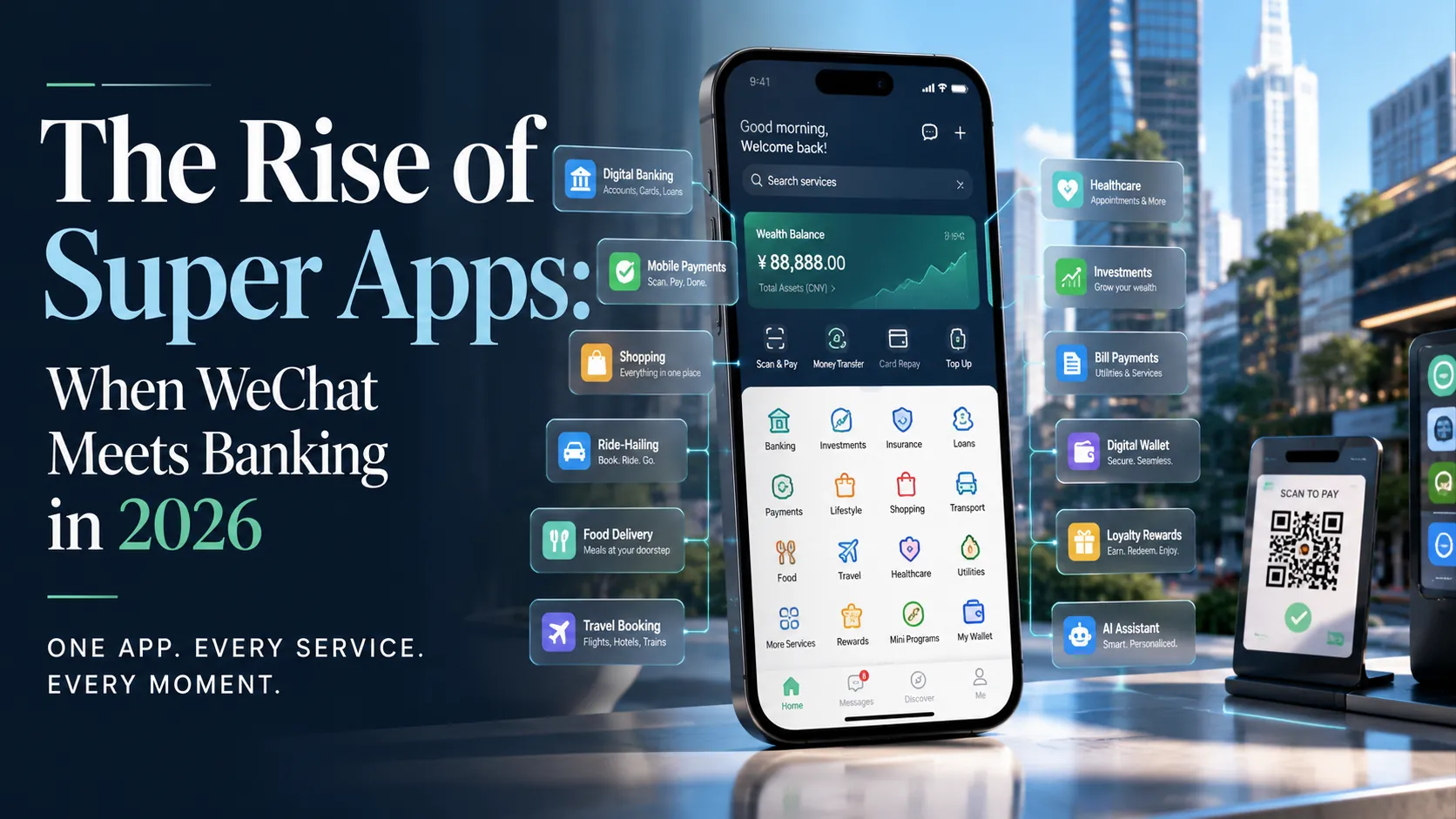
Super apps are not coming. They are here. The super app wallet market reached $1.745 trillion in 2026 and is projected to hit $5.12 trillion by 2034. WeChat has 1.3 billion users. Grab serves 187 million. And Revolut, PayPal, and Uber are all moving toward the model in Western markets.
A super app is a single mobile application that combines messaging, payments, financial services, e-commerce, ride-hailing, food delivery, and often government services into one unified experience. The concept sounds simple. The execution involves solving one of the hardest problems in product design: building an ecosystem users stay inside rather than leaving for specialised apps.
Understanding how super apps finance themselves, why they work so well in Asia, and why the Western version has been slower to emerge shapes how the next decade of financial services unfolds.
How Super Apps Build Their Financial Core
Every major super app followed the same playbook, just starting from different anchors. WeChat started with messaging, then added payments. Grab started with ride-hailing, then added GrabPay in 2018. Paytm started with mobile phone recharges and built upward to digital wallets, loans, and insurance. The pattern is consistent: establish a high-frequency anchor that generates daily sessions, add payments infrastructure, then use the payment relationship as a platform for financial services.
The financial layer is not an add-on. It is the strategy. Once a super app processes your payments, it collects transaction data that is more valuable than almost any other signal for underwriting credit, predicting behaviour, and personalising product offers. First-party transaction data from a super app is the most powerful financial dataset available.
GrabPay’s Q2 2025 performance: Total payment volume surged 38 percent year-on-year to approximately $5.8 billion in a single quarter. GrabAds, built on this transaction data, reached a $236 million annualised run-rate growing 45 percent annually.
WeChat’s ecosystem depth: WeChat combines messaging, social media, e-commerce, government services, ride-hailing, and food delivery for 1.3 billion users. WeChat Pay has 935 million users. The platform’s mini-program ecosystem allows third-party developers to build services within WeChat without users ever leaving the app.
Paytm in India: With 450 million registered users, Paytm operates on top of India’s UPI rail where 228.3 billion transactions worth approximately 300 lakh crore rupees were processed in 2025. Paytm is competing for super app positioning alongside PhonePe and Google Pay on the same infrastructure.
The Four Revenue Layers of a Super App
Layer 1: Transaction Fees
Charging a small percentage or flat fee on each payment processed through the platform. Low margins individually but enormous volume at scale. This is the base layer that funds everything above it.
Layer 2: Financial Services
Using payment data to offer lending, insurance, and investment products at dramatically lower customer acquisition cost than standalone fintech companies. Grab offers small business loans using merchant sales data. Alipay offers Ant Group’s investment and insurance products. The underwriting is better because the data is better.
Layer 3: Advertising
First-party transaction data makes super app advertising extraordinarily targetable. As third-party cookies disappear globally, the first-party data advantage of super apps becomes more valuable, not less. Shopee’s advertising revenue grew over 70 percent year-on-year in Q3 2025.
Layer 4: Platform and Ecosystem Fees
Revenue from third-party developers, mini-program operators, and enterprise service providers building inside the platform. This is the highest-margin layer and most resembles the app store model applied to an entire services ecosystem. WeChat’s mini-program ecosystem is the most developed example globally.
Why Super Apps Struggled in Western Markets (Until Now)
The regulatory environment is the primary reason. Europe’s GDPR, open banking regulations that require financial data portability, and antitrust oversight that limits data consolidation all work against the WeChat model of combining everything under one privacy policy. The data advantage that makes Asian super apps so powerful runs into structural resistance in the West.
Consumer behaviour is the second factor. Western consumers typically have multiple well-functioning apps for each service: a messaging app, a banking app, a delivery app, a navigation app. The friction of switching from apps that work to a single app requires compelling advantage that many Western consumers have not yet experienced.
Both factors are softening. Revolut, Klarna, and PayPal are successfully building super app functionality in Europe by focusing on financial services as the anchor rather than messaging. Uber is integrating public transit, financial services, and expanded delivery to build Western super app positioning. The cash-on-delivery share in Southeast Asia has already fallen to 31 percent as of Q1 2026, showing the pace at which digital payment habits change once a compelling super app exists.
| Super App | Region | Users | Core Anchor | Key Financial Service |
| China | 1.3B | Messaging | WeChat Pay, Wealth Management | |
| Grab | SE Asia | 187M | Ride-hailing | GrabPay, GrabFinance loans |
| Paytm | India | 450M | Mobile recharge | UPI payments, loans, insurance |
| Gojek | SE Asia | 170M | Motorbike rides | GoPay, GoInvestasi |
| Revolut | Europe/Global | 45M+ | Currency exchange | Banking, crypto, insurance |
| Uber | US/Global | 131M+ | Ride-hailing | Uber Money, delivery finance |
Frequently Asked Questions About Super Apps and Finance
What is a super app in finance?
A super app is a single mobile application combining multiple services including payments, financial products, e-commerce, and daily services in one unified platform. WeChat, Grab, and Paytm are the most cited examples. The financial layer, typically payments and lending, is what makes them commercially powerful.
Why are super apps more common in Asia than the West?
Super apps succeeded in Asia partly because they emerged before separate app ecosystems solidified. WeChat and Alipay became the default way to pay before Western alternatives were available. In the West, entrenched single-purpose apps and stricter data regulations have slowed consolidation, though Revolut and others are making meaningful progress.
How large is the super app wallet market in 2026?
The super app wallet market reached approximately $1.745 trillion in 2026, according to IntelMarketResearch analysis, and is projected to grow to $5.12 trillion by 2034 at a 14.3 percent CAGR. This includes transaction volumes through WeChat Pay, GrabPay, GoPay, Alipay, and other integrated platforms.
Will super apps replace banks?
They will not replace banks entirely, but they are displacing banks from everyday financial interactions. In markets with strong super apps, the bank is increasingly a back-end infrastructure provider while the customer relationship sits with the super app. Grab offers small business loans, insurance, and investment products on top of a banking partner’s infrastructure.
Is Revolut a super app?
Revolut is moving toward the super app model in Europe. It offers banking, crypto trading, stock investment, insurance, and consumer perks in a single app for 45 million-plus users. It lacks the messaging and ride-hailing layers of Asian super apps, but its financial services breadth represents the Western version of the model.
What makes super apps so profitable?
First-party transaction data, low customer acquisition costs across services, and platform fees from third-party developers. Once a user is inside the super app for one service, offering adjacent services costs a fraction of acquiring new customers through standalone apps. This compounding efficiency is the core economic model.
The Platform That Wins Daily Habits Wins Finance
The fundamental insight of the super app model is that financial services are not where the relationship starts. The relationship starts with messaging, or rides, or food delivery. Finance enters once the habit is established. Western fintech companies building daily-use engagement on top of financial services are following the same playbook, just from a different starting point.
The $5.12 trillion projection for 2034 is not based on innovation in financial products. It is based on the compounding of daily habits into financial relationships at scale.