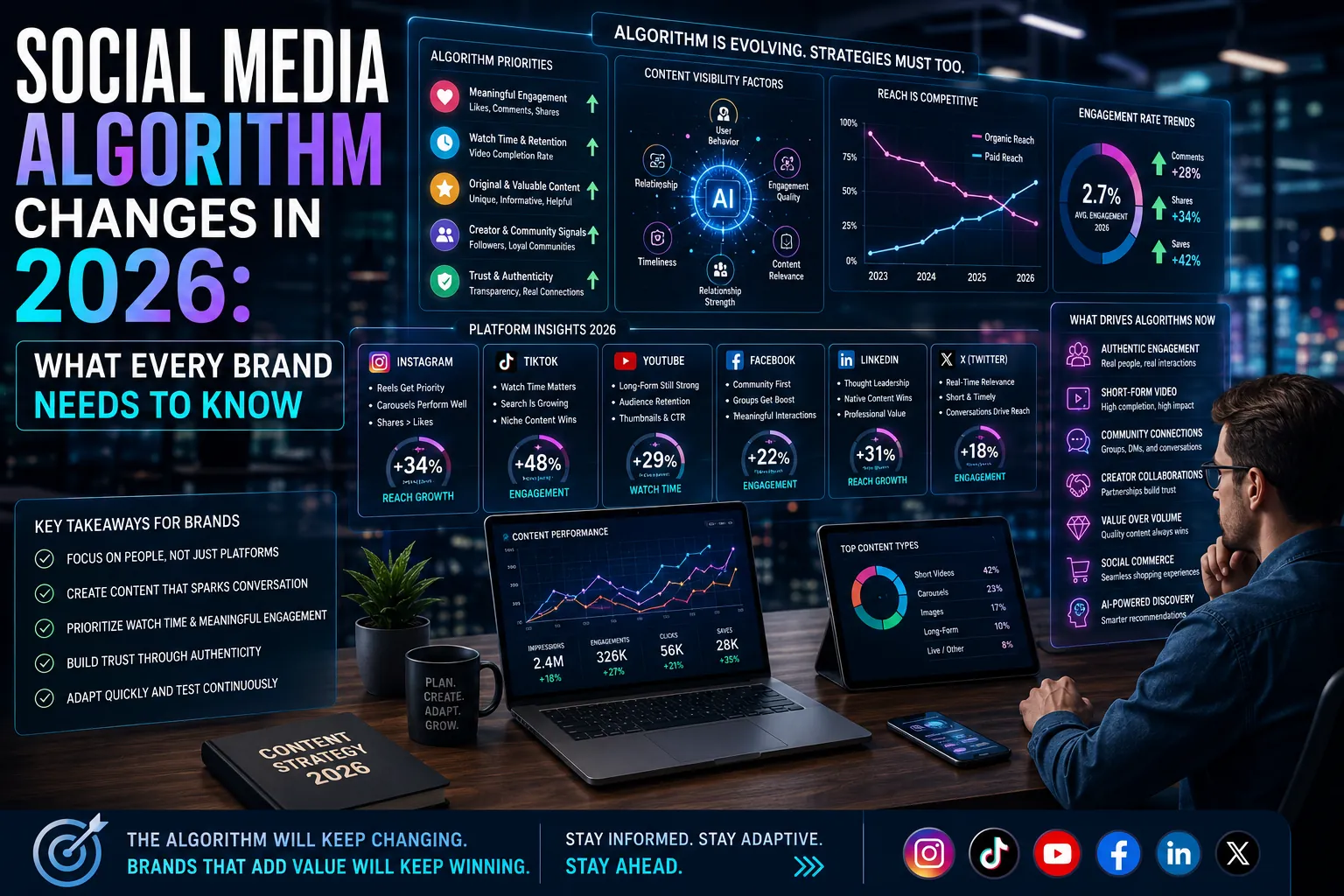
Two thirds of US consumers now use social media platforms as search engines. Instagram’s algorithm indexes caption text. TikTok rewards native shopping integration. LinkedIn’s AI rewards professional value over popularity. The 2026 algorithm landscape is not an update. It is a fundamentally different operating environment.
Social media algorithm changes in 2026 share a common direction across platforms: AI-powered systems have become sophisticated enough to evaluate content quality, user satisfaction, and contextual relevance at a level that makes gaming individual metrics increasingly futile. The brands gaining organic reach are those producing content that genuinely serves their audience on each specific platform.
Instagram Algorithm 2026: Shares in DMs Are Now King
Instagram’s most significant 2026 algorithm update moved DM shares to the top of engagement signals. When someone sends your content to a friend privately, it signals genuine value to the algorithm far more strongly than a passive like. Instagram tests every post in an initial distribution window and expands reach based on early engagement velocity.
Native content format priority: Reels dominate feed distribution. Instagram explicitly deprioritises content cross-posted from TikTok (identifiable by the TikTok watermark) or uploaded without platform-native formatting. The distribution penalty for non-native content is measurable.
Instagram SEO is real: Instagram’s algorithm now indexes caption text for keyword relevance, not just hashtags. Including relevant keywords naturally in captions improves searchability. Two thirds of users use social platforms as search engines according to Hootsuite research, and Instagram now ranks in that search behaviour.
What to do: Create for DM-sharing: content that is useful or entertaining enough that followers will send it to specific people. Write captions with keywords included naturally. Upload natively without cross-posting watermarks.
TikTok Algorithm 2026: Predictive and Commerce-Integrated
TikTok’s algorithm remains the most sophisticated content distribution system in social media. In 2026, it has become predictive, surfacing content before users actively know they want it, based on deep behavioural pattern analysis. Every video undergoes a diagnostic stress test in the first 60 minutes after posting: strong early engagement triggers exponential distribution.
Shopping integration drives algorithmic priority: Creators who use TikTok’s native shopping features receive algorithmic preference. The platform is actively merging entertainment and e-commerce, making live selling a significant growth channel. Brands with TikTok Shop integration have measurable reach advantages over those without.
Keyword control for creators: TikTok now allows creators to suggest or block keywords automatically assigned to their videos. This control over how content is matched to searches and audiences is a meaningful discovery optimisation tool.
What to do: Post in the 7 to 9 AM or 7 to 9 PM windows when your audience is most active. Integrate TikTok Shop if relevant. Optimise the first 3 seconds relentlessly. Weak opening seconds = suppressed distribution regardless of later quality.
LinkedIn Algorithm 2026: Professional Value Over Popularity
LinkedIn’s algorithm has one stated mission in 2026: make your feed feel like a concentrated professional education. Saves, meaningful comments, and shares matter more than likes. AI assistants now recommend what to post based on your industry and network trends. Short-form learning content performs particularly well.
Video posts drive 3x follower growth: Video posts on LinkedIn drive 3x follower growth compared to text-only posts. Native uploaded video significantly outperforms links to external video platforms. Captions are essential since most LinkedIn video is watched without sound.
Personal profiles outperform company pages: LinkedIn’s algorithm gives significantly more organic reach to personal profile content than company page content. Brands should invest in executives and team members posting thought leadership rather than relying solely on company page distribution.
Live streaming requires events from June 2026: Starting June 22, 2026, LinkedIn Live requires a pre-scheduled Event attached before broadcasting. Create the Event page in advance. The upside: LinkedIn promotes upcoming Events in feeds, improving viewership.
Facebook Algorithm 2026: AI-Curated Hybrid Feeds
Facebook is moving toward a hybrid feed model combining AI-curated recommendations with chronological options for users who prefer them. AR and VR integration through smart glasses and Meta’s Quest ecosystem is becoming a growing feature layer. For brands, Facebook’s paid distribution remains more reliable than organic, with AI-powered ad targeting becoming more precise.
Recommendation content surface: Facebook’s algorithm recommends content from accounts users do not follow when its AI determines they would find it valuable. This represents a meaningful organic discovery opportunity for content that generates strong engagement signals from existing followers.
The Principles That Work Across All 2026 Algorithms
Platform-native content: Every platform’s algorithm detects and penalises obvious cross-posts. A TikTok watermark on an Instagram Reel suppresses reach. Plan content natively for each channel or accept the distribution penalty.
Quality over frequency: 2026 algorithms reward content that generates genuine interaction over content that posts frequently. A 3-times-per-week posting cadence with consistently good content outperforms daily posting with inconsistent quality.
First 60 minutes are diagnostic: Across Instagram, TikTok, and LinkedIn, early engagement velocity determines tier-2 distribution. Schedule content for when your audience is most active. Respond to comments in the first hour to drive engagement signals.
Search optimisation is now social: Hashtags alone are insufficient. Keyword-rich captions, titles, and descriptions optimised for how your audience searches on each platform determine discoverability in 2026.
Why is my social media reach declining in 2026?
Algorithm changes on Instagram and TikTok now prioritise saves and DM shares over passive likes. Content that generates shallow engagement (likes without shares or saves) is distributed less broadly. Platform-native content, genuine audience value, and early engagement velocity are the primary distribution drivers.
What does the Instagram algorithm prioritise in 2026?
DM shares (sending posts to friends) are the top engagement signal. Reels outperform static posts in feed distribution. Instagram now indexes caption text for keyword search. Content posted natively without TikTok watermarks or cross-post indicators receives full distribution.
How does the TikTok algorithm work in 2026?
TikTok’s algorithm distributes content based on completion rate, shares, comments, and saves in the first 60 minutes. It is predictive, surfacing content to users based on behavioural patterns before they actively search for it. Native shopping integration receives algorithmic preference.
Should brands focus on personal profiles or company pages?
On LinkedIn, personal profiles receive significantly more organic reach than company pages. On Instagram and TikTok, creator accounts and brand accounts perform comparably. The most effective strategy for most B2B brands is a combination: strong company page presence supplemented by active personal posting from leadership.
What content format works best on social media in 2026?
Short-form vertical video leads on Instagram (Reels), TikTok, and increasingly LinkedIn. Document posts (carousels) perform exceptionally for educational and informational content on LinkedIn. Carousel formats also work on Instagram. Text posts on LinkedIn remain effective for thought leadership from personal profiles.
How important are hashtags in 2026 for social media reach?
Less important than keyword-rich captions and descriptions. Instagram’s algorithm now indexes all caption text, making relevant keywords in captions more valuable than hashtag lists. TikTok’s keyword control feature for creators is more useful than hashtag optimisation alone. LinkedIn hashtags have limited impact compared to caption and post content.
Adapt the Strategy, Not Just the Tactics
The 2026 algorithm landscape rewards brands that understand why each platform’s algorithm works the way it does, not just what the current recommendations are. Algorithms change. The underlying logic, rewarding content that genuinely serves users on that specific platform, changes much more slowly.
Brands with that understanding adapt faster when specific tactics shift. Brands chasing individual algorithm hacks constantly start over every time the rules update.