
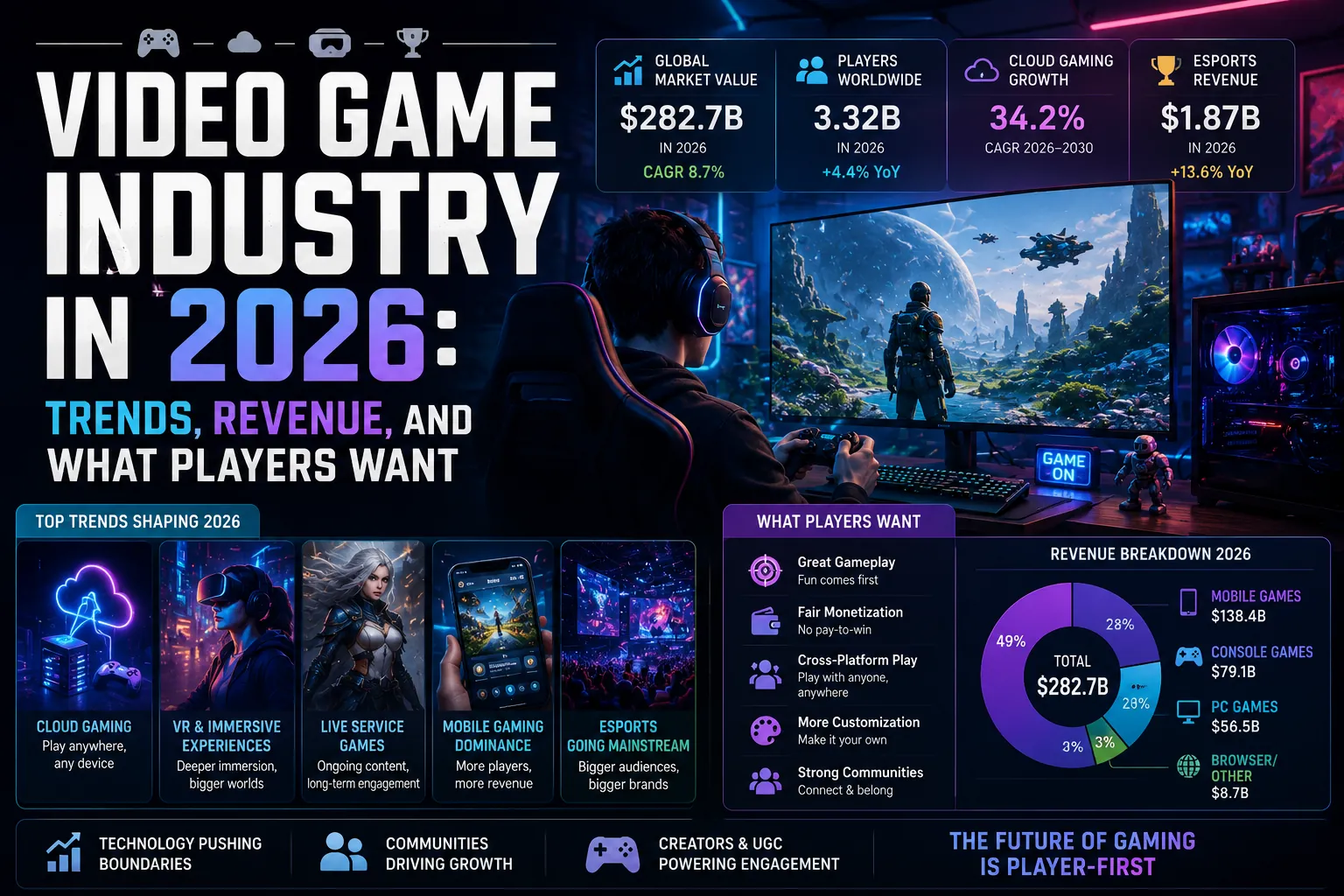
The global video game industry is projected to generate $205 billion in 2026, up 4.6 percent from 2025 and significantly larger than the global film industry combined. With 3.6 billion players worldwide, gaming is not a niche entertainment category. It is the dominant entertainment format of the 21st century.
The video game industry in 2026 is simultaneously larger, more diverse, and more technically sophisticated than at any previous point. Mobile gaming alone will generate approximately $107 billion this year, representing 52 percent of total industry revenue. Cloud gaming has crossed meaningful commercial thresholds. AI is reshaping game development pipelines. And players are making their preferences clear through where and how they spend.
This analysis covers the major trends, the revenue picture by platform, and what the data tells us about what players actually want.
The Revenue Breakdown: Where $205 Billion Comes From
| Segment | 2026 Revenue | Market Share | Growth Rate |
| Mobile gaming | ~$107 billion | 52% | ~5% YoY |
| Console gaming | ~$48 billion | 23% | 5.5% YoY (fastest growing platform) |
| PC gaming | ~$40 billion | 20% | Stable |
| Cloud gaming | $6-8 billion | 3-4% | ~35% CAGR |
| VR/AR gaming | ~$3 billion | 1.5% | Growing but niche |
95 percent of game sales are now digital (downloads or streaming) versus 5 percent physical, a near-complete reversal from a decade ago. In-game purchases drove $74.4 billion of total industry revenue in 2025, up 4.6 percent from 2024. Subscription services including Xbox Game Pass (37 million subscribers) and PlayStation Plus (51.6 million subscribers) contributed $11 billion.
The Five Biggest Trends in the Video Game Industry in 2026
1. Mobile Is Not Just Bigger, It Is Reshaping Everything
Mobile gaming generating 52 percent of global video game revenue fundamentally changes who the gaming industry serves. The average mobile gamer in 2026 is not the teenage console player of a decade ago. Mobile gaming demographics skew broadly: 40 percent of mobile gamers are over 35, significant female demographic representation, and strong growth across age groups in Asia and emerging markets.
This demographic shift is changing game design and monetisation. Hybrid-casual games with accessible mechanics but in-app purchase depth saw in-app purchase revenue surge 37 percent year-on-year. Strategy games lead mobile revenue at $17.5 billion in in-app purchases. 11 mobile titles crossed $1 billion in annual revenue in 2025, a record for the industry.
2. Cloud Gaming Crosses the Viability Threshold
Cloud gaming revenue is projected at $6 to $8 billion in 2026, growing at approximately 35 percent CAGR. Xbox Cloud Gaming, NVIDIA GeForce Now, and PlayStation Cloud Streaming are all expanding. US cloud gaming subscribers hit 12.5 million. Xbox Game Pass subscribers at 37 million globally have significant cloud gaming access.
The technology infrastructure finally matches the ambition. 5G expansion has reduced the latency issues that made early cloud gaming unplayable for precision-requiring genres. For players without high-end hardware, cloud gaming delivers console-quality experiences on any screen. This represents a meaningful access expansion for the industry.
3. AI Is Entering the Game Development Pipeline
AI is reshaping game development in 2026 across three specific applications. Procedural content generation uses AI to create environments, dialogue, and quests at a scale that was previously impossible. NPC (non-player character) behaviour systems powered by LLMs are producing more dynamic, contextually responsive character interactions. Quality assurance processes using AI testing have reduced development cycle times for several major studios.
The concern players and developers share is the same: AI-generated content requires careful integration to maintain the authored quality that players associate with the games they love most. Studios using AI as a development tool alongside human designers are reporting productivity gains. Studios attempting to replace core creative roles with AI are facing significant quality and player backlash.
4. Subscription Models Are Changing the Value Equation
Xbox Game Pass (37 million subscribers) and PlayStation Plus (51.6 million subscribers) have normalised the subscription model for console gaming. 51.2 percent of Gen Alpha are digital gamers on subscriptions. The 81 percent average retention rate for gaming subscriptions is among the highest of any consumer subscription category.
The subscription model changes player behaviour in important ways. Players are more likely to try genres they would not have purchased outright, which benefits smaller and experimental titles. But it also raises questions about long-term economics for individual game development if subscription revenue does not sustain the investment required for large-budget titles.
5. Esports Reaches Its Commercial Ceiling Before Finding New Growth
The global esports market is projected at $4.8 billion in 2025, growing at 5.56 percent CAGR through 2029. This is meaningful growth but the rapid expansion period of 2017 to 2022 is clearly over. Several major esports leagues restructured their team ownership models as franchise fees proved unsustainable. Viewership of major events remains very strong but the advertising and sponsorship revenue per viewer remains far below traditional sports.
The new growth is in collegiate and grassroots esports. University esports programmes have expanded dramatically. High school esports leagues in the US have reached more than 100,000 student participants. This grassroots base provides the audience development that professional esports requires for long-term commercial sustainability.
What Players Actually Want in 2026
Survey data and behavioural data from 3.6 billion players consistently points to the same priorities: gameplay depth over graphical fidelity, consistent live-service updates that respect player time, fair monetisation that does not gate competitive advantages behind paywalls, and cross-platform play that lets players play with friends regardless of hardware.
Cross-platform play will influence 65 percent of game development roadmaps by 2026 according to industry surveys. Pay-to-win mechanics remain the highest-cited reason players abandon games they enjoyed. Battle passes with cosmetic-only rewards are now the dominant accepted monetisation model for live-service games after the pay-to-win backlash of 2019 to 2022.
Player feedback on AI-generated content is notably mixed. Players who discover that significant portions of a game’s dialogue or environments were AI-generated without human curation report lower quality perception, even when they cannot identify specifically where the AI content appears. The perception of care and authorship in game development is a significant component of player satisfaction.
How big is the video game industry in 2026?
The global video game industry is projected to generate $205 billion in 2026 according to Newzoo market analysis, a 4.6 percent increase from 2025. This makes gaming larger than the global film and music industries combined. The worldwide player base reached 3.6 billion gamers across all platforms.
Is mobile gaming bigger than console gaming?
Yes, significantly. Mobile gaming is projected to generate approximately $107 billion in 2026, representing 52 percent of total global gaming revenue. Console gaming is estimated at $48 billion (23 percent market share). Mobile passed console in revenue around 2018 and the gap has grown consistently since.
What is cloud gaming and how big is it in 2026?
Cloud gaming streams game rendering from remote servers to any screen, eliminating the need for high-end local hardware. Revenue is projected at $6 to $8 billion in 2026 growing at roughly 35 percent CAGR. Xbox Cloud Gaming and NVIDIA GeForce Now are leading platforms. US cloud gaming subscribers reached 12.5 million.
How is AI being used in video game development?
AI is being applied in three main areas: procedural content generation (creating environments and quests at scale), NPC behaviour systems using LLMs for more dynamic character responses, and automated quality assurance testing. Studios using AI as a development tool alongside human designers report significant productivity gains.
What are players most unhappy about in 2026?
Pay-to-win monetisation remains the most-cited player complaint. AI-generated content without clear human curation receives negative reception. Incomplete games released with substantial paid DLC required to reach the full experience. Server-side shutdowns of games players have purchased outright.
Are gaming subscriptions like Xbox Game Pass sustainable for developers?
The sustainability question is actively debated in the industry. Game Pass provides exposure and reduces friction for new game adoption, benefiting smaller titles significantly. For large-budget games requiring $100 million or more in development, subscription revenue alone may not sustain the investment. The industry is still working out the long-term economic model.
An Industry Growing Faster Than It Looks
The 4.6 percent year-on-year growth figure for 2026 understates what is happening at the edges of the industry. Cloud gaming is growing at 35 percent. Mobile in-app purchases for hybrid-casual games grew 37 percent. The base is $205 billion and still expanding into demographics, geographies, and technologies that were not gaming markets five years ago.
For the 3.6 billion players already in the ecosystem, the content, access, and quality available in 2026 is the best it has ever been. For the industry building it, the business model questions around AI, subscriptions, and fair monetisation are the defining challenges of the next five years.
With over 3.6 billion players worldwide and a market exceeding $205 billion, gaming has become the world’s leading entertainment industry. From mobile gaming and cloud streaming to AI-powered development and evolving subscription models, the next decade promises even more innovation and opportunity.
Stay updated with the latest gaming trends, technology breakthroughs, esports developments, and digital entertainment insights by exploring more expert content on WritoryBuzz.