
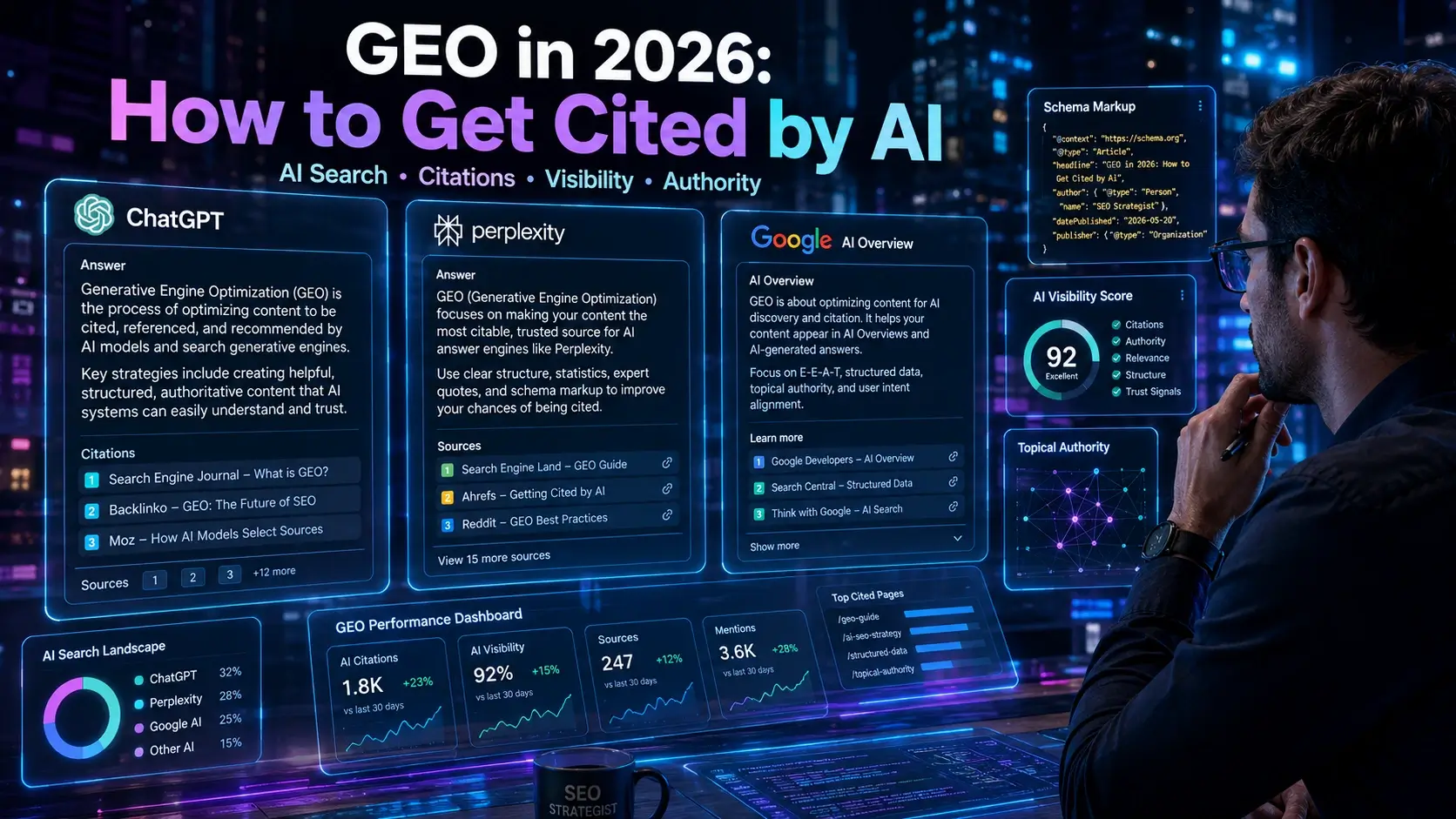
Google AI Overviews now appear on over 30% of search queries. ChatGPT handles more than 100 million weekly searches. Perplexity processes millions of research queries daily. The way people find information has fundamentally changed, and most content strategies have not caught up.
Generative Engine Optimization (GEO) is the practice of structuring and optimizing content so that AI systems cite it as a source in their generated responses. If SEO is about ranking in a list of blue links, GEO is about being quoted by the AI that is replacing those links.
This is not a theoretical framework. It is a practical playbook built on how these AI systems actually select, extract, and attribute sources in 2026. Every tactic in this guide is based on observed citation behavior, not speculation.
What Is Generative Engine Optimization (GEO)?
GEO is the optimization of content to appear as a cited source in AI-generated answers from platforms like ChatGPT, Perplexity, Google AI Overviews, Claude, and Microsoft Copilot.
Traditional SEO optimizes for search engine ranking positions. GEO optimizes for AI citation selection. The two are related but distinct. A page can rank number one in Google and never be cited by an AI Overview. Conversely, a page buried on page three of search results can be the primary source an AI engine pulls from.
The difference lies in what AI systems value when generating answers: structured information, clear authority signals, specific data points, and content that reads well when extracted and paraphrased.
GEO vs. SEO vs. AEO: What Is the Difference?
| Discipline | Optimizes For | Primary Platforms | Key Metrics |
|---|---|---|---|
| SEO | Blue link rankings, organic traffic | Google, Bing search results | Rankings, clicks, traffic, CTR |
| AEO | Featured snippets, voice answers | Google Featured Snippets, voice assistants | Snippet ownership, voice answer rate |
| GEO | AI citation and source attribution | ChatGPT, Perplexity, AI Overviews, Claude | Citation frequency, brand mention rate |
Think of it this way: SEO gets you found. AEO gets you quoted in a box. GEO gets you quoted by an AI that millions of people treat as a trusted advisor.
How AI Systems Choose Which Sources to Cite
Each AI platform has different citation preferences. Understanding these preferences is the foundation of effective GEO strategy.
Google AI Overviews
Google AI Overviews prioritize content that already ranks well organically, carries strong E-E-A-T (Experience, Expertise, Authoritativeness, Trustworthiness) signals, and uses structured data markup. If your page ranks in the top 10 for a query, it has a significantly higher chance of being cited in the AI Overview for that query.
Content with proper schema markup shows 30% to 40% higher visibility in AI-generated answers. Google’s system favors clear, factual statements that can be extracted and attributed without significant paraphrasing.
ChatGPT (with Web Search)
Research shows Wikipedia accounts for 47.9% of ChatGPT’s top cited sources when answering factual questions. After Wikipedia, news sites and educational resources dominate.
ChatGPT citations favor: clear, answer-first introductions, accessible supporting detail, concise definitions, and page sections that can stand independently. Content that requires reading multiple paragraphs to extract a coherent answer is less likely to be cited.
Perplexity AI
Perplexity’s citation patterns reveal a surprising preference. Nearly half (46.7%) of its top sources come from Reddit. The platform shows a strong bias toward recently published content, with a preference for articles published within the past 90 days.
This means freshness matters enormously for Perplexity visibility. Regularly updating content and publishing timely pieces on trending topics significantly increases citation chances.
The GEO Playbook: 10 Tactics That Drive AI Citations

1. Lead with Direct Answers
Every major section of your content should open with a clear, standalone answer to the implied question. AI systems extract passages. If your answer requires reading three paragraphs of context, it will be skipped in favor of a competitor’s direct statement.
Example: Instead of building up to “Embedded finance is the integration of financial services into non-financial platforms,” lead with that definition in the first sentence. Add context after.
2. Include Specific Data Every 150 to 200 Words
AI engines preferentially cite content that includes hard data because it adds credibility to their generated responses. Every 150 to 200 words, include a specific statistic, percentage, or data point with a source reference.
Content with cited statistics gets selected as an AI source more frequently than content that makes claims without numerical backing.
3. Use Structured Data Markup (Schema)
Implement FAQ schema, HowTo schema, Article schema, and Organization schema on your content pages. Structured data gives AI systems machine-readable context about your content’s purpose, authority, and structure.
Schema-marked pages show 30% to 40% higher visibility in AI-generated answers. This is one of the highest-impact, lowest-effort GEO tactics available.
4. Write for Extraction, Not Just Reading
AI systems extract passages, not pages. Write each paragraph so it can stand alone as a coherent, attributable statement. Avoid paragraphs that only make sense in the context of surrounding text.
Think of each paragraph as a potential quote card. If an AI pulled just that paragraph and attributed it to your site, would it make sense? Would it be useful? If not, rewrite it.
5. Build Topical Authority Through Content Clusters
AI systems assess source authority partly through topical coverage density. A site that publishes 20 high-quality articles about cybersecurity is more likely to be cited on cybersecurity queries than a site with one excellent post on the topic.
Build interconnected content clusters with a pillar page and supporting articles. Internal linking between these pieces signals topical depth to both traditional search engines and AI systems.
6. Optimize for Conversational Queries
People query AI systems differently than traditional search engines. They ask questions in natural language: “How does quantum computing threaten cybersecurity?” not “quantum computing cybersecurity threat.”
Structure your content around natural-language questions. Use headings that mirror how people phrase questions to AI assistants. Include FAQ sections that address real conversational queries.
7. Establish Author and Brand Authority Signals
AI systems evaluate source credibility. Author bylines with credentials, about pages with verifiable expertise, citations in reputable publications, and consistent brand presence across the web all contribute to citation likelihood.
Digital PR becomes a core GEO tactic, not just an SEO one. If trusted publications consistently mention your brand, AI tools recognize that authority signal.
8. Update Content Frequently
Perplexity strongly favors content published within the past 90 days. Google AI Overviews also consider content freshness. Regular updates (adding new data, refreshing examples, updating statistics) keep your content in the citation-eligible window.
Add visible “Last Updated” dates to your content. AI systems and their underlying crawlers use these signals to assess currency.
9. Avoid Keyword Stuffing (AI Penalizes It)
Tests on Perplexity showed that keyword-stuffed content underperformed baseline content by 10%. Because AI models are trained on natural language, they detect and penalize clumsy phrasing caused by forced keywords.
Write naturally. Use semantic variations. Let the topic determine the vocabulary, not a keyword density target.
10. Create Citable Assets: Tables, Lists, and Frameworks
AI systems frequently cite content that contains comparison tables, numbered lists, step-by-step frameworks, and definition boxes. These structured formats are easy for AI to extract, attribute, and present to users.
Every cornerstone piece of content should include at least one table, one numbered process, or one named framework that becomes a citable asset.
How to Measure GEO Performance
GEO measurement is still maturing. There is no equivalent of Google Search Console for AI citations. But practical approaches exist.
Manual Query Testing
Test 10 to 15 relevant queries across ChatGPT, Perplexity, and Google AI Overviews monthly. Document when and how your brand or content appears. Capture screenshots because outputs change frequently.
Brand Mention Tracking
Use tools like Otterly.ai or manual monitoring to track when AI platforms mention your brand or cite your content. Log the prompt, platform, citation status, position, and date.
Traditional SEO Correlation
Monitor whether pages that gain AI citations also see changes in organic traffic, backlinks, and brand search volume. Early data suggests AI citations create a positive feedback loop with traditional SEO signals.
Referral Traffic from AI Platforms
Check your analytics for referral traffic from chat.openai.com, perplexity.ai, and google.com (AI Overview clicks). This traffic is still small but growing rapidly.
Platform-Specific GEO Cheat Sheet
| Factor | Google AI Overviews | ChatGPT | Perplexity |
|---|---|---|---|
| Top signal | Organic rankings + E-E-A-T | Authority + clarity | Freshness + Reddit presence |
| Schema impact | Very high (30-40% lift) | Moderate | Low to moderate |
| Freshness weight | Moderate | Moderate | Very high (90-day window) |
| Content format | Structured, factual, extractable | Answer-first, standalone sections | Data-rich, updated frequently |
| Brand authority | Strong factor | Wikipedia-level trust preferred | Community validation matters |
Expert Tips for GEO Success in 2026
GEO and SEO Are Complementary, Not Competing
The best GEO strategy starts with strong SEO fundamentals. Pages that rank well organically are more likely to be cited by AI systems. Do not abandon SEO for GEO. Layer GEO tactics on top of existing SEO practices.
Focus on Being the Definitive Source, Not Just a Source
AI systems consolidate information from multiple pages. Being cited requires being the most authoritative, clear, and data-rich source available. Second-best content gets paraphrased without attribution.
Monitor AI Citation Patterns Monthly, Not Daily
AI outputs are non-deterministic. The same query can produce different citations on different days. Monthly sampling gives a more reliable picture than daily spot-checks.
Invest in Digital PR Specifically for AI Visibility
Brand mentions in authoritative publications increase AI citation probability. Target media coverage, industry report citations, and guest contributions on high-authority sites.
Prepare for the AI Traffic Shift Now
AI-driven search is eroding traditional click-through rates for informational queries. The traffic model is shifting from “clicks to your site” to “brand trust built through AI citations.” Adapt your attribution models accordingly.
Common GEO Mistakes
Optimizing Only for Google AI Overviews
Each AI platform has different citation preferences. A strategy that works for Google may underperform on ChatGPT or Perplexity. Optimize across platforms.
Ignoring Content Freshness
Stale content loses citation eligibility, especially on Perplexity. Regular updates are not optional for GEO performance.
Over-Optimizing for AI at the Expense of Human Readers
Content written purely for AI extraction often reads poorly for humans. Since human engagement signals (time on page, bounce rate, social shares) also influence AI citation algorithms, you need content that serves both audiences.
Expecting Immediate Results
GEO is a compounding strategy. Topical authority, brand signals, and citation history build over months. Expect 3 to 6 months before seeing consistent citation improvements.
Frequently Asked Questions
What Is Generative Engine Optimization (GEO)?
GEO is the practice of optimizing content to be selected and cited as a source in AI-generated answers from platforms like ChatGPT, Perplexity, Google AI Overviews, and Claude. It involves structuring content for extractability, building authority signals, including specific data points, implementing structured data markup, and maintaining content freshness.
How Is GEO Different From SEO?
SEO optimizes for search engine ranking positions and click-through rates. GEO optimizes for AI citation selection and brand mention in generated responses. While SEO focuses on keywords, backlinks, and traffic, GEO prioritizes content structure, authority signals, data richness, and extractability. Strong SEO provides a foundation for GEO, but the tactics diverge significantly.
How Do I Know if My Content Is Being Cited by AI?
Currently, there is no centralized dashboard for AI citations. The practical approach is manual query testing (searching 10 to 15 relevant prompts monthly across ChatGPT, Perplexity, and Google AI Overviews), brand mention monitoring tools like Otterly.ai, and tracking referral traffic from AI platform domains in your analytics.
Your Next Step
GEO is not a future consideration. It is a present reality. Millions of people are getting answers from AI systems every day. The content those systems cite shapes brand perception, drives trust, and influences purchasing decisions.
Start by auditing your top 10 pieces of content against the 10 GEO tactics in this guide. Add schema markup. Include specific data points. Restructure for extractability. Test your target queries across ChatGPT, Perplexity, and Google AI Overviews to see where you stand today.
The brands that invest in GEO now will own the AI-mediated conversations that define the next era of digital visibility.
Want your brand to stay visible in the AI search era? Publish high-authority guest posts through WritoryBuzz and strengthen your SEO, GEO, and digital authority with strategic placements on trusted technology and business websites.