
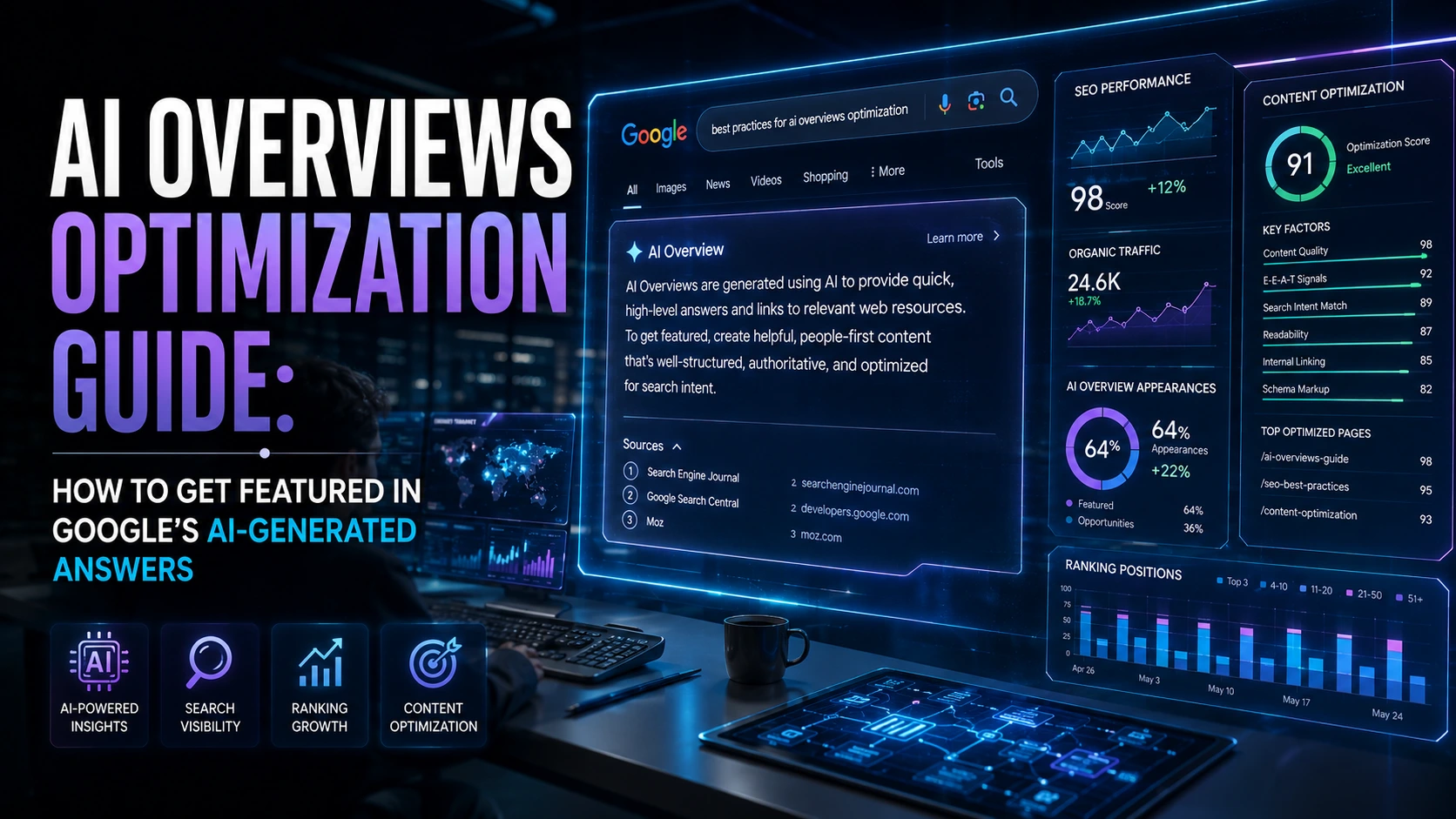
Google search has changed. When someone types a question into Google today, the first thing they see is not a list of blue links. It is an AI-generated summary that pulls information from multiple sources and presents a direct answer at the top of the page.
These AI Overviews now appear for 30% of U.S. desktop keywords and reach 2 billion monthly users across 200+ countries. That is not a beta feature. That is the new front page of the internet.
The problem? Organic click-through rates have dropped 61% for queries where AI Overviews appear. If your content is not being cited in these summaries, you are losing visibility fast. But here is the upside: the sites that do get cited are seeing higher-quality traffic with conversion rates that outperform traditional organic by a wide margin.
This guide covers exactly how to optimize your content for AI Overviews, what Google’s AI looks for when selecting sources, and the practical steps you can take to get featured in 2026.
What Are Google AI Overviews?
AI Overviews are AI-generated summaries that appear at the top of Google search results for certain queries. Google’s large language model reads and synthesizes information from multiple web pages, then presents a concise answer with links to the source material.
Unlike featured snippets that pull a single block of text from one page, AI Overviews combine insights from several sources into a unified response. They include inline citations that link back to the pages Google’s AI used to generate the answer.
For users, AI Overviews provide faster answers. For publishers and businesses, they represent a completely new battleground for search visibility. Getting cited in an AI Overview can drive significant traffic, but being excluded from them means your content may never be seen even if it ranks on page one.
| Feature | Featured Snippets | AI Overviews |
| Source count | Single page | Multiple pages synthesized |
| Content format | Direct text extraction | AI-generated summary with citations |
| Position on SERP | Top of organic results | Above all organic results |
| Query types | Simple, direct questions | Complex, multi-faceted questions |
| User interaction | Click to read more | Answer visible without clicking |
| Impact on CTR | Moderate reduction | 61% average CTR reduction |
How Google Selects Sources for AI Overviews
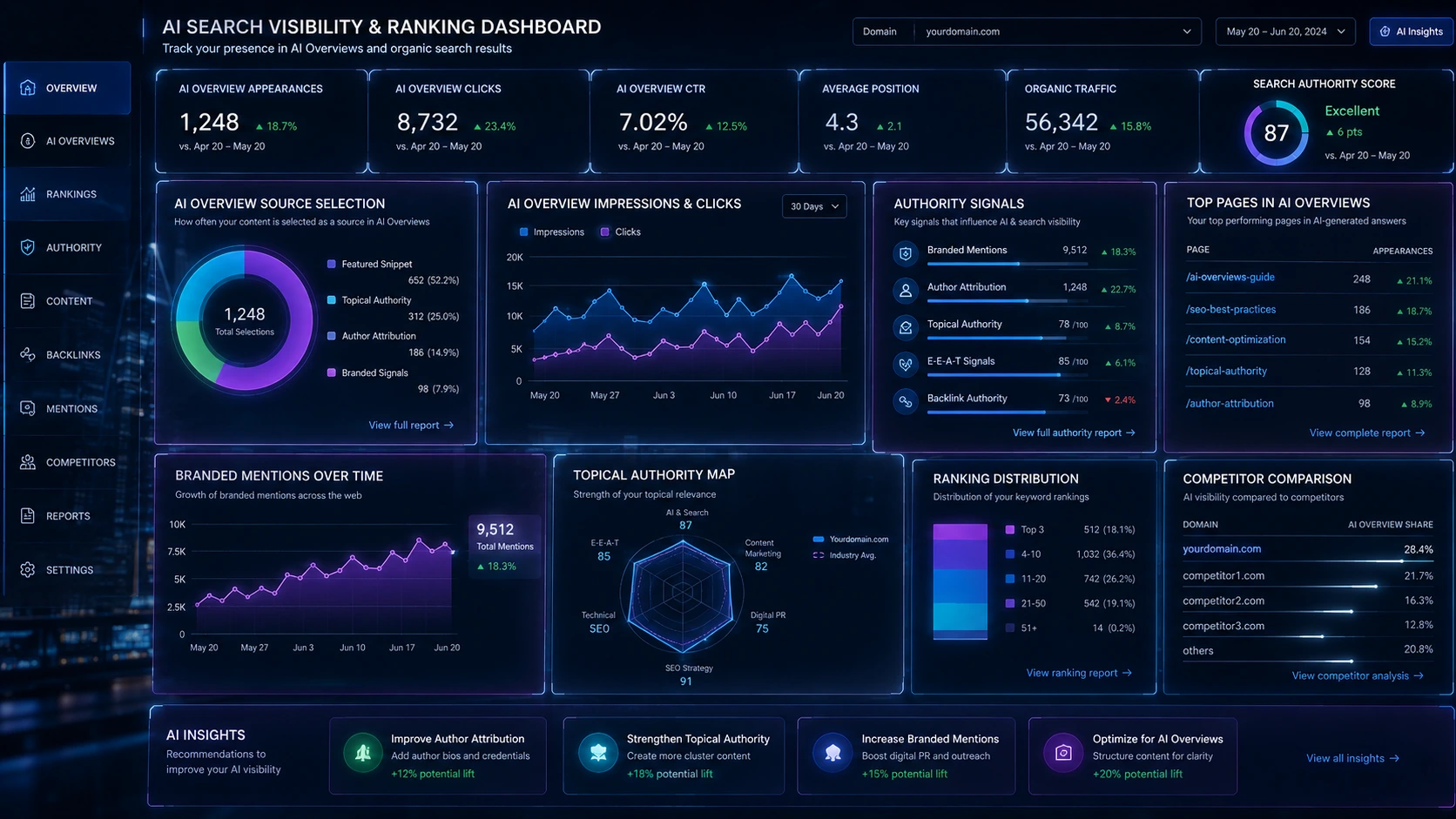
Google’s AI does not randomly pick sources. There is a clear pattern in what gets cited and what gets ignored. Understanding these selection criteria is the foundation of any AI Overviews optimization strategy.
Organic ranking matters most. Pages cited in AI Overviews almost always rank in the top five organic results. If your page is not ranking organically, it is essentially invisible to the AI Overview selection process. Strong traditional SEO remains the entry ticket.
Branded web mentions carry the highest weight. Research shows that branded web mentions have the strongest correlation (0.664) with AI Overview appearances, much higher than backlinks (0.218). Being mentioned across authoritative publications, forums, and industry sites signals trust to Google’s AI.
Author attribution increases citation probability. Pages with clear author attribution are 53% more likely to be cited within AI-generated answers. A visible author bio, credentials, and byline tell Google’s AI that a real expert created the content.
Content freshness signals quality. Google’s AI shows measurable preference for recently published or updated content. The AI wants to present current information, so pages with recent publish dates and visible update timestamps have an advantage.
Topical authority compounds citations. Sites with well-developed topic clusters and interlinked authoritative content see up to 30% higher citation rates in AI Overviews. Covering a topic comprehensively across multiple related pages builds the trust that gets you cited repeatedly.
Content Structure That Gets Cited
The way you structure content directly affects whether Google’s AI can extract and cite it. Research into citation patterns reveals exactly where in your content citations come from.
| Content Position | Citation Share | What This Means |
| First 30% (intro section) | 44.2% of all citations | Lead with your strongest, most complete answer upfront |
| Middle 30-70% | 31.1% of all citations | Supporting details, examples, and data get cited frequently |
| Last 30% (conclusion) | 24.7% of all citations | Summaries and key takeaways still attract citations |
Nearly half of all citations come from the first third of your content. This means your opening paragraphs need to deliver a clear, self-contained answer to the primary question before expanding into details.
The Inverted Pyramid Approach
Start every page with a direct, comprehensive answer to the target question. Do not build up to it. Do not save the conclusion for the end. Give the answer first, then explain why, then provide supporting evidence. This matches how Google’s AI processes and selects content for citations.
Paragraph-Level Citability
Google’s AI cites specific passages, not entire pages. Each paragraph should be able to stand on its own as a useful answer to a potential question. Write self-contained paragraphs that make a clear point, include specific data or details, and do not depend on surrounding text for context.
10 Actionable Strategies to Optimize for AI Overviews
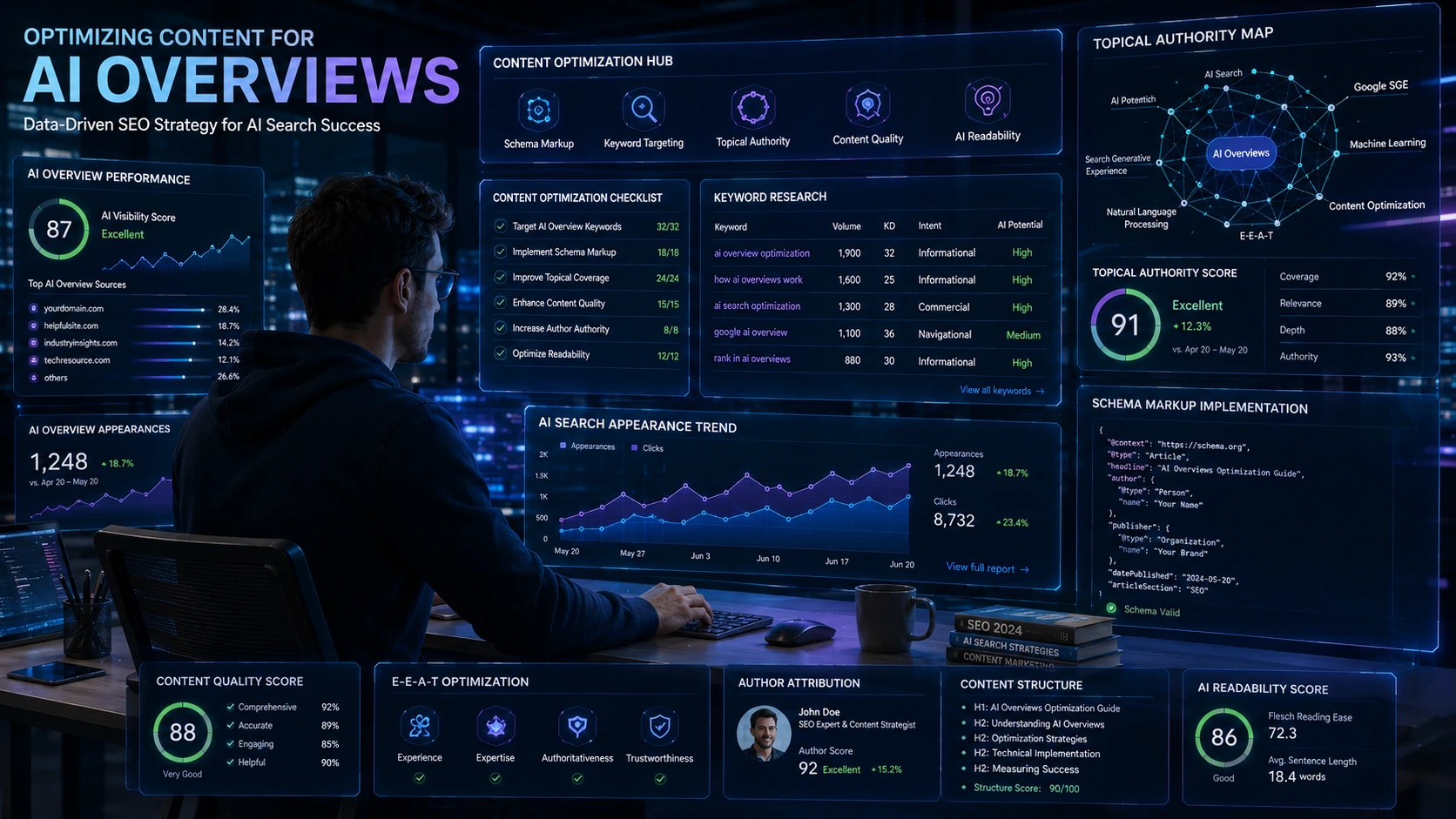
1. Nail Your On-Page SEO First
AI Overviews source from top-ranking pages. If you are not in the top five organic results, optimization for AI Overviews is premature. Focus on title tags, meta descriptions, header hierarchy, internal linking, and core web vitals before anything else.
2. Answer the Question in Your First 100 Words
Open every piece of content with a direct, factual answer to the target query. Google’s AI heavily favors introductions that provide immediate value. Avoid lengthy preambles, anecdotes, or throat-clearing paragraphs that delay the answer.
3. Use Structured Data Markup
Implement FAQPage, HowTo, Article, and Speakable schema markup. These structured data types help Google’s AI understand the format and context of your content. Test all markup with Google’s Rich Results Test before publishing.
4. Build Topical Authority Through Content Clusters
Create comprehensive content hubs around your core topics. A pillar page supported by 10 to 15 interlinked supporting articles signals deep expertise. Sites with strong topic clusters see 30% higher citation rates in AI Overviews.
5. Add Clear Author Attribution and E-E-A-T Signals
Include detailed author bios with credentials, link to author profiles across platforms, and display relevant certifications or experience. Pages with visible author attribution are 53% more likely to be cited. For health, finance, and legal topics, expert authorship is practically required.
6. Include Data, Statistics, and Original Research
Google’s AI favors content with specific numbers, research citations, and original data. Include statistics from credible sources, run your own surveys or analyses, and present unique data points that cannot be found elsewhere. Specificity gets cited. Vague generalizations do not.
7. Optimize for Conversational and Long-Tail Queries
AI Overviews trigger most often for complex, multi-faceted questions rather than simple navigational queries. Target question-based keywords, how-to searches, and comparison queries. Use natural language that matches how people actually ask questions.
8. Keep Content Fresh and Visibly Updated
Add visible publish and last-updated dates to every page. Review and refresh content quarterly. Update statistics, replace outdated references, and add new information as it becomes available. Freshness is a measurable ranking factor for AI Overview inclusion.
9. Distribute Content Across Multiple Platforms
Research shows that distributing content across a wide range of publications can increase AI citations by up to 325% compared to publishing only on your own site. Guest posts, industry publications, press releases, and syndicated content all contribute to the branded mentions that correlate with AI Overview visibility.
10. Format for Scannability and Extraction
Use clear H2 and H3 headings that match common search queries. Break content into short paragraphs of 2 to 3 sentences. Use tables for comparative data. Include numbered steps for how-to content. Each section should work as a standalone answer that Google’s AI can extract cleanly.
Query Types That Trigger AI Overviews Most Often
| Query Type | Example | Optimization Approach |
| How-to questions | How to implement zero trust security | Step-by-step format with numbered instructions |
| What-is definitions | What is generative AI | Clear definition in first paragraph, then expand |
| Comparison queries | React vs Vue in 2026 | Side-by-side tables with specific criteria |
| Best/top lists | Best AI tools for marketing | Curated lists with brief descriptions and use cases |
| Why questions | Why is cybersecurity important | Direct answer followed by supporting evidence |
| Complex multi-part | How does blockchain improve supply chain | Comprehensive coverage with clear subsections |
Measuring Your AI Overview Performance
You cannot optimize what you cannot measure. Several tools and methods help track your visibility in AI Overviews.
Google Search Console: Monitor impressions and clicks for queries where AI Overviews appear. Look for changes in CTR patterns that indicate AI Overview presence.
Third-party tracking tools: Platforms like Semrush, Ahrefs, and SE Ranking now track AI Overview appearances and source citations. Use these to identify which of your pages are being cited and which competitors are getting featured.
Manual SERP audits: Search for your target keywords in an incognito browser and document which queries trigger AI Overviews. Note the sources cited and analyze what those pages have in common.
Citation monitoring: Track how often your brand and domain appear as cited sources across AI Overviews. Look for patterns in the content types and topics that get cited most frequently.
Expert Tips for AI Overview Optimization
Think in passages, not pages. Google’s AI cites specific paragraphs. Write every paragraph as if it could be extracted and displayed independently. Include the key fact, the context, and the conclusion within each paragraph.
Do not optimize only for Google. AI Overviews are just one AI search surface. ChatGPT, Perplexity, and Bing Copilot all use similar citation logic. Optimizing for one improves your chances across all AI search platforms.
Track the overlap gap. Only 13.7% of citations overlap between AI Overviews and Google’s AI Mode. This means you need to optimize for both surfaces, which requires broader topical coverage and more diverse content formats.
Prioritize trust signals over link building. Branded mentions correlate 3x more strongly with AI Overview citations than backlinks alone. Focus on PR, industry mentions, expert quotes, and cross-platform visibility alongside your link building efforts.
Test with featured snippets first. Pages that win featured snippets have a higher probability of appearing in AI Overviews. Optimize for featured snippets as a stepping stone to AI Overview visibility.
Frequently Asked Questions
What are Google AI Overviews?
Google AI Overviews are AI-generated summaries that appear at the top of search results for certain queries. They synthesize information from multiple web pages and present a concise answer with inline citations linking back to the source pages. They currently appear for about 30% of U.S. desktop searches and reach over 2 billion users monthly worldwide.
How do I get my content featured in AI Overviews?
Start by ranking in the top five organic results for your target keywords, as nearly all AI Overview citations come from top-ranking pages. Then structure your content with clear, direct answers in the opening paragraphs, add schema markup, build topical authority through content clusters, include author attribution, and keep content fresh with visible update dates.
Do AI Overviews hurt organic traffic?
AI Overviews reduce average organic CTR by about 61% for queries where they appear. However, traffic from AI citations tends to be higher quality. ChatGPT-referred visitors convert at 15.9% compared to 1.76% for standard Google organic traffic. The goal is to be cited within the AI Overview rather than competing below it.
What schema markup helps with AI Overviews?
FAQPage, HowTo, Article, and Speakable schema types are most relevant. These help Google’s AI understand your content structure and context. Always validate your markup using Google’s Rich Results Test before deploying to production.
How is optimizing for AI Overviews different from traditional SEO?
Traditional SEO focuses on ranking pages in organic results. AI Overview optimization focuses on making your content citable at the passage level. This requires stronger E-E-A-T signals, clearer content structure, broader brand visibility across the web, and content that can stand on its own when extracted from context.
Can small websites get featured in AI Overviews?
Yes, but it requires strong topical authority in a focused niche. Small sites that cover a specific topic comprehensively with expert-authored content can compete with larger publishers. Focus on depth over breadth, build genuine expertise signals, and distribute your insights across multiple platforms to increase branded mentions.
Start Optimizing for the New Search Reality
AI Overviews are not going away. They are expanding to more queries, more countries, and more languages every quarter. The publishers who adapt their content strategy now will own the visibility that matters most in 2026 and beyond.
For more SEO strategies, content optimization guides, and digital marketing insights, explore WritoryBuzz.com. We cover the tactics and tools that keep your content visible in an AI-first search world.