
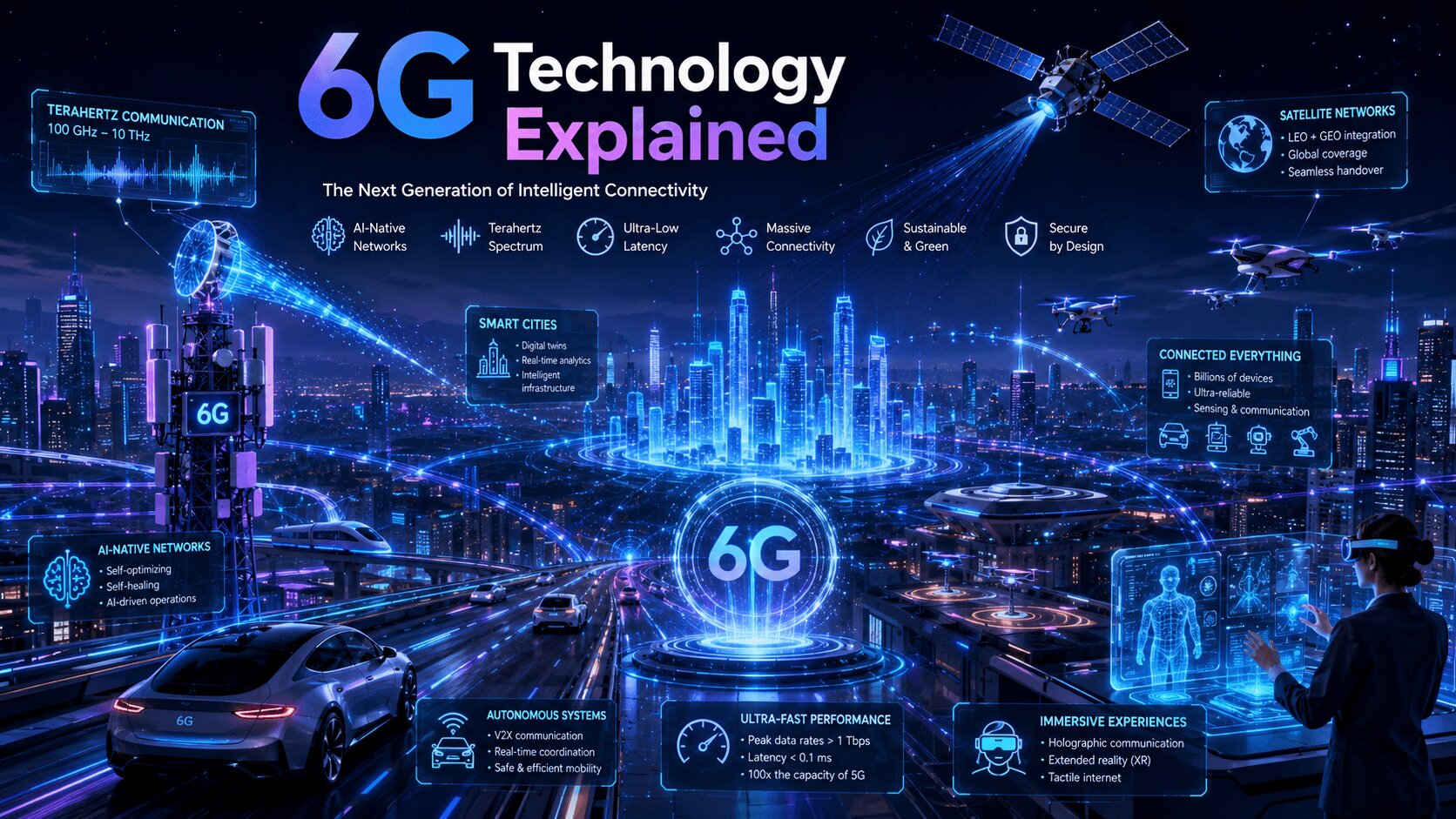
5G is still being switched on in cities across the world. Millions of people are still waiting for it to reach their area. And the telecommunications industry is already deep into building what comes after it.
6G is not a rumour or a marketing concept. It has a formal standards body. It has a published development timeline. It has had a working chip since 2025. And it will change what wireless networks can do far more dramatically than 5G changed things from 4G.
Here is what it actually is, what it will be capable of, who is building it, and the realistic answer to when any of this reaches you.
Where We Are Right Now: 2026 Is a 6G Milestone Year
The phrase ‘6G is coming’ has been used so loosely that it’s easy to miss the actual progress underneath. In 2026, something concrete is happening. The International Telecommunication Union’s IMT-2030 framework – the official definition of what 6G must do – is being finalised. And 3GPP, the body that writes the actual technical specifications used by every major telecoms company, is deciding the duration and structure of Release 21, which will contain the first 6G standard.
Why 2026 Matters More Than It Looks
Standards decisions made this year will determine what 6G actually becomes at a technical level. Once those decisions are locked in, the development path becomes fixed for the rest of the decade.
As IEEE Member Gabrielle Silva put it: 2026 could mark the year that discussions shift from what could be possible to what will actually be built. That transition from aspiration to specification is what makes this year significant, even though there is nothing yet in your pocket to show for it.
What 6G Actually Is
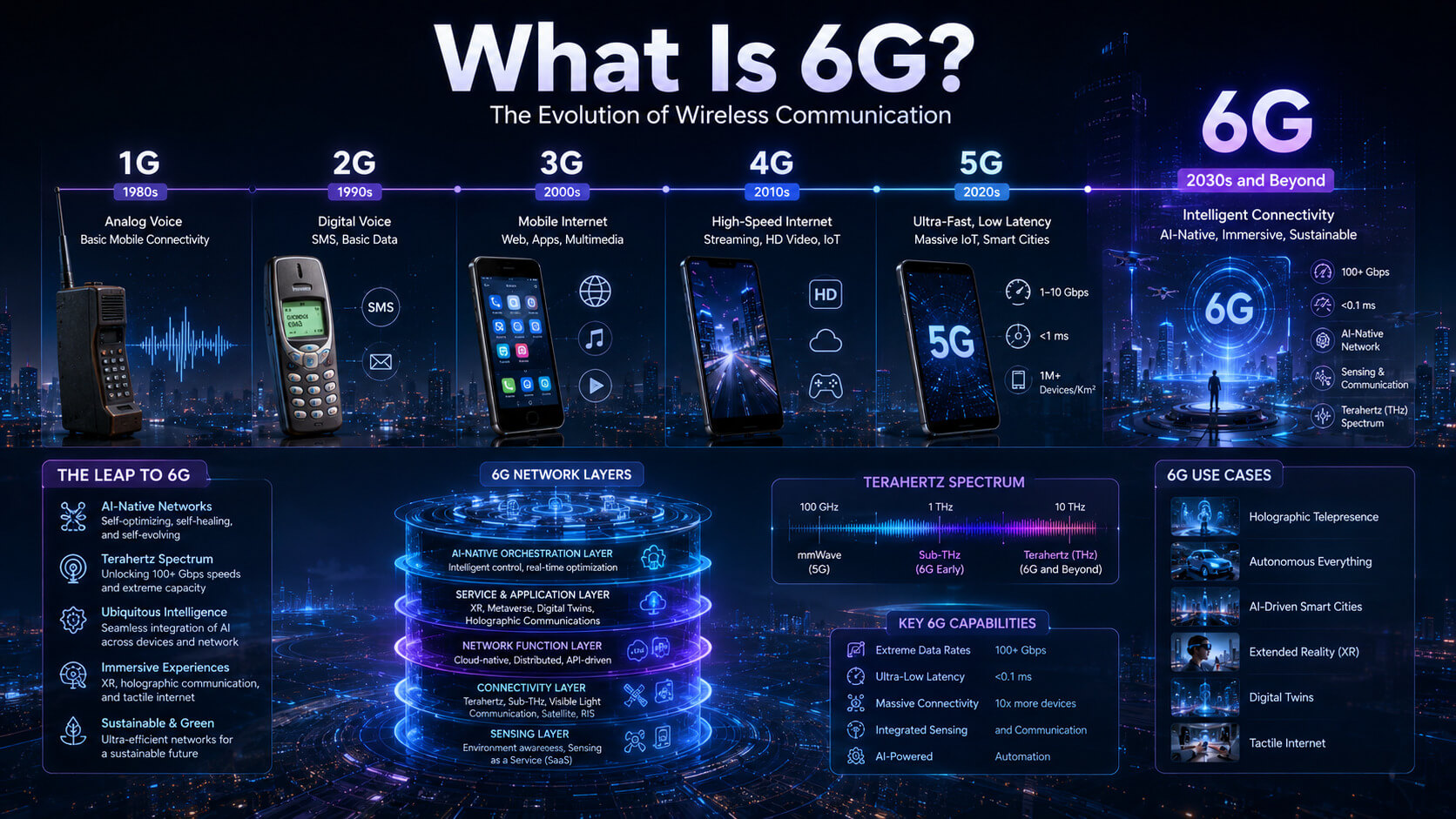
6G is the sixth generation of wireless cellular technology. It follows 5G the way 5G followed 4G: a step change in speed, capacity, and capability, not just an incremental upgrade to the previous generation.
But framing 6G purely as ‘faster 5G’ misses the real story. The three most significant things 6G will bring are not just measured in gigabits per second.
Beyond Speed – The Three Real Breakthroughs
AI-native networks. 5G was designed as a traditional network with AI features bolted on afterward. 6G is being designed from the ground up with AI embedded in the network core. The network itself will learn, adapt, and optimise in real time – allocating spectrum dynamically, predicting congestion before it happens, and managing billions of connected devices autonomously. This is a fundamentally different architecture, not a speed upgrade.
Terahertz spectrum. 5G uses millimetre wave frequencies at the high end (up to around 100 GHz). 6G will operate in the terahertz range (100 GHz to 10 THz). This unlocks the bandwidth needed for speeds measured in terabits per second and latency below a tenth of a millisecond. The physics challenges are significant – terahertz signals don’t travel far and are blocked by most solid objects – but chip and antenna research in 2024 and 2025 has moved this from theoretical to demonstrable.
Energy efficiency at scale. For every bit of data transmitted, 6G is being designed to use up to 100 times less energy than 5G. As global mobile data traffic is forecast to grow by a factor of 2.4 between 2026 and 2031 alone, the energy footprint of wireless networks is a serious sustainability concern. 6G’s efficiency gains are not a nice-to-have — they are a condition of viability at that scale.
6G vs 5G: The Numbers That Matter
Speed gets most of the headlines but it is only one part of the performance picture.
| Metric | 5G (current best) | 6G (projected) |
| Peak download speed | ~10 Gbps | ~1 Tbps (100x faster) |
| Latency | ~1 millisecond | ~0.1 millisecond |
| Device density | 1M devices/km² | 10M+ devices/km² |
| Frequency band | Sub-6 GHz + mmWave | Terahertz (THz) spectrum |
| AI integration | Bolted on | Native — AI in the network core |
| Energy efficiency | Baseline | Up to 100x more efficient per bit |
The 100 Gbps chip demonstrated in September 2025 by US and Chinese researchers gives a tangible reference point: at that speed, a 3 GB HD film downloads in under a quarter of a second. The full 1 Tbps theoretical peak would put that in the realm of the imperceptible.
The latency reduction matters more for most use cases than the raw speed. Sub-millisecond latency is the threshold that enables real-time applications that 5G cannot support reliably: remote surgery, autonomous vehicle coordination, holographic communication, and industrial automation at the level of reflex rather than reaction.
The Official 6G Development Timeline
The timeline below reflects the current official position of 3GPP, ITU, and major industry players as of mid-2026.
| Period | Phase | Key Activity | Who’s Leading |
| 2020–2024 | Research | Lab experiments, concept papers, spectrum studies | Universities, Samsung, NTT Docomo |
| 2024–2026 | Specification | 3GPP requirement work, ITU IMT-2030 framework, initial prototypes | 3GPP, ITU, Ericsson, Nokia |
| 2026–2028 | Standardisation | 3GPP Release 21 spec work, test network deployments | All major telcos + regulators |
| 2028–2030 | Pre-commercial | Evaluation, limited trials, device development begins | South Korea, Japan, China first |
| 2030+ | Commercial | Initial commercial launch, mostly enterprise / urban first | Global — consumer ~2031–2032 |
| The Gap That Matters: Standards vs Consumer Access
A ‘2030 commercial launch’ does not mean 6G on your phone in 2030. It means initial commercial network availability, likely in select cities in South Korea, Japan, and parts of China first. Consumer device availability follows network infrastructure by 1–2 years. Most analysts place broad consumer access — the point where a 6G handset is available and makes sense to buy — at 2031 to 2033, depending on region. Europe and the US are typically 12–24 months behind the initial Asian launches for new network generations. |
Who Is Leading the 6G Race?
6G development is explicitly geopolitical. Countries treat wireless infrastructure leadership as a matter of economic and strategic importance. The race for 6G is more openly contested than the race for 5G was.
South Korea and Japan
South Korea has been the most aggressive. The government committed to a commercial 6G launch by 2028, ahead of most other nations. Samsung and LG are both major contributors to 6G research output. Japan’s NTT Docomo has been involved in 6G concept development since 2020 and is targeting a 2030 commercial launch with pre-commercial trials from 2028.
China
China has invested heavily in 6G research through Huawei, ZTE, and government-affiliated research institutes. The goal of setting global 6G standards — rather than adopting standards set by Western-led bodies — is an explicit priority. Chinese researchers have been among the most productive in terahertz antenna work and have filed a significant share of 6G-related patents globally.
USA and Europe
The US is coordinating through the Next G Alliance, a public-private initiative under the Alliance for Telecommunications Industry Solutions (ATIS). Federal funding has supported university and industry research programmes. Early tests by major carriers are expected between 2026 and 2028. Broad consumer access is aligned with a 2030 or later window.
Europe’s approach is coordinated through the Hexa-X and Hexa-X-II research projects backed by the European Commission. The target is commercial availability by 2030, with broader testing from 2026 onward. The EU has prioritised open network architectures and sustainability standards as differentiators in its 6G approach.
What 6G Will Actually Be Used For
The use cases that 6G enables fall into two categories: things that are theoretically possible with 5G but do not work reliably in practice, and things that are genuinely new.
Extended reality at scale. Augmented and virtual reality applications currently struggle with the latency and bandwidth constraints of 5G, particularly in dense environments. 6G’s combination of terahertz speeds and sub-millisecond latency makes persistent, shared AR environments – not just on a headset in your living room but overlaid on physical public space — technically viable.
Autonomous vehicle coordination. Individual autonomous vehicles can function on 5G. Coordinating thousands of autonomous vehicles in real time, sharing sensor data and making collective decisions faster than any human reaction time, requires 6G’s device density and latency profile.
Remote surgical systems. Current telesurgery systems require near-zero latency to be safe. 5G is not consistent enough. 6G’s guaranteed sub-millisecond latency opens the door to surgical procedures performed across cities or continents with a robot in the operating theatre and a surgeon anywhere.
Sensing networks. 6G’s terahertz frequencies enable imaging and sensing applications in addition to communication. A 6G network could effectively act as a distributed radar system, enabling applications in environmental monitoring, security, and infrastructure inspection that no previous wireless generation could support.
Industrial automation. Smart factories running on 5G today require dedicated network slices and careful management. 6G’s AI-native architecture makes the same level of reliability and responsiveness available without the same level of manual configuration.
The Honest Reality Check
Several things that 6G articles routinely predict will not happen the way they’re described.
Most people will not have 6G devices in 2030. The initial launch will be infrastructure in selected markets. Consumer handsets typically lag network launches by 1 to 2 years, and adoption lags device availability by another 2 to 3 years. The 5G experience – where networks launched in 2019 and 2020 still aren’t available to large portions of the global population in 2026 – is likely to repeat.
Terahertz signals have serious range limitations. The frequencies that enable 6G’s headline speeds don’t travel through walls or over distances beyond a few hundred metres. Dense small-cell infrastructure will be required, which is expensive and takes years to deploy. Indoor coverage will need separate solutions.
5G Advanced – the enhanced version of 5G already being standardised – will be the technology most people actually use throughout the 2026 to 2030 window. It incorporates early 6G concepts including AI integration and improved efficiency while running on existing infrastructure. This is the relevant near-term technology for most organisations, not 6G itself.
What Businesses Should Do Now
For most organisations, 6G is a planning horizon item, not an immediate action. But a few things are worth doing now.
- Track the 5G Advanced rollout in your region. This is the technology that will actually matter for enterprise connectivity in 2026 to 2029 and has real capabilities worth understanding for infrastructure planning.
- Follow 3GPP Release 21 timelines. The technical decisions made in 2026 and 2027 will determine 6G’s actual capabilities. Organisations in telecom, hardware, automotive, healthcare, or defence have a genuine interest in following these decisions.
- Assess spectrum holdings and partnerships. Companies with heavy wireless connectivity requirements should be working with carriers now on 5G Advanced capabilities and having early conversations about 6G transition paths.
- Watch South Korea and Japan for early signals. The technologies and use cases that prove out in initial 2028 to 2030 deployments in these markets will give everyone else a clearer picture of what 6G actually does in practice versus what the standards promised.
Frequently Asked Questions
When will 6G be available to consumers?
The most likely timeline for initial commercial 6G networks is around 2030, starting in South Korea, Japan, and parts of China. Consumer-grade devices supporting 6G are not expected to reach most markets until 2031 to 2033. Broad availability comparable to current 5G rollout will take most of the 2030s.
How much faster is 6G than 5G?
The theoretical peak speed for 6G is around 1 terabyte per second, compared to 5G’s 10 gigabits per second peak — roughly 100 times faster at maximum. More practically, a 6G chip demonstrated in 2025 achieved 100 Gbps, which is still around 10 to 30 times faster than today’s best 5G implementations. Latency drops from about 1 millisecond in 5G to 0.1 milliseconds in 6G.
Which countries are ahead in 6G development?
South Korea is the most advanced in terms of government commitments and target dates. China has the highest research output and patent filings. Japan’s NTT Docomo has been involved since 2020. The US and EU are both funding substantial research programmes but are targeting commercial availability in 2030 or later.
Is 6G the same as what the terahertz chip news was about?
Yes. The 100 Gbps full-spectrum 6G chip announced in September 2025 by US and Chinese researchers uses terahertz frequencies that are central to 6G’s design. It was a demonstration of technical feasibility, not a commercial product. The path from that chip to a handset in a consumer’s pocket runs through standards, infrastructure, device manufacturing, and regulatory approval – a multi-year process.
Keep Watching, But Don’t Wait
6G will be a genuine step change when it arrives. The combination of AI-native architecture, terahertz speeds, and near-zero latency will enable things that are not practically possible today.
But 2030 is four years away, and broad consumer access is further still. The technology that matters for most organisations and individuals over the next three years is 5G Advanced, not 6G. Understanding both is the right approach: use what’s available now, plan for what’s coming.
The standards decisions being made in 2026 are worth following. What gets specified this year becomes the technology you will actually use in 2031.