
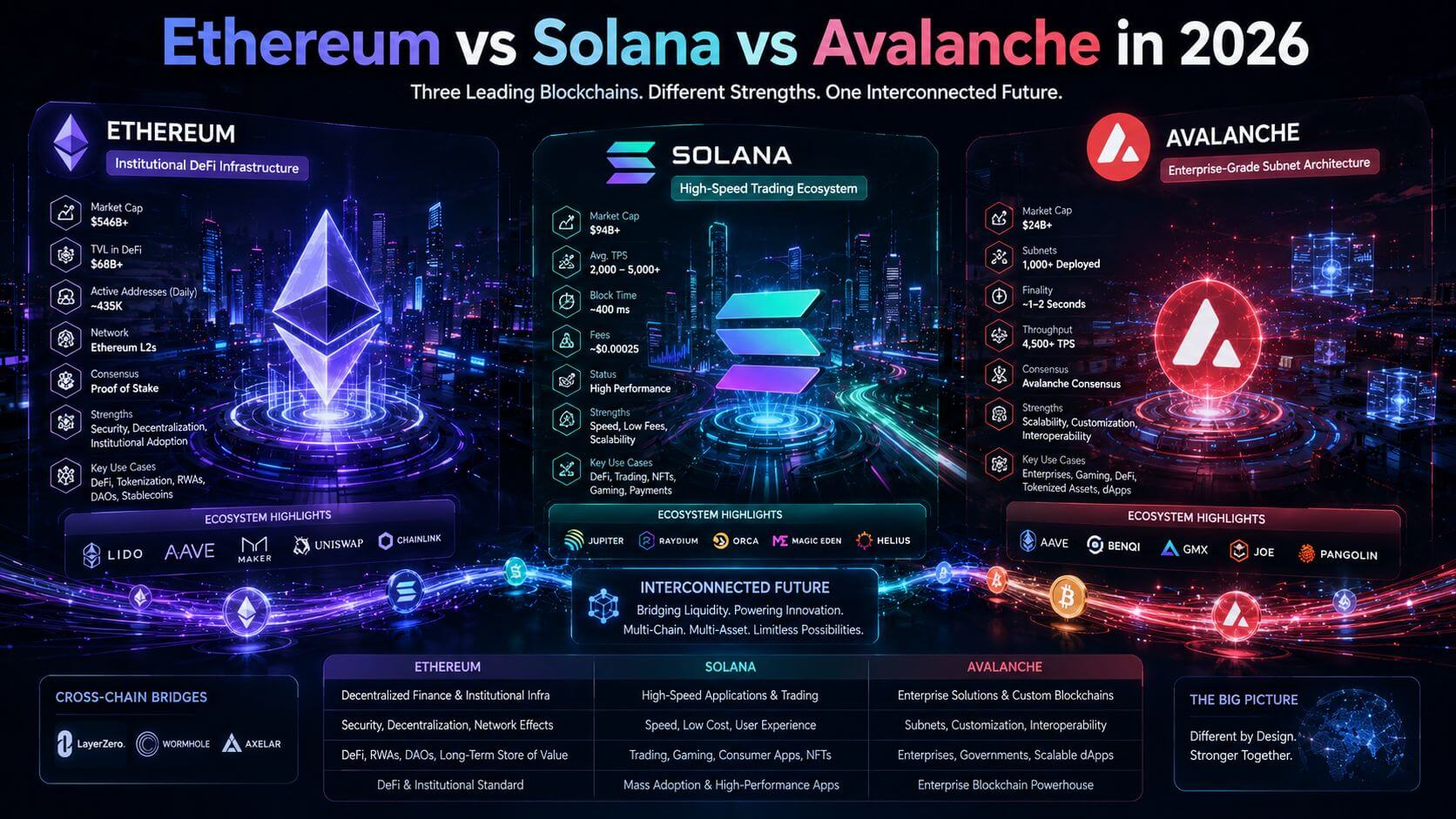
The ‘Ethereum killer’ narrative that dominated crypto media for years has finally been put to rest. Not because Ethereum won, but because the question was always wrong.
Ethereum, Solana, and Avalanche are not competing for the same users doing the same things. They have each settled into distinct roles in the blockchain ecosystem. Ethereum dominates high-value DeFi and institutional applications. Solana owns speed-dependent consumer applications and trading volume. Avalanche has carved out the enterprise and custom-chain space.
Understanding which one is right for you depends entirely on what you are trying to build or do. This guide makes that decision straightforward.
The ‘Ethereum Killer’ Narrative Is Dead

From 2020 to 2023, every fast blockchain with low fees was marketed as a potential replacement for Ethereum. The argument was simple: Ethereum was slow and expensive, therefore a faster, cheaper alternative would take its users.
It did not play out that way. Ethereum still holds over 60 percent of total DeFi value locked. Institutional money still flows primarily through Ethereum infrastructure. The most significant NFT markets, the biggest lending protocols, and the most regulated financial products all live on Ethereum.
But Solana is processing more DEX trading volume than any other chain. And Avalanche is quietly becoming the blockchain of choice for enterprises that need custom compliance rules and institutional-grade infrastructure.
Why Asking ‘Which Is Best?’ Is the Wrong Question
A better question is: best for what? A high-frequency DEX trader and an institutional fund deploying tokenised securities have almost nothing in common in terms of what they need from a blockchain. Recommending one chain for both use cases is like recommending one vehicle for Formula 1 racing and long-haul freight.
The three chains have not failed to beat each other. They have each found the market that values what they specifically offer.
Where Each Blockchain Stands in 2026
Before the detailed comparison, here is the one-paragraph summary for each.
Ethereum: The most valuable, most trusted, and most decentralised smart contract platform. Slow and expensive at the base layer, but Layer 2 networks (Arbitrum, Optimism, Base, zkSync) have effectively solved that for most use cases. Still the default choice for anything where security and composability with existing DeFi matter most.
Solana: The fastest major blockchain in production. Processes 50 percent of global DEX volume. Fees are fractions of a cent. The preferred chain for consumer-facing applications, trading, gaming, and anything that needs speed and volume at minimal cost. Has had reliability issues historically but network stability has improved substantially since 2024.
Avalanche: Built differently from the other two. Its subnet architecture lets developers launch custom blockchains with their own validator sets, fee structures, and compliance rules — all while benefiting from Avalanche’s shared security. The chain of choice for enterprise blockchain deployments, regulated finance experiments, and gaming studios that need predictable performance.
Head-to-Head Metrics Comparison
| Metric | Ethereum | Solana | Avalanche |
| TPS (practical) | ~100 base layer (L2s: 1,000–10,000+) | ~3,000–5,000 sustained | ~4,500 (single subnet) |
| Avg transaction fee | $0.10–$2 (L2); $2–$20 mainnet | $0.0001–$0.001 | $0.01–$0.10 |
| Finality time | ~12 seconds | ~400 milliseconds | < 1 second |
| DeFi TVL (2026) | ~$90B+ (60%+ market share) | ~$12B | ~$1.5B |
| Monthly active devs | ~7,000+ | ~2,500+ | ~400+ |
| Consensus model | Proof-of-Stake | Proof-of-History + PoS | Avalanche Consensus |
| EVM compatible? | Native | No (Neon EVM bridge) | Yes (C-Chain) |
| Best known for | Security, DeFi, institutional | Speed, DEX trading, meme coins | Subnets, enterprise, gaming |
| Important Context on These Numbers
TPS figures are theoretical or peak measurements. Practical sustained throughput is lower. Ethereum mainnet’s 100 TPS limitation has been largely bypassed by Layer 2 networks, which process transactions off-chain and settle batches to mainnet. For most practical purposes in 2026, Ethereum L2 speeds are competitive with Solana and Avalanche. |
Ethereum in 2026: Still the Bedrock
Ethereum’s value proposition has never been about speed. It has always been about security, decentralisation, and the depth of its ecosystem. No other chain has Ethereum’s track record, its developer community, or its composability: the ability for any application to interact with any other application seamlessly.
The numbers bear this out. Over $90 billion of DeFi value is locked on Ethereum and its L2 networks. Major banks, asset managers, and institutional investors building blockchain products almost uniformly choose Ethereum for the base layer of serious financial infrastructure.
What Layer 2s Changed Everything
The most significant development in the Ethereum ecosystem over the past two years has not happened on Ethereum mainnet. It happened one layer above it.
Layer 2 networks — Arbitrum, Optimism, Base, and zkSync being the largest — process transactions off the main Ethereum chain, bundle them, and post compressed proofs back to Ethereum for settlement. The result is transaction speeds measured in seconds rather than minutes, fees of a fraction of a cent, and full Ethereum security guarantees.
Base, built by Coinbase, now processes hundreds of millions of transactions and has brought millions of new users to the Ethereum ecosystem. Arbitrum handles a significant share of DeFi activity. For the vast majority of use cases that previously would have considered going to Solana or Avalanche for speed and cost reasons, an Ethereum L2 is now the answer.
This is why the narrative shifted. Ethereum did not get faster at the base layer. It built a scalable layer on top that preserved its security while delivering the performance numbers users needed.
Solana in 2026: The Speed and Volume Leader
Solana is the most used blockchain for actual transaction activity in 2026, measured by volume and daily transactions. The combination of near-instant finality (around 400 milliseconds), fees that cost fractions of a cent, and a growing ecosystem of consumer applications has made it the default chain for anything where user-facing performance is the primary requirement.
The DEX trading ecosystem on Solana — Jupiter, Raydium, Orca — processes more volume than any other chain’s DEX ecosystem. The meme coin culture that dominated crypto news in 2024 found its natural home on Solana because the fees made high-frequency small-value trading viable. NFT minting and trading on Solana runs at a scale that would be uneconomical on Ethereum mainnet.
The Reliability Question
Solana’s history includes several network outages between 2021 and 2023, where high transaction volume caused validators to fall out of consensus and the chain effectively stopped for hours. This was a genuine and serious problem that damaged trust.
The engineering response was substantial. Firedancer, a new validator client developed by Jump Crypto, is now live on mainnet and has materially improved network resilience. Solana has not had a major unplanned outage since early 2024. The reliability concern is no longer current, though the historical incidents remain part of its reputation in risk-conscious institutional circles.
Avalanche in 2026: The Enterprise and Subnet Play
Avalanche is less discussed in retail crypto circles than Ethereum or Solana, but it is doing something neither of those chains can do: letting enterprises deploy application-specific blockchains with their own rules.
The subnet architecture means an organisation can create a blockchain that uses Avalanche’s consensus mechanism and security model, but with a custom validator set (so only approved validators can participate), custom fee structures, and compliance rules built into the protocol. A financial institution can build a subnet for tokenised securities where KYC-compliant wallets are the only ones that can transact, without those compliance rules affecting or being visible to the rest of the Avalanche ecosystem.
Who Is Actually Using It
Institutions and enterprises are the core Avalanche growth story. Several large banks and asset managers have used Avalanche subnets for private chain deployments. GameFi studios have used the subnet model to create gaming chains with custom tokenomics that don’t pollute the main Avalanche C-Chain with gaming microtransactions.
The DeFi TVL on Avalanche (~$1.5 billion) is significantly smaller than Ethereum’s, but that comparison is not Avalanche’s primary goal. The subnet model targets use cases where a shared public chain is actually the wrong architecture.
How to Choose: The Decision Framework
The right chain depends entirely on what you are building or doing. Here is the practical decision guide.
| Use Case | Recommended Chain |
| High-value DeFi, institutional lending/borrowing | Ethereum (battle-tested security, deepest liquidity) |
| High-frequency DEX trading, meme coin exposure | Solana (lowest fees, fastest execution) |
| Enterprise blockchain with custom compliance rules | Avalanche (subnet architecture, EVM-compatible) |
| Gaming with microtransactions | Solana or Avalanche subnet |
| NFT project launch (secondary market depth) | Ethereum for high-value; Solana for volume |
| Building an EVM app and want speed + low cost | Ethereum L2 (Arbitrum, Base) or Avalanche C-Chain |
| Regulated financial product (tokenised securities) | Avalanche subnet (custom validator sets, compliance) |
| Consumer app needing scale from day one | Solana |
The Honest Limitations of Each Chain
Ethereum: Mainnet fees during high congestion are still expensive for small-value transactions. L2s solve this, but L2 fragmentation — liquidity split across Arbitrum, Optimism, Base, and others — creates a more complex user experience. Bridging assets between L2s introduces friction and security risk.
Solana: Still not the choice for applications where maximum security and decentralisation are non-negotiable requirements. The validator set, while larger than in previous years, is less decentralised than Ethereum’s. The Rust-based smart contract environment is more complex for developers coming from an EVM background.
Avalanche: Smaller ecosystem than the other two. Fewer users, less liquidity on the main C-Chain, and less name recognition for consumer-facing applications. The subnet model adds complexity — building a subnet requires significant technical and operational investment. It is not the easy choice for anything.
Frequently Asked Questions
Is Ethereum still worth using in 2026 when Solana is so much faster?
Yes, for the right use cases. Ethereum’s combination of security, institutional trust, deep DeFi liquidity, and Layer 2 scalability makes it the right choice for high-value applications, institutional products, and anything where composability with the existing DeFi ecosystem matters. For consumer apps needing speed and low cost, Solana or an Ethereum L2 are both strong options.
Which blockchain is best for building a DeFi application?
Depends on what kind of DeFi. For protocols requiring deep liquidity, composability with Uniswap, Aave, Compound, and other established protocols, and institutional credibility: Ethereum mainnet or Arbitrum. For trading apps where speed and fee minimisation are the priority: Solana. For regulated DeFi with compliance requirements: Avalanche subnet.
What is Avalanche’s subnet model and why does it matter?
Subnets are custom blockchains built on Avalanche’s infrastructure. They use Avalanche’s consensus and can inherit its security, but they have their own validator sets, rules, and fee structures. This lets enterprises build compliant, permissioned blockchains without the risks or constraints of a fully public chain.
Has Solana fixed its network reliability problems?
Substantially, yes. The Firedancer validator client launched in 2024 and 2025 materially improved network resilience. There has been no significant unplanned outage since early 2024. The historical reliability issues are documented and part of its reputation in institutional circles, but they are not representative of current network behaviour.
The Answer Is Plural
The most accurate answer to ‘which blockchain wins in 2026’ is that three different chains are each winning in three different markets.
Ethereum is winning on security, institutional adoption, and DeFi depth. Solana is winning on speed, consumer adoption, and trading volume. Avalanche is winning on enterprise and custom chain deployment.
If you are choosing where to build, the question is what problem you are solving, who your users are, and what trade-offs you can accept. Map that to the table above and the answer becomes clear.
Want to grow your blockchain, crypto, or fintech brand online? Publish high-authority guest posts through WritoryBuzz and improve your SEO, digital visibility, and industry credibility with strategic placements on trusted finance and technology websites.