
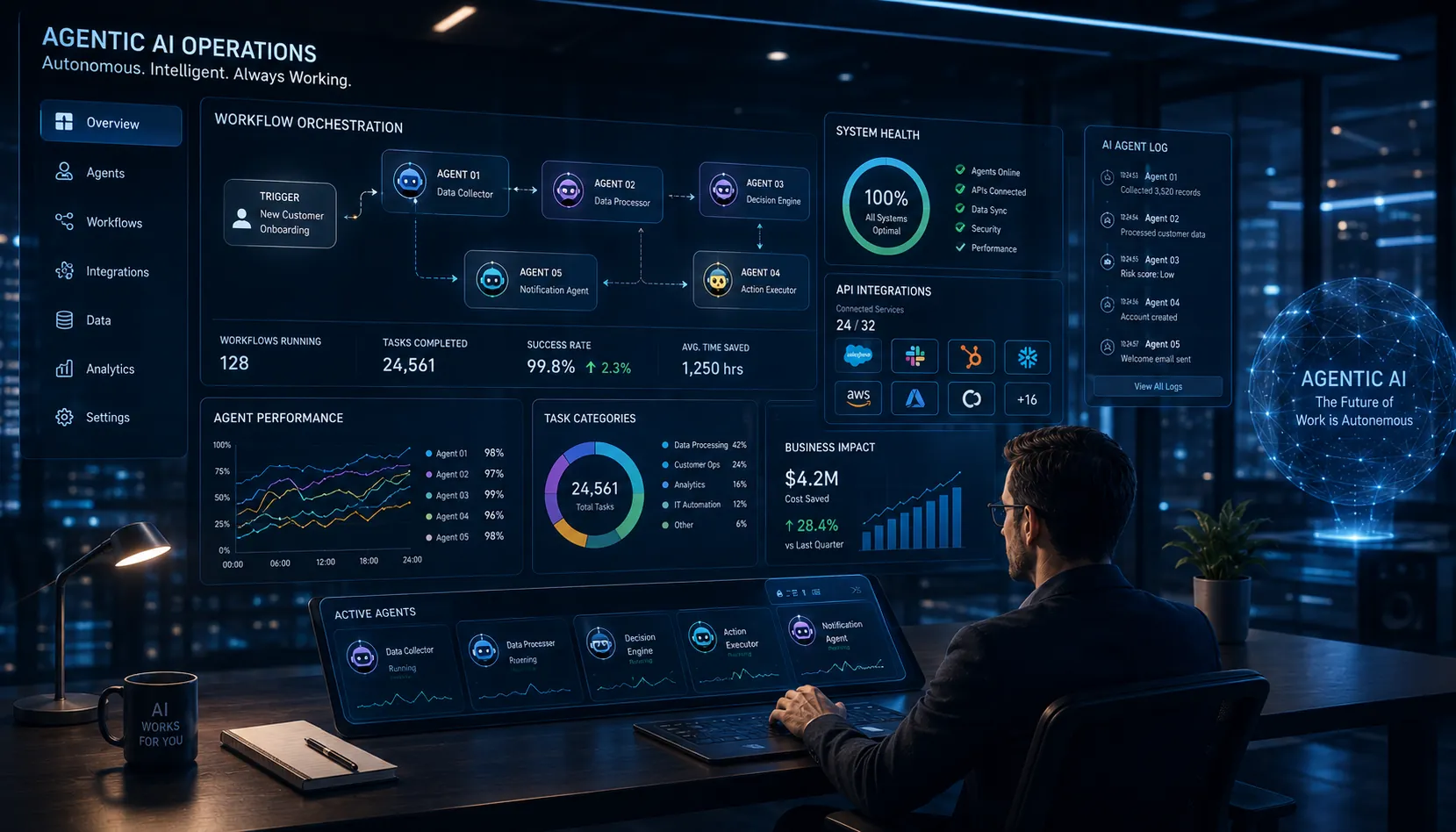
Something shifted in 2026. AI stopped waiting to be asked.
The systems now deployed in large enterprises do not respond to a single prompt and stop. They perceive context, set goals, plan multi-step actions, use tools and APIs, and adapt based on outcomes. That is what agentic AI means in practice.
By end of 2026, roughly 40% of business workflows are expected to be managed by agentic AI systems, according to industry analyst projections. That number was below 5% just a year ago.
What ‘Agentic’ Actually Means
The word gets thrown around a lot. Here is the simple version: traditional AI responds to one input and produces one output. Agentic AI takes a goal and figures out the steps to get there.
You say: ‘Increase blog traffic by 30% in 90 days.’ An agentic system runs keyword research, identifies content gaps, creates briefs, schedules publishing, monitors rankings, and adjusts the plan based on what is working.
You are not prompting every step. The system handles the workflow.
Why 2026 Is the Tipping Point
CES 2026 made it clear: the age of the solitary chatbot is over. Hardware built specifically for low-latency agent inference is now shipping. Robotics platforms are advertising ‘agentic brains.’ The infrastructure is catching up to the vision.
The enterprise shift is just as real. Multiple industry reports characterize 2026 as the transition year from pilots to production. Companies that spent 2023 and 2024 experimenting are now deploying.
One telling number: 94% of marketing teams are using AI in 2026, but only 23.3% have integrated autonomous agents capable of making independent decisions. The gap between tool users and true adopters is wide, and the companies on the right side of it are already seeing results.
How Agentic Workflows Are Built
Every functional agentic system runs on five layers. Understanding them helps you evaluate what you are actually buying when a vendor pitches ‘agentic AI.’
| Layer | What It Does | Why It Matters |
| Perception | Reading context, signals, data, user state | Knows what situation it is operating in |
| Planning | Breaking a goal into ordered sub-tasks | Does not just react, decides what to do next |
| Tool Use | Calling APIs, querying databases, triggering actions | Can interact with real business systems |
| Memory | Retaining state across tasks and sessions | Remembers what happened yesterday |
| Adaptation | Adjusting based on outcomes | Learns from results within the workflow |
Multi-Agent Systems: When AI Delegates to AI
More advanced deployments use multiple specialized agents coordinated by an orchestrator. Think researcher, planner, executor, and quality-check agents each handling their domain.
A delivery logistics company, for example, deploys an agent that monitors fleet data, automatically reschedules deliveries if a van breaks down, applies service credits to affected accounts, and notifies customers with new time slots. No human triggers any of this. The cascade of actions happens in seconds.
This is not the same as robotic process automation. RPA follows predefined scripts. Agentic AI adapts based on results. That gap is significant.
Real-World Use Cases in 2026
| Old Way | Agentic Way |
| Finance teams manually reconciling invoices weekly | AI agent handles end-to-end invoice matching, flags exceptions only |
| Content teams briefing writers per article | Agentic content engine researches, briefs, schedules, and monitors performance |
| IT support teams triaging tickets manually | AI agents classify, route, and resolve tier-1 tickets without human review |
| Sales ops running weekly CRM hygiene manually | Agent audits CRM, updates contacts, flags stale deals automatically |
Where It Goes Wrong
Mistakes scale faster with autonomous systems than with traditional automation. In 2026, an internal AI agent error at Meta briefly exposed sensitive internal data, illustrating the risk of uncontrolled autonomous action.
The accountability gap is real: 81% of teams using AI initiatives have no formal way to measure whether those initiatives are actually working. Governance cannot be an afterthought.
High-impact domains require audit trails, clear accountability structures, and human-in-the-loop checkpoints for consequential decisions. The EU AI Act is already shaping deployment expectations, with increasing requirements for transparency and risk classification.
How to Evaluate Vendors
Many vendors are rebadging standard automation as agentic AI. Before signing anything, run through this checklist:
- Can the system plan and execute multi-step work without predefined scripts?
- Does it integrate with your actual systems through secure API connectors?
- Are permissions, approvals, and safe action bounds built into the architecture?
- Can you access a full audit trail of what the agent decided and why?
- Is human oversight designed into the workflow, not bolted on later?
What to Do Right Now
If your organization is still in the ‘babysitting every AI step’ category, the path forward is not to deploy an agentic system overnight. Start with one repetitive process, automate that workflow, add tracking and feedback loops, then expand.
The companies pulling ahead are not the ones with the most AI tools. They are the ones that figured out where autonomy adds value and where it introduces unacceptable risk.
Common Mistakes
- Treating agentic AI as an upgrade to existing automation rather than a different system design entirely
- Skipping governance frameworks because the pilot worked fine
- Buying ‘agentic’ tools without verifying the autonomy checklist above
- Starting with high-stakes workflows instead of lower-risk, high-frequency processes
FAQ
What is the difference between an AI agent and a chatbot?
A chatbot responds to a single input. An AI agent sets a goal, plans steps, uses tools, and acts across multiple systems to complete the goal without being prompted for every step.
How are companies actually using agentic AI in 2026?
The most common deployments are in customer service ticket routing, finance reconciliation, content operations, and IT support. These are all high-frequency, rule-based workflows with clear success metrics.
Is agentic AI safe to deploy in regulated industries?
With proper governance, yes. Human-in-the-loop checkpoints, audit trails, and clear accountability structures are required for high-impact domains, and the EU AI Act is formalizing these expectations.
Complex AI trends become more valuable when explained with clarity and real-world relevance. WritoryBuzz creates SEO-focused technology content that helps brands educate audiences, build authority, and stay ahead in fast-moving industries.