
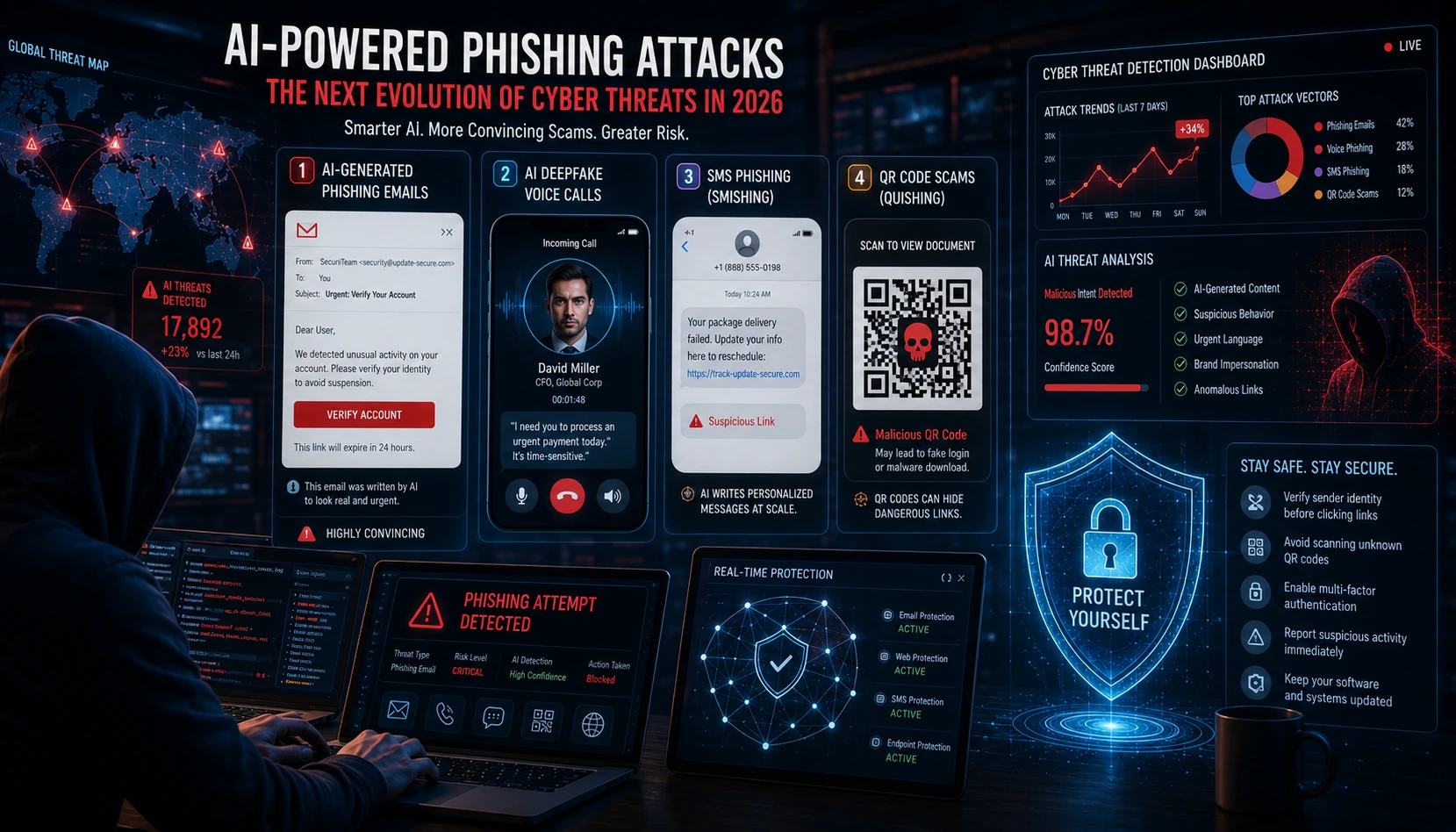
Phishing used to be easy to spot. Broken English, suspicious links, urgent requests from Nigerian princes.
That era is over. In 2026, 82.6% of phishing emails are AI-generated. They are grammatically perfect, contextually aware, and personalized to your specific role, company, and recent activity.
The attack has not just scaled. It has fundamentally changed.
The Numbers Behind the Threat
| Stat | Context | Stat | Context |
| 3.4 billion | Phishing emails sent daily | $25 billion | Global annual losses |
| 82.6% | Phishing emails that are AI-generated | 54% | Click rate for AI spear phishing |
| 36% | Data breaches linked to phishing (Verizon) | 442% | Surge in voice phishing (vishing) |
| 400% | Rise in QR code phishing | 254 days | Average time to identify a breach |
How AI Changed Phishing
Traditional phishing was a volume game. Send a million generic emails, hope 1% fall for it. AI phishing is the opposite: hyper-targeted, hyper-convincing, and cheap to run.
AI spear phishing now matches human-expert click rates at 95% lower cost. A single campaign can research a target’s LinkedIn profile, recent company announcements, and email communication style to craft a message that looks completely legitimate.
Deepfake voice cloning can replicate someone’s voice from just three seconds of audio. Employees are now receiving phone calls from what sounds exactly like their CFO, authorizing a wire transfer. Human detection accuracy for high-quality deepfake video is only 24.5%.
The Four Attack Types You Need to Know
Email Phishing (Still the Most Common)
Traditional email phishing now uses AI for personalization, perfect grammar, and contextual hooks. The signal to watch for is no longer typos. Look for mismatched reply-to addresses and unexpected links from supposedly known contacts.
Spear Phishing
Targeted at specific individuals. Attackers research their target across LinkedIn, company websites, and public communications before sending a single message. 91% of successful high-value breaches start here.
Vishing (Voice Phishing)
Voice attacks surged 442% between 2023 and 2024. AI-powered calls adapt in real time to what the target says. You cannot train someone to spot a deepfake voice by showing them badly formatted emails.
Smishing and Quishing
SMS-based phishing now accounts for 35% of all phishing attacks and grew 40% year-over-year. QR code phishing (quishing) increased 400% between 2023 and 2025. Both bypass traditional email security gateways entirely.
Why Phishing Still Works in 2026
It works because it targets humans, not software. No patch fixes the human vulnerability.
Healthcare employees have a 41.9% baseline chance of falling for a phishing attack. Insurance and retail workers are not far behind. Finance, healthcare, and government remain the top three targeted sectors.
Multi-channel orchestration makes it worse. A campaign now combines email, text, and a follow-up phone call. Each channel reinforces the others, building credibility before the final request.
How to Protect Yourself and Your Team
Switch to Phishing-Resistant MFA
SMS-based MFA is no longer enough. Attackers can intercept SMS codes or use SIM-swapping attacks. Hardware security keys (FIDO2) and authenticator app-based MFA with device binding are the current standard.
Run Simulations, Not Just Training
Awareness training that shows slides about phishing does not build resistance. Regular simulated phishing campaigns, especially multi-channel ones, are what actually change behavior. Organizations running phishing simulations consistently see susceptibility drop below 5%.
Verify Out of Band
Before acting on any financial request or credential change from an email or call, verify through a completely separate channel. Call the person on a known number. Do not reply to the original message.
Implement DMARC, DKIM, and SPF
These three email authentication protocols block domain impersonation at the server level. Surprisingly, many organizations still have not fully configured them in enforcement mode.
Common Mistakes
- Relying on grammar as the primary signal for detecting phishing in 2026
- Treating phishing as an email-only problem when 35% of attacks now come via SMS
- Using SMS-based MFA and considering the account secure
- Skipping simulations and running annual awareness training only
FAQ
How do I recognize a phishing email if AI makes them grammatically perfect?
Check context, not grammar. Look for mismatched reply-to addresses, unexpected links, unusual requests tied to urgency, or references to events that feel slightly off. Verify through a separate channel for anything involving money or credentials.
What is phishing-resistant MFA?
Hardware security keys (FIDO2) and some authenticator apps that bind to a specific device. Unlike SMS codes, these cannot be intercepted mid-transmission or socially engineered in a phone call.
Is my phone safer than my email for avoiding phishing?
No. Smishing via SMS now accounts for 35% of phishing attacks, and 70% of mobile phishing happens through text messages. Mobile devices typically have weaker security controls than corporate endpoints.
Clear and practical cybersecurity content helps audiences stay informed in a rapidly evolving digital world. WritoryBuzz creates SEO-focused technology content that builds trust, authority, and long-term audience engagement.