
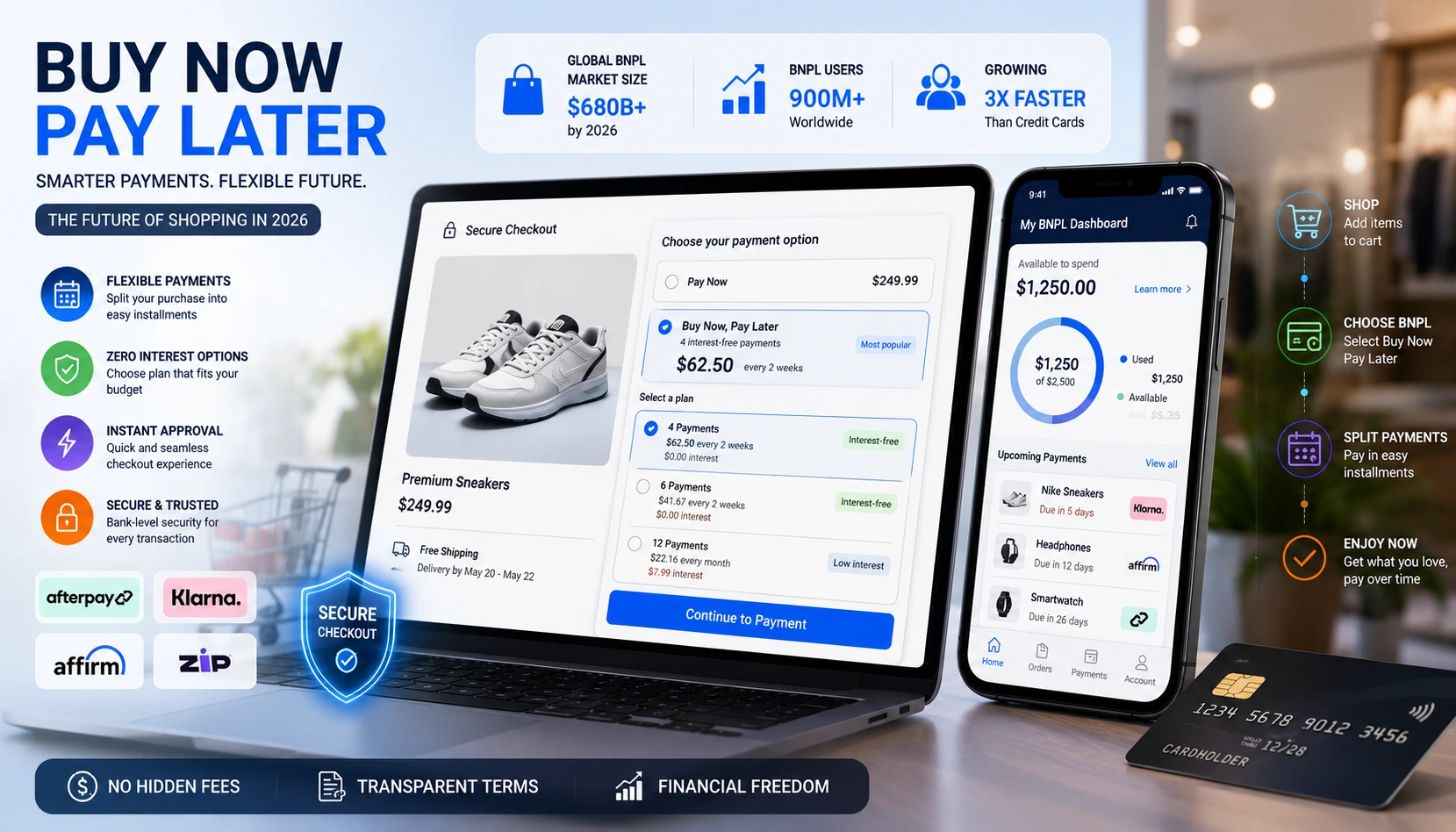
Buy Now Pay Later was supposed to be either the future of consumer credit or a debt trap waiting to collapse. Two years later, neither prediction is quite right.
BNPL is growing, regulation is tightening, and the easy-money era for providers is over. Here is where things actually stand.
The Growth Numbers
Global BNPL users reached around 380 million in 2024, with projections toward 670 million by 2028. The market hit approximately $560 billion in gross merchandise value in 2025, a 13.7% year-over-year increase.
The market is forecast to expand from $10.87 billion in provider revenue in 2025 to $14.09 billion in 2026, growing at roughly 29.6%. That is strong, but slower than the explosive rates of 2021 to 2023.
Growth is real. It is just maturing.
How BNPL Works (And Where the Money Comes From)
The basic model: a consumer selects BNPL at checkout, splits the purchase into three or four interest-free installments, and pays over six to eight weeks. No credit check, no interest (for the consumer).
The merchant pays. Average BNPL fees run around 2.77% of transaction value, well above the typical credit card rate. In exchange, merchants get higher average order values, lower cart abandonment, and more repeat purchases.
Retail BNPL sales jumped 61%, order values increased 28%, and cart abandonment dropped 34% in markets with integrated BNPL. Those numbers explain why merchants keep paying the premium.
The Risks That Do Not Get Enough Attention
Late Payments Are More Common Than Default Rates Suggest
Official BNPL default rates (charge-offs) sit at a low 1.8% to 2%. That sounds healthy. But 34% to 41% of users report making at least one late payment. Late fees, penalty charges, and the cascade of subsequent purchases on top of missed installments create a different picture than the headline default number.
Merchant Costs Are Significant
At 2.77% per transaction, BNPL is one of the most expensive payment methods a merchant can offer. For high-volume retailers with thin margins, this adds up fast. Some are re-evaluating their BNPL integrations as the novelty fades.
Provider Economics Are Tight
High credit losses, low consumer fees, and significant marketing spend are compressing provider margins. Among mid-tier and smaller BNPL lenders, some may not survive increasing regulatory and economic pressure.
The Regulation Wave
This is the part that changes BNPL most significantly in 2026.
| Market | What Is Changing |
| UK | FCA oversight from mid-2026: mandatory affordability checks, credit bureau reporting, access to Financial Ombudsman |
| US | CFPB withdrew its 2024 rule, pushing enforcement to state level, creating patchwork compliance complexity |
| EU | Increasing pressure for transparent repayment structures and responsible lending frameworks |
| Australia | Existing regulation from Afterpay’s home market setting global precedent for provider behavior |
UK regulation could exclude 10% to 30% of current BNPL users who fail affordability checks. That is a structural market contraction in the short term, even if it produces a healthier long-term user base.
BNPL vs Credit Card: An Honest Comparison
| Factor | BNPL | Credit Card |
| Interest | None (if on time) | 15-25% APR |
| Late fees | Yes, can compound | Yes, plus interest |
| Credit check | Usually soft or none | Hard inquiry |
| Rewards | None | Cashback, miles |
| Merchant fee | 2.77% avg | 1.5-2.5% avg |
| Credit building | Often not reported | Builds credit history |
What to Watch in the Second Half of 2026
- UK regulation kicks in mid-year, revealing how many users fail affordability checks
- Whether smaller BNPL providers begin consolidating or exiting the market
- Embedded BNPL inside super apps and banking platforms accelerating
- AI-based credit assessment replacing the current informal model
Is BNPL Right for You?
As a consumer: useful for spreading a genuine planned purchase, dangerous for impulse buying. The interest-free framing makes it feel free. It is not free if you miss a payment.
As a merchant: high conversion and order value benefits are real. The 2.77% fee requires honest margin analysis before committing.
As an investor or fintech observer: the market is maturing, not dying. The next wave is embedded BNPL inside apps and platforms, not standalone services.
FAQ
Does using BNPL affect my credit score?
In most markets, BNPL is not currently reported to credit bureaus. UK regulation from mid-2026 will change this for British consumers. Missed payments, however, can be sent to collections, which does affect your score.
Is BNPL safer than a credit card?
For a single planned purchase paid on time, yes. For ongoing use across multiple purchases, the lack of a credit limit means it is easy to overextend without the warning signals a credit card balance provides.
Which BNPL provider is best in 2026?
Klarna, Affirm, and Afterpay/Clearpay are the largest and most stable. For consumers, the key difference is merchant coverage and fee transparency. For merchants, compare rates and integration complexity rather than brand recognition.
Readers trust content that simplifies complex financial topics without losing accuracy. WritoryBuzz creates SEO-focused finance and fintech content designed to educate audiences and strengthen brand authority.