
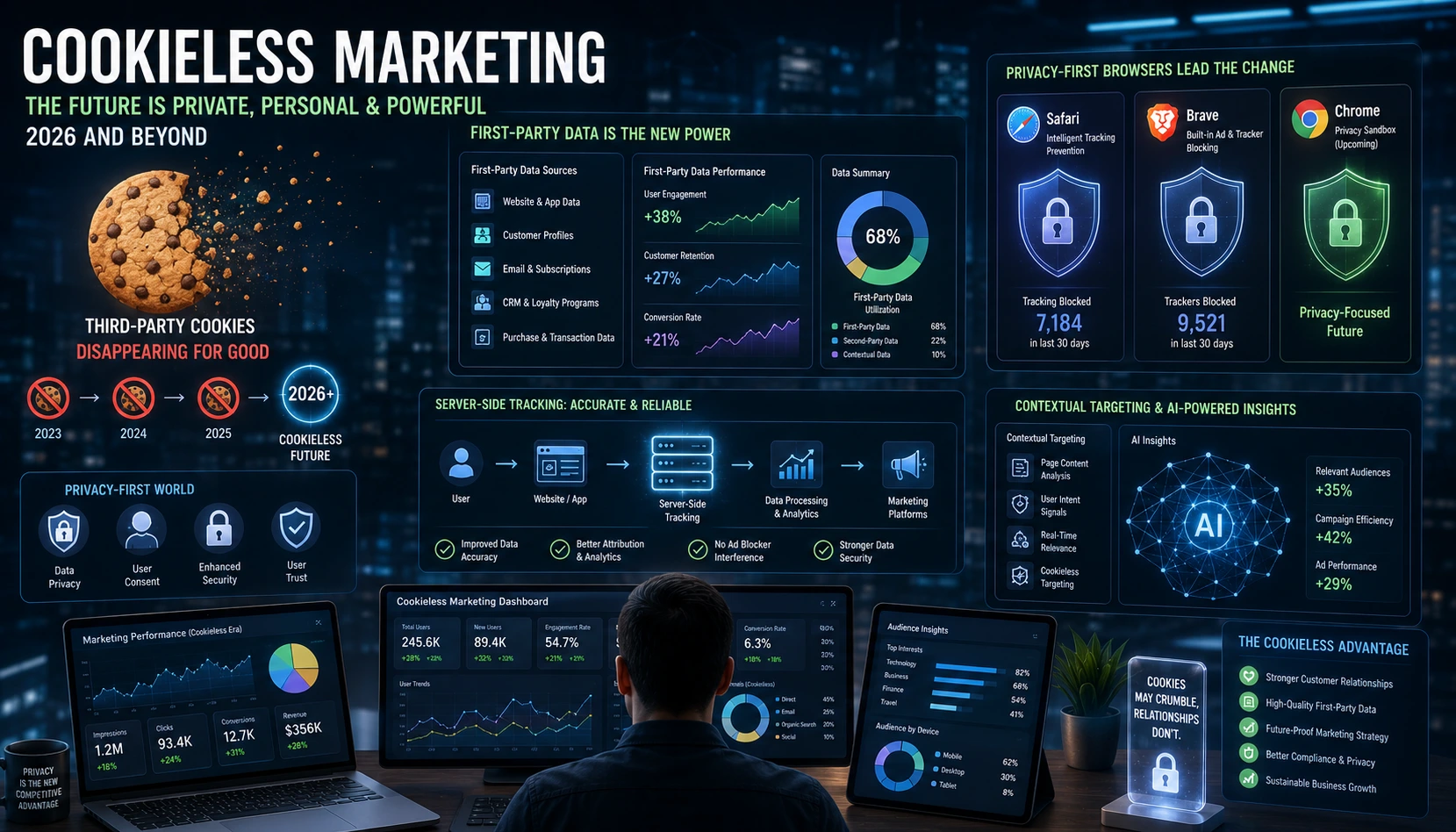
The tracking infrastructure that powered digital advertising for two decades is collapsing. Not in one sudden moment, but in a slow, irreversible squeeze.
Safari blocked cross-site tracking in 2020. Firefox followed. Chrome, the largest browser by far, tested deprecation through 2024 and 2025, then pivoted to a user-control model while continuing Privacy Sandbox alternatives. By early 2026, 34.9% of US browser traffic already blocks third-party cookies by default.
The single-event ‘death day’ never arrived. What arrived instead is messier and more permanent: fewer identifiers following users around the web, consent requirements everywhere, and a hard premium on owning your own data.
What Third-Party Cookies Actually Did (And What You Are Now Missing)
Third-party cookies were small files dropped by external services (ad networks, analytics tools, data brokers) when a user visited your site. They tracked that user across every other site using the same external service.
This enabled cross-site behavioral targeting, retargeting campaigns that followed users around the web, and attribution models showing which touchpoints drove a conversion. All of that now works partially at best.
In practical terms: if your attribution data shows 100 conversions but your actual revenue suggests significantly more, you are already seeing the gap.
What Is Actually Replacing Them
First-Party Data
Information you collect directly from users on your own properties through website interactions, email signups, purchase history, and app usage. This is the single most valuable asset a marketer can build in 2026.
By early 2026, around 30% of global publishers had adopted a first-party ID solution. The other 70% are still exposed.
Zero-Party Data
Data that users voluntarily share with you through quizzes, preference centers, and surveys. L’Oreal’s Routine Finder quiz, for example, helped collect specific customer preferences that led to a 134% increase in order values. Interactive tools with five to eight questions work best. Longer forms lose completion.
Server-Side Tracking
Instead of the browser sending data to analytics and ad platforms, your server sends it directly. This bypasses browser-level blocking entirely and produces more accurate attribution than client-side tracking ever could.
Contextual Advertising
Targeting based on the content of the page, not the behavior of the user. You place ads on content relevant to your product rather than following specific users around the web. Privacy-compliant and increasingly effective as personalization alternatives mature.
Universal ID Frameworks
Solutions like Unified ID 2.0 (The Trade Desk) and RampID (LiveRamp) create consented, cross-site identifiers from authenticated user data, typically email addresses. They work across publishers who have signed on to the framework.
The Practical Transition Plan
| Action | What It Achieves |
| Audit your tracking dependencies | Document which tools use third-party cookies and which conversions you are currently missing |
| Build first-party data infrastructure | Email capture, preference centers, loyalty programs, gated content with consent |
| Implement server-side tracking | Move Google Tag Manager, Meta, and other pixels to server-side configuration |
| Test contextual targeting | Run parallel campaigns comparing contextual vs behavioral performance |
| Explore Universal IDs | Evaluate Unified ID 2.0 or RampID for cross-publisher reach with consent |
| Adopt Marketing Mix Modelling | MMM evaluates channel performance without individual tracking, using aggregated data |
The Honest Assessment: Some Things Actually Got Better
Server-side tracking, when implemented correctly, delivers more accurate conversion data than cookie-based tracking provided. Cookies dropped at the browser level often misfire, duplicate, or get stripped by aggressive privacy settings.
Brands with strong owned audiences (email lists, app users, loyalty members) are outperforming brands that relied on third-party data to reach audiences they had no direct relationship with. The discipline that cookieless marketing forces is making some teams better at their jobs.
What Small Businesses Should Do Differently
Cookie-less marketing is particularly suited to small businesses. You are not losing the ability to reach people. You are losing the ability to follow unknown people around the web.
Focus on: excellent content that earns organic search traffic, email list building with genuine value exchange, and direct publisher partnerships for relevant reach. These approaches often deliver better return than expensive third-party data solutions ever did.
FAQ
Are third-party cookies actually gone in 2026?
Safari and Firefox block them by default. Chrome maintained them with user controls after backing off full deprecation, but continues building Privacy Sandbox alternatives. Relying on them is no longer viable.
What is first-party data?
Data you collect directly from your own users on your own properties, with their consent. Email addresses, purchase history, website behavior, app usage, and preference center selections all count.
How does the end of cookies affect retargeting?
Standard retargeting across the open web is significantly degraded. You can still retarget your own customers using first-party data uploaded to ad platforms, or target lookalike audiences built from that data.